The Simplex Algorithm, Mathematical Details!!!
 Watch on YouTube →
Overview
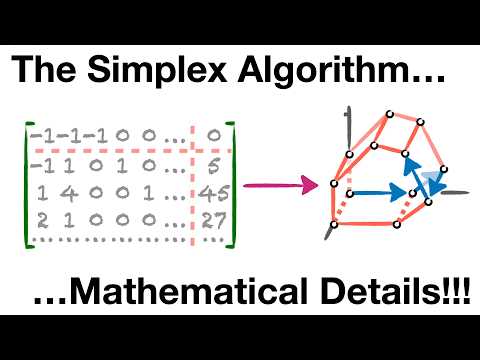
Josh Starmer of StatQuest details the mathematical underpinnings of the Simplex Algorithm, explaining how it iteratively moves between vertices of a feasible region to maximize an objective function. The process involves converting inequalities to equalities with slack variables, representing the problem in a matrix, and using row reduction (Gaussian elimination) to find optimal solutions, as demonstrated with two- and three-variable examples.
Key takeaways
- The Simplex Algorithm iteratively moves to adjacent vertices of a feasible region to maximize an objective function, guided by the largest negative coefficient in the objective row.
- Slack variables are crucial for converting inequality constraints into equalities, representing unused resources and enabling matrix-based operations.
- Gaussian elimination (row reduction) is the core mathematical technique used to update the simplex tableau, allowing the algorithm to determine the coordinates of new vertices and the objective function value.
- The algorithm terminates when all coefficients in the objective function row are non-negative, signifying that no further improvement is possible.
- The Simplex Algorithm can be extended to problems with more than two variables, requiring a higher-dimensional feasible region and a larger matrix representation.
- The 'ratio test' (dividing totals by positive pivot column entries) is used to identify the pivot row, ensuring the algorithm moves to a vertex that remains within the feasible region.
Chapters
0:00
Introduction to Linear Programming and Simplex Algorithm Concepts
- Simplex algorithm finds optimal solutions by moving between vertices of a feasible region.
- Objective function (e.g., revenue) is maximized by moving to adjacent vertices that increase its value.
- Constraints define the feasible region, and variables (e.g., mix amounts) must be non-negative.
- Linear equations are required for the feasible region's shape.
4:55
Converting Constraints and Adding Slack Variables
- Inequalities are converted to 'less than or equal to' by multiplying by -1 if necessary.
- Equality constraints are replaced by two inequality constraints.
- Slack variables are added to inequalities to convert them into equalities, representing unused resources.
- Slack variables are also added to the objective function with zero coefficients.
11:40
Matrix Representation and Initial Pivot (Two-Variable Example)
- Problem coefficients and totals are organized into a matrix.
- The first row is multiplied by -1 for algorithmic convenience.
- The largest negative number in the first row determines the pivot column (e.g., cookie mix).
- Ratios of totals to positive pivot column values determine the pivot row (lowest ratio indicates feasible vertex).
17:21
Row Reduction and Finding Vertex Coordinates (Two-Variable Example)
- Gaussian elimination (row reduction) is used to transform the matrix.
- The pivot row is scaled to have a '1' in the pivot column.
- Multiples of the pivot row are added to other rows to create zeros in the pivot column.
- The resulting matrix directly provides the coordinates of the current vertex (e.g., cookie=10, donut=0) and the objective function value (e.g., revenue=30).
22:30
Iterative Optimization and Termination (Two-Variable Example)
- The process repeats: identify the next pivot column from the largest negative in the first row (e.g., donut mix).
- Calculate ratios to find the pivot row and the next vertex (e.g., cookie=10, donut=10).
- The algorithm terminates when there are no negative numbers in the first row, indicating the optimal solution (e.g., revenue=50).
- A three-variable example demonstrates the extension to higher dimensions.
Summary, takeaways, and chapters were generated by AI from the video's transcript and may contain errors. The video belongs to its creator, StatQuest with Josh Starmer.