The Simple Genius of Morocco's Economic Rise
 Watch on YouTube →
Overview
Morocco has strategically transformed into North Africa's industrial hub by developing specialized industrial zones, prioritizing logistics with ports like Tangier Med, and investing in workforce development through industry partnerships and universities like UM6P. This proactive approach, coupled with political stability and geographical proximity to Europe, has attracted significant foreign investment in sectors such as automotive and aerospace, positioning Morocco as a reliable, cost-effective manufacturing base.
Key takeaways
- Morocco's industrial strategy prioritized proximity to Europe, cost-effectiveness, and political stability, making it an attractive manufacturing alternative to Asia.
- The development of integrated industrial zones, like Tangier Med and Kenitra Atlantic, with specialized infrastructure and logistics, was key to attracting global manufacturers.
- Morocco's significant investment in renewable energy (solar and wind) provides a stable and cost-effective power supply crucial for industrial operations.
- Control over 70% of global phosphate reserves provides a strategic economic anchor through fertilizer and battery component production.
- Despite industrial success, Morocco faces internal challenges with high youth unemployment and uneven distribution of economic gains, creating a 'two-speed' economy.
- The country's long-term resilience depends on translating industrial growth into broad-based employment and moving up the value chain beyond assembly.
Chapters
0:00
Morocco's Strategic Shift to Industrialization
- Morocco transitioned from agriculture/fishing/tourism to an industrial economy over 10-15 years.
- Became the second-largest car producer in Africa, exporting over half a million vehicles annually.
- Developed specialized industrial zones with tailored regulations and logistics access, like Tangier Free Zone (est. 1999) and Tangier Automotive City (est. 2013).
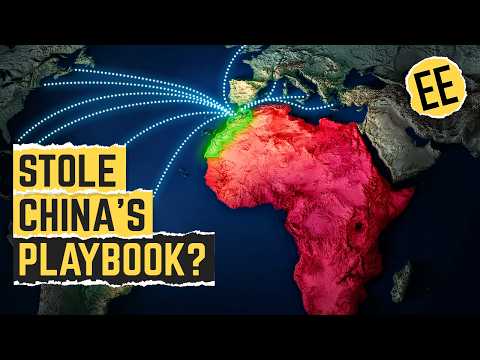
- Leveraged Tangier Med, Africa's largest port, for global connectivity to over 180 ports in 70 countries.
7:00
Infrastructure, Workforce, and Energy Investments
- Industrial zones were strategically located near ports, unlike inland parks in Ethiopia that faced logistical challenges.
- Invested in workforce development via partnerships with companies like Renault and Safran, and institutions like UM6P (Morocco's Silicon Valley).
- Expanded highway networks to over 2,177 km and upgraded rail with the Al Boraq high-speed line, connecting major industrial corridors.
- Heavily invested in renewable energy, building large-scale solar (e.g., Noor Ouarzazate) and wind farms for reliable industrial power.
15:35
Trade Agreements and Geographic Advantages
- Secured free trade agreements with the EU, US, Turkey, and African/Arab partners, making manufacturing in Morocco akin to EU production with lower costs.
- Geographic proximity to Spain (14 km across the Strait of Gibraltar) offers extremely short and safe supply lines into Europe.
- Maintained political stability and policy continuity throughout the 2010s, contrasting with regional instability, creating a low-risk investment environment.
- Reliable energy supply from renewables reduced manufacturing uncertainty and exposure to fossil fuel price volatility.
20:13
Sectoral Growth and Future Challenges
- Became a major automotive hub, with Renault and Stellantis plants producing over 550,000 vehicles annually, with 80% exported to Europe.
- Developed a significant aerospace sector with 150 firms supplying components to Boeing and Airbus, with exports exceeding $2 billion annually.
- Controls 70% of global phosphate reserves, crucial for fertilizer (food security) and LFP batteries (energy transition), managed by OCP Group.
- Faces challenges of uneven growth, high youth unemployment (over a third), and the need to move into higher-value engineering and design.
Summary, takeaways, and chapters were generated by AI from the video's transcript and may contain errors. The video belongs to its creator, Economics Explained.