The Secret Life Beneath Our Feet I FULL DOC | SLICE WILD
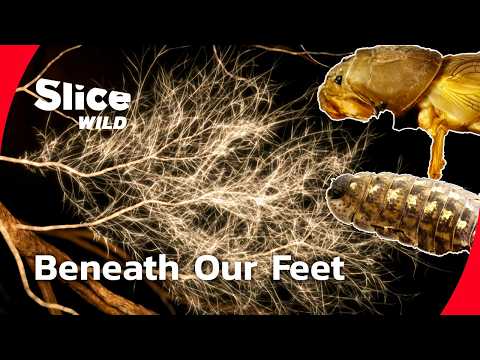 Watch on YouTube →
Overview
SLICE Wild explores the hidden ecosystem beneath the soil through researchers including Jean-François Ponge, Jean-Lou Justine, Vincent Jabiol, Lionel Ranjard, Christophe Jourdan, and Marc-André Selosse. The documentary reveals how earthworms, bacteria, fungi (via mycorrhizal symbiosis), and tree roots collaborate to create fertile soil, while invasive Brazilian flatworms (Platyhelminthes) now threaten European earthworm populations and soil permeability.
Key takeaways
- A single gram of soil contains over a billion bacteria from millions of strains, and the underground microbial biomass of a pasture exceeds the combined mass of its plants and grazing livestock.
- Earthworm castings are dramatically enriched fertilizer — 4x the nitrogen, 7x the phosphorus and 3x the calcium of surrounding soil — and their tunnels are what keep soil permeable to rainwater.
- Invasive Platyhelminthes flatworms from southern Brazil have established along France's Atlantic coast and in Britain, where collapsing earthworm populations are causing measurable soil flooding because no native predator controls them.
- Roughly 90% of plant species cannot extract enough phosphate and nitrogen on their own; they depend on mycorrhizal fungi whose mycelium extends their effective root surface a thousandfold in exchange for plant sugars.
- Eucalyptus roots discovered 15 meters underground — 40 meters from the canopy — have structurally different, enlarged water-transport vessels, suggesting a drought-survival strategy relevant to climate adaptation.
- White rot fungi are the only organisms on Earth capable of digesting lignin, making them the indispensable first step that allows wood and tannin-rich leaves to enter the broader soil food web.
Chapters
0:00
The Unknown World Beneath the Surface
- Less than 10% of underground organisms have been identified
- Soil diversity underlies all visible landscapes from deserts to forests
- Plants form complex partnerships with subterranean life
1:26
Leaf Litter and White Rot Fungi
- Jean-François Ponge of the Paris Museum of Natural History examines beech leaves
- Decomposition takes 1-10+ years depending on soil richness and climate
- White rot fungi break down tannins that make leaves inedible, turning them into 'lace' for soil fauna
4:05
Humus and Its Microscopic Inhabitants
- Springtails, mites, woodlice and millipedes recycle organic matter
- Humus layer is roughly 30 cm thick and hosts hundreds of coexisting species per handful
- The 3D fragmented structure of soil allows organisms to occupy non-competing niches
7:40
Earthworms: The Soil's Master Engineers
- Hydraulic segmented bodies plus retractable bristles allow burrowing up to 1 meter deep
- Three types: epigeic (surface), endogeic (subsoil feeders), anecic (vertical migrators)
- One hectare can contain 250,000 earthworms processing hundreds of tons of soil annually
11:30
Castings, Seed Banks and Predators
- Worm castings contain 4x more nitrogen, 7x more phosphorus, 3x more calcium than surrounding soil
- Earthworms bury seeds into soil seed banks, then expose them via castings to enable germination
- Mole crickets (up to 10 cm) prey on earthworms underground
14:30
The Invasive Platyhelminthes Threat
- Jean-Lou Justine tracks flatworms originating from southern Brazil now spreading along France's Atlantic coast
- Hermaphroditic flatworms produce egg cocoons with 5-10 offspring every two weeks from age 2 weeks
- They wrap around earthworms and digest them externally via an abdominal pharynx; British soil flooding linked to earthworm collapse
21:50
Soil Diversity Across Landscapes
- Pedologist Vincent Jabiol compares forest, valley grain field, and sandy soils within kilometers
- Valley soils accumulate 1.5+ meters of deposits from upslope erosion, supporting deep roots and worms
- Sandy sedimentary soils are acidic and drain too fast, excluding earthworms entirely
27:55
Bacteria as Soil Identity and Fertility Engine
- Lionel Ranjard (INRA) finds over 1 billion bacteria of millions of strains per gram of soil
- Microbial biomass below ground exceeds plant and livestock biomass above (even with 10 cows or 50 sheep per hectare)
- Alfalfa growth experiments show fertilizer cannot compensate for reduced bacterial diversity
33:20
Rhizobia, Nodules and Symbiotic Nitrogen Fixation
- Clover and pea roots host nodules containing rhizobia bacteria
- Plants supply sap; bacteria fix atmospheric nitrogen in exchange
- INRA has genetically catalogued over 10,000 soil samples as microbiological references
36:50
Deep Roots: Eucalyptus and Drought Adaptation
- Christophe Jourdan (CIRAD) uses underground scanners on Brazilian eucalyptus plantations
- Fine roots grow 1-2 cm/day with an 8-10 month lifespan, injecting organic matter at depth
- Roots found 15 m underground (40 m from canopy) have enlarged water-transport vessels for drought survival
42:50
Mycorrhizal Symbiosis with Fungi
- Marc-André Selosse explains that 90% of plant species depend on fungi for phosphate and nitrogen
- Mycelium sheaths or penetrates root cells, expanding soil exploration a thousandfold in exchange for plant sugars
- White rot fungi are the only organisms capable of digesting lignin, unlocking wood for the rest of the food web
48:40
Pedogenesis: From Bedrock to Living Skin
- Soil forms over tens to hundreds of thousands of years from rock-biosphere interaction
- Layered strata record the joint action of animals, bacteria, roots and fungi
- The planet's thin soil skin remains largely unexplored and increasingly fragile
Summary, takeaways, and chapters were generated by AI from the video's transcript and may contain errors. The video belongs to its creator, SLICE Wild.