The Physics of Euler's Formula | Laplace Transform Prelude
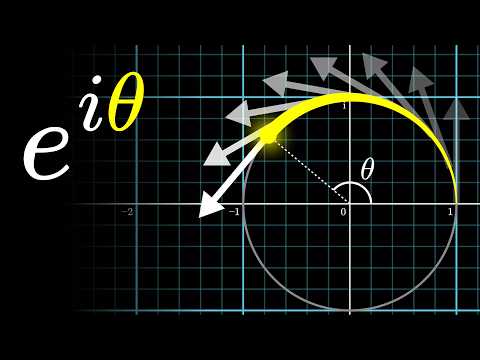 Watch on YouTube →
Overview
3Blue1Brown introduces the Laplace transform by exploring the physics of Euler's formula, demonstrating how exponential functions e^(st) are fundamental to understanding differential equations. The video visually connects complex exponents to rotations in the complex plane and shows how the 'guess e^(st)' trick transforms differential equations into algebraic problems, motivating the need for tools like the Laplace transform to handle more complex real-world scenarios.
Key takeaways
- Exponential functions e^(st) are fundamental 'atoms of calculus' whose behavior (growth, decay, oscillation) is determined by the complex number 's' in the exponent.
- Plugging complex numbers into e^(st) geometrically corresponds to rotations and scaling in the complex plane, with the imaginary part of 's' controlling rotation speed and the real part controlling magnitude change.
- The 'guess e^(st)' method transforms linear differential equations into algebraic polynomial equations, simplifying their solution by finding the roots 's'.
- For a damped harmonic oscillator, the solutions for 's' can have both real and imaginary components, leading to solutions that exhibit both decay and oscillation.
- While the 'guess e^(st)' trick works for linear differential equations, more complex real-world problems (like forced harmonic oscillators) require more advanced techniques, pointing towards the Laplace transform.
- The Laplace transform translates differential equations into an algebraic domain where derivatives become multiplication by 's', simplifying the problem-solving process.
Chapters
0:00
Exponential Functions as the Foundation
- Introduces e^(st) as central to understanding differential equations and the Laplace transform.
- Motivates allowing 's' to be complex to understand physical phenomena.
- Explains e^t's derivative as its own velocity, defining 'e' and its growth rate.
5:59
Complex Exponents and Rotational Motion
- Demonstrates e^(it) results in 90-degree rotations in the complex plane due to multiplication by 'i'.
- Explains e^(it) traces a unit circle at unit speed, leading to Euler's identity e^(πi) = -1.
- Interprets e^(it) via its Taylor series, showing the spiraling sum converges to -1.
11:40
The S-Plane: Encoding Growth, Decay, and Oscillation
- Visualizes e^(st) for complex 's' on the S-plane, where 's' encodes function behavior.
- Imaginary part of 's' dictates oscillation rate (angular frequency ω), real part dictates growth/decay.
- Combinations of real and imaginary parts in 's' lead to spiraling motions (decaying or growing).
15:57
The Mass-Spring System and the 'Guess e^(st)' Trick
- Models a mass on a spring with a second-order linear differential equation including damping.
- The 'guess e^(st)' trick transforms the differential equation into a quadratic algebraic equation for 's'.
- Solutions for 's' can be complex, leading to oscillatory behavior (e^(iωt)) for undamped systems.
Summary, takeaways, and chapters were generated by AI from the video's transcript and may contain errors. The video belongs to its creator, 3Blue1Brown.