The most beautiful formula not enough people understand
 Watch on YouTube →
Overview
Grant Sanderson (3Blue1Brown) explores the volume formula for n-dimensional balls, arguing it's an underappreciated mathematical gem. He builds intuition through probability puzzles and geometric analogies, demonstrating how higher-dimensional geometry, though counterintuitive, is crucial for fields like machine learning. Sanderson derives the formula using a recursive relationship based on Archimedes' projection method and calculus, revealing that unit balls shrink dramatically in high dimensions, becoming negligible compared to their bounding cubes.
Key takeaways
- The volume of an n-dimensional unit ball, V_n, peaks around n=5 and then shrinks exponentially, becoming practically zero in high dimensions (e.g., V_100 ≈ 2.37 x 10^-40).
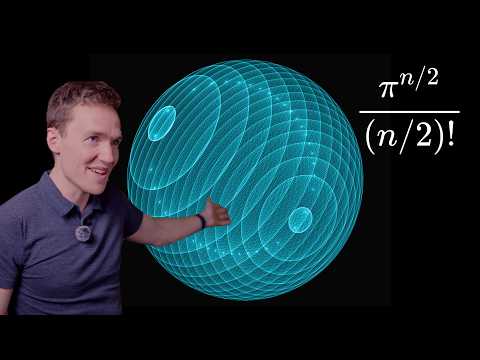
- The formula for n-dimensional ball volume, V_n(r) = (pi^(n/2) / Gamma(n/2 + 1)) * r^n, reveals that in high dimensions, nearly all the volume is concentrated at the boundary.
- The counterintuitive nature of high-dimensional geometry arises from cubes becoming disproportionately larger than inscribed spheres as dimensions increase.
- Archimedes' area-preserving projection method can be generalized as a 'knight's move' in dimension space, enabling a recursive derivation of n-dimensional ball volumes.
- The Gamma function generalizes the factorial, allowing the volume formula to apply to both even and odd dimensions, with Gamma(1/2) = sqrt(pi) being a key value.
Chapters
0:00
Introduction to Underappreciated Formulas and Geometric Puzzles
- Introduces the goal: understanding the 'why' behind a beautiful, underappreciated mathematical formula.
- Presents the first puzzle: probability of x^2 + y^2 <= 1 for uniformly random x, y in [-1, 1].
- Highlights the geometric interpretation: area of a unit circle within a 2x2 square, yielding pi/4.
5:04
Extending Geometric Probability to Higher Dimensions
- Extends the puzzle to three dimensions: probability of x^2 + y^2 + z^2 <= 1.
- Geometric interpretation: volume of a unit sphere within a 2x2x2 cube.
- Discusses the conceptual leap to four and 100 dimensions, emphasizing the utility of high-dimensional geometry in machine learning and LLMs.
10:25
Counterintuitive Geometry: The Sphere Packing Puzzle
- Presents a classic puzzle: placing unit circles at the corners of a square and finding the radius of the largest inscribed circle.
- Solution involves the diagonal of the square: sqrt(2) - 1.
- Extends the puzzle to 3D: unit spheres at cube corners, inscribed sphere radius is sqrt(3) - 1.
15:39
The Counterintuitive Nature of High-Dimensional Cubes
- Calculates the distance to the corner of an n-dimensional hypercube as sqrt(n).
- For n=10, distance to corner is sqrt(10) ≈ 3.16, while distance to edge is 1.
- Explains that cubes become 'spiky' in high dimensions, with corners vastly farther than edges, making inscribed spheres appear disproportionately large.
24:10
Formulas for Boundaries and Interiors of N-Dimensional Balls
- Reviews familiar formulas: circle circumference (2*pi*r), area (pi*r^2), sphere surface area (4*pi*r^2), volume (4/3*pi*r^3).
- Establishes a diagram: top row = boundary volume, bottom row = interior volume (ball).
- Highlights the calculus relationship: derivative connects boundary to interior (e.g., d(Area)/dr = Circumference).
32:19
One-Dimensional Geometry and the Surface Area of a Sphere
- Explores 1D: volume of a ball is 2*r (length), boundary volume is 2 (two points).
- Explains Archimedes' projection method: mapping sphere surface patches to an enclosing cylinder preserves area.
- Derives sphere surface area (4*pi*r^2) by projecting onto a cylinder and calculating the cylinder's unwrapped area.
43:13
Generalizing Archimedes' Method: The 'Knight's Move'
- Interprets Archimedes' projection as a 'knight's move' in the dimension diagram: moving up and right.
- Applies this to 4D: boundary volume = interior of 2D ball * circle (pi*r^2 * 2*pi*r = 2*pi^2*r^3).
- Explains the volume calculation relies on independence of dimensions, allowing multiplication of volumes.
55:54
Recursive Formula for N-Dimensional Ball Volumes
- Establishes the recursive rule: V_n(r) = (2*pi/n) * V_{n-2}(r).
- Demonstrates calculating V_8 using V_6, V_4, and V_2 (area of unit circle).
- Introduces the general formula: V_n(r) = (pi^(n/2) / Gamma(n/2 + 1)) * r^n, where Gamma is the generalized factorial.
Summary, takeaways, and chapters were generated by AI from the video's transcript and may contain errors. The video belongs to its creator, 3Blue1Brown.