The Medical Manuscript | Understanding Medical Research
 Watch on YouTube →
Overview
YaleCourses breaks down the structure and components of a medical manuscript, using a hypothetical study on water's effect on thirst as an example. The course emphasizes that while methods and results sections are objective, the background and discussion sections can be subject to 'spin,' requiring critical evaluation from the reader.
Key takeaways
- A medical manuscript's title must clearly identify the exposure and the outcome of the study.
- The methods section of a medical manuscript should provide enough detail for a reader to recapitulate the entire study.
- Table One in the results section is crucial for understanding the characteristics of the study population and assessing generalizability.
- The discussion section is where authors speculate on findings, and readers should approach these interpretations with skepticism.
- While methods and results are generally objective, background and discussion sections may contain 'spin' that requires critical evaluation.
- The abstract offers a concise overview of a paper, often accessible before a paywall, covering background, methods, results, and conclusions.
Chapters
0:00
Introduction to Medical Manuscripts and Hypothetical Study Design
- Medical manuscripts are highly structured documents with established rules for writing and reading.
- A hypothetical study tested if providing water to thirsty graduate students reduced their thirst.
- 100 thirsty subjects were randomized: 50 received water, 50 an empty glass.
- The water-drinking group showed significantly lower thirst scores.
2:32
Title, Abstract, Background, and Methods Sections
- Titles must clearly state the study's exposure and outcome (e.g., 'deep learning algorithm' for exposure, 'detection of lymph node metastases' for outcome).
- Abstracts provide a short summary of background, methods, results, and conclusions.
- The background/introduction explains the study's importance, context, and primary hypothesis.
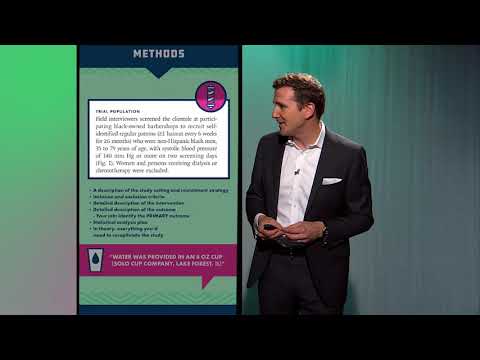
- Methods detail participant enrollment, interventions, measurements, and statistical comparisons, aiming for reproducibility.
12:32
Results, Discussion, and Key Takeaways
- Results present data and measurements without editorializing or hypothesizing; Table One describes population characteristics.
- The discussion section involves author speculation on the meaning of results, requiring critical reading ('with major grains of salt').
- Methods and results are objective, while background, discussion, and conclusions can be subject to 'spin'.
- Readers should use skeptical hats when evaluating the background and discussion sections.
Summary, takeaways, and chapters were generated by AI from the video's transcript and may contain errors. The video belongs to its creator, YaleCourses.