The Invaders Who Ended the Bronze Age | The Sea Peoples
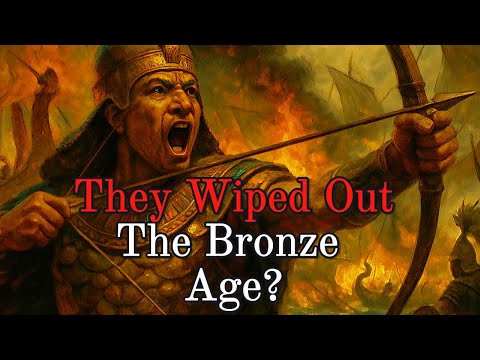 Watch on YouTube →
Overview
The Sea Peoples are presented not as one clearly identifiable nation but as a shifting mix of raiders, migrants, and mercenaries whose attacks coincided with drought, earthquakes, famine, and weakening trade networks around 1200 BCE. From the destruction of Hattusa, Ugarit, and Mycenaean centers to Ramses III’s costly defense of Egypt, the account argues that interconnected systems can fail rapidly when multiple stresses converge—and that the Sea Peoples’ origins remain unresolved.
Key takeaways
- The Sea Peoples were not demonstrably a single nation: Egyptian records name groups such as the Sherden, Lukka, and Peleset, while archaeology has not identified one shared homeland.
- The late Bronze Age collapse affected interconnected centers from Hattusa and Ugarit to Mycenaean Greece, and the account cites at least 40 sites with destruction or abandonment between about 1220 and 1150 BCE.
- Ramses III repelled an attack in the Nile Delta, but Egypt’s survival came at significant cost, including depleted resources and growing internal political strain.
- Drought, earthquakes, famine, migration, and disrupted trade are presented as overlapping pressures that made the Sea Peoples’ attacks more consequential than a single invasion alone.
- The loss of palace institutions also erased or interrupted knowledge: Linear B writing disappeared in Greece for roughly 400 years, and Ugarit’s archives ended in the destruction of the city.
- The modern analogy is about systemic risk, not a prediction: dependence on concentrated supply chains and digital infrastructure can transmit disruption far beyond its point of origin.
Chapters
0:00
The Bronze Age Trade Network Before the Sea Peoples
- Egypt, the Hittite Empire, Mycenaean Greece, Cyprus, and Ugarit depended on maritime trade in copper, tin, cedar, grain, and luxury goods.
- Palace administrations coordinated this exchange through systems such as Mycenaean Linear B records and multilingual contracts at Ugarit.
- The opening frames this interdependence as a source of wealth and a vulnerability: disruption to one supply route could affect distant kingdoms.
6:47
Attacks on Cyprus, Hattusa, Ugarit, and Mycenaean Palaces
- Around 1200 BCE, attackers strike Cypriot ports; reports of coastal destruction and displacement spread through Anatolia and the Levant.
- Hattusa, the Hittite capital, is abandoned amid destruction, while Ugarit’s King Ammurapi sends a desperate appeal for help as enemy forces approach.
- Mycenaean centers including Pylos, Mycenae, Tiryns, and Thebes suffer destruction; Linear B tablets record emergency defenses before palace record-keeping ends.
- Ramses III confronts invading forces in the Nile Delta, using Egyptian ships, archers, and marsh channels to defeat them, but the campaign strains Egypt’s finances.
13:38
Sherden, Lukka, Peleset: Who Were the Sea Peoples?
- The label “Sea Peoples” is a modern umbrella for groups named in Egyptian records, including the Sherden, Shekelesh, Lukka, Peleset, Tjeker, and Denyen.
- Proposed connections place the Lukka in Lycia and associate the Peleset with the later Philistines, but the name matches and migration routes remain debated.
- Theories include displaced Anatolian fighters, Aegean sailors, and migrations originating farther north; none establishes a single homeland for all the groups.
- The account links these possibilities to drought, famine, earthquakes, and political disruption, suggesting loosely allied groups rather than one unified invading nation.
21:57
The Collapse of Hittite, Mycenaean, and Ugaritic Systems
- The Hittite Empire disappears, and its capital Hattusa yields abandoned archives and administrative records that end abruptly.
- After Mycenaean palaces fall, Linear B writing disappears in Greece for roughly 400 years, while long-distance trade and palace-centered production contract.
- Cypriot copper production declines, disrupting the supply of a key ingredient in bronze; local ironworking and village-scale production become more important.
- Egypt survives Ramses III’s campaigns but faces depleted resources, labor unrest, stronger provincial authorities, and later political fragmentation.
29:42
Medinet Habu, Ugarit, and the Archaeological Evidence
- Ramses III’s reliefs at Medinet Habu depict naval combat and invading groups; their inscriptions preserve names that scholars use to investigate the Sea Peoples.
- Excavations at Ras Shamra identified ancient Ugarit, where burned archives preserve correspondence describing approaching enemies and urgent requests for aid.
- Excavations at Hattusa uncovered abandoned neighborhoods, royal records, and archives that help establish the abrupt end of Hittite rule.
- The transcript cites destruction or abandonment at at least 40 sites between about 1220 and 1150 BCE, alongside evidence for drought, earthquakes, and migration.
37:17
Why the Sea Peoples’ Origins Remain Uncertain
- Egyptian records describe multiple groups with different equipment and names, but no known Sea Peoples archive or definitive homeland has been found.
- Evidence from early Philistine burials at Ashkelon suggests a limited Aegean-related ancestry that blends into the local population within a few centuries.
- Pottery, inscriptions, and burial evidence point to movement and cultural mixing, not a uniform people leaving a single archaeological signature.
- The account treats the Sea Peoples as a possible symptom and amplifier of broader collapse, while acknowledging that their precise role is disputed.
39:12
How Interdependence Turned Local Crises into Systemic Collapse
- Bronze production depended on linked supplies, including Cypriot copper and tin brought across long-distance routes; broken trade connections disrupted armies and workshops.
- The proposed crisis combined drought, earthquakes, famine, migration, piracy, and political instability rather than relying on one cause.
- Egypt’s survival required Ramses III’s military response and heavy spending, leaving the kingdom weakened even after it repelled the attackers.
- The central lesson is that a tightly connected system can spread disruption across regions when several vulnerabilities peak at once.
42:22
Bronze Age Supply Shocks and Modern Global Dependencies
- The account compares ancient copper and tin routes with modern supply chains for semiconductors, lithium, and other critical materials.
- It cites the 2021 Suez Canal blockage, which delayed nearly 12% of global trade, as an example of how one chokepoint can disrupt distant markets.
- Modern climate displacement and drought are presented as parallels to ancient pressures, not proof that contemporary society will repeat the Bronze Age collapse.
- The comparison emphasizes that resilience requires anticipating combined risks rather than treating climate stress, migration, and trade disruption as isolated problems.
46:13
What the Bronze Age Collapse Left Behind
- The collapse destroyed or obscured diplomatic records, medical texts, literature, and technical knowledge held in palace archives at sites such as Hattusa and Ugarit.
- Survivors adapted through more local governance, ironworking less dependent on distant tin, and writing traditions that later included the Phoenician alphabet.
- The account warns that modern digital records also depend on vulnerable infrastructure such as electricity, server farms, and undersea cables.
- Its closing argument is that complexity is not invincibility: societies need systems and knowledge that can endure when central institutions and trade networks fail.
Summary, takeaways, and chapters were generated by AI from the video's transcript and may contain errors. The video belongs to its creator, Archive 1900.