The Greatest General in History? Alexander the Great (All Parts)
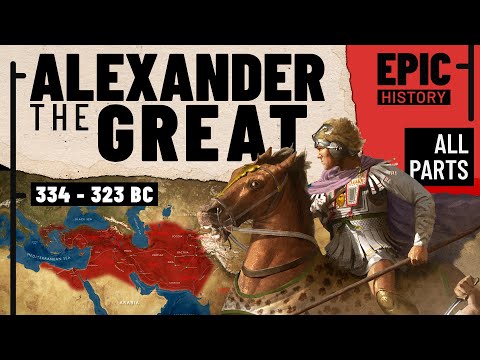 Watch on YouTube →
Overview
Alexander the Great used the Macedonian army—especially its sarissa-armed phalanx and Companion Cavalry—to defeat Persian forces at Granicus, Issus, and Gaugamela, then conquered territory from Egypt to India in a decade-long campaign. His empire stretched from Greece to Pakistan, but endless campaigning, conflict over Persian customs, and the absence of a succession plan left it unstable after his death at 32; its fragmentation nevertheless spread Greek culture into the Hellenistic world.
Key takeaways
- Alexander's army combined the 18-foot sarissa phalanx with elite cavalry, allowing him to pin opponents in place and exploit openings with rapid attacks at battles such as Issus and Gaugamela.
- At Gaugamela, Alexander's outward movement deliberately drew Persian troops away from Darius's center; a concentrated Companion Cavalry charge then broke the weakened line.
- Alexander's conquests relied on both force and political incorporation: he retained loyal Persian officials, founded cities across the eastern provinces, and arranged marriages linking Macedonian officers to Persian nobility.
- The long eastern campaigns and Alexander's adoption of Persian court practices alienated Macedonian troops, contributing to resistance at the Hyphasis and mutiny at Opis.
- Alexander's empire depended heavily on his personal authority; without a succession plan, his generals fought over it, while Greek culture continued to spread through the successor kingdoms.
Chapters
0:00
Philip II Unites Greece and Alexander Takes the Throne
- After decades of conflict between Greek city-states, Philip II strengthened Macedonia with the sarissa, an 18-foot pike used by trained phalanx infantry.
- Philip defeated Athens and Thebes at Chaeronea in 338 BC and united most of Greece in the League of Corinth.
- After Philip's assassination, 20-year-old Alexander secured the throne by suppressing rebellions, including the destruction of Thebes, before invading Persia in 334 BC.
6:00
The Macedonian Army Wins the Battle of the Granicus
- Alexander's roughly 40,000-strong army combined 9,000 Macedonian phalangites, elite hypaspists, allied hoplites, skirmishers, and Companion Cavalry.
- At the Granicus River, Alexander attacked before dawn despite the risks of crossing against a Persian cavalry line.
- Alexander was nearly killed by Persian nobles, but Cleitus the Black saved him; the Macedonian crossing and phalanx forced the Persian cavalry to flee.
- Alexander refused mercy to the Persian Greek mercenaries, who were surrounded and massacred after the battle.
15:44
Issus: Alexander Defeats Darius III and Secures the Coast
- Alexander took Sardis and targeted Persian naval bases at Miletus and Halicarnassus rather than challenge Persia's fleet at sea.
- At Issus in 333 BC, the narrow coastal battlefield limited Darius III's numerical advantage, despite estimates that his army outnumbered Alexander's nearly two to one.
- Alexander's charge toward the Persian center caused Darius to flee; Macedonian troops captured Darius's family and treated them well.
- After the victory, Phoenician cities submitted, bringing Persian naval power in the Mediterranean close to an end.
23:04
Tyre, Egypt, and Alexander's Claim to Rule Asia
- Tyre resisted for seven months, but Alexander's causeway and siege towers eventually enabled him to breach the island city's defenses; Gaza also fell.
- Egypt's Persian governor surrendered at Pelusium, and Egyptian priests welcomed Alexander as Pharaoh.
- Alexander founded Alexandria at the Nile Delta and visited the oracle of Siwah, where some accounts say he was acclaimed as the son of Amun.
- When Darius offered gold, marriage, and half his empire for peace, Alexander rejected the terms and continued toward Persia's heartland.
28:31
Gaugamela Breaks Persian Power
- At Gaugamela, Darius assembled troops from across the empire, including cavalry, up to 200 scythed chariots, and war elephants.
- Alexander moved his right wing outward to draw Persian troops away from the center, then led the Companion Cavalry into the resulting gap.
- Persian chariots were blunted by Agrianian javelin-throwers and gaps opened by Greek infantry; Darius fled as his center collapsed.
- Alexander entered Babylon and Susa as ruler, then captured Persepolis, which he ordered looted and burned in retaliation for the Persian invasion of Greece.
- Darius was murdered by the governor Bessus; Alexander arranged Darius's burial and retained some Persian officials in his new administration.
37:04
Eastern Campaigns: Bessus, Sogdia, and the Limits of Loyalty
- Alexander put down Satibarzanes's revolt in Aria, founded Alexandria Ariana near modern Herat, and later founded Alexandria Arachosia near modern Kandahar.
- After Philotas was executed for concealing an assassination plot, Alexander ordered assassins to kill Philotas's father, Parmenion, before he could react.
- Bessus was betrayed and captured near modern Kunduz, then sent back for execution as Darius's killer.
- Alexander fought prolonged resistance in Bactria and Sogdia, reached the Jaxartes River, and founded Alexandria Eschate, his farthest city.
- After killing Cleitus the Black during a drunken quarrel, Alexander faced further resistance to Persian court customs such as proskynesis; he married Roxana in 327 BC.
41:05
Indian Campaign: Hydaspes Victory and the Army's Mutiny
- Alexander crossed the Hindu Kush and fought the Aspasii and Assaceni in the Swat Valley before taking Massaga after a siege.
- With the ruler of Taxila as an ally, Alexander defeated King Porus at the Hydaspes, a costly battle in which Porus's war elephants inflicted heavy losses.
- At the Hyphasis River, the Beas, Alexander's troops refused to march farther into India after years away from home and reports of larger armies ahead.
- During the return down the Punjab rivers, Alexander was nearly killed in an assault on a Mallian city, then sent Nearchus's fleet west by sea while leading another force across the Gedrosian desert.
47:30
Imperial Integration, Hephaestion's Death, and Alexander's Final Plans
- Back in Persia, Alexander punished viceroys accused of abusing their authority and arranged marriages between Macedonian officers and 80 Persian noblewomen.
- At Opis, Macedonian troops mutinied over Alexander's adoption of Persian customs and advisers; executions and a speech recalling their shared victories preceded reconciliation.
- Alexander paid his soldiers' debts and ordered 30,000 youths from across the empire to train in Macedonian warfare.
- After Hephaestion died of fever, Alexander ordered public mourning; he later died in Babylon at 32 while planning a campaign in Arabia.
50:19
The Successors Divide Alexander's Empire and Begin the Hellenistic Age
- Alexander died undefeated in battle, but left no succession plan; his generals fought to divide an empire stretching from Greece to Pakistan.
- In the Wars of the Successors, Roxana and Alexander's young son were murdered, while Alexander's gold sarcophagus ended up in Alexandria.
- Greek ideas spread through successor kingdoms and blended with local traditions, shaping Hellenistic art, science, government, and language.
- The successor states endured for different lengths of time before falling to later powers, including Rome.
Summary, takeaways, and chapters were generated by AI from the video's transcript and may contain errors. The video belongs to its creator, Epic History.