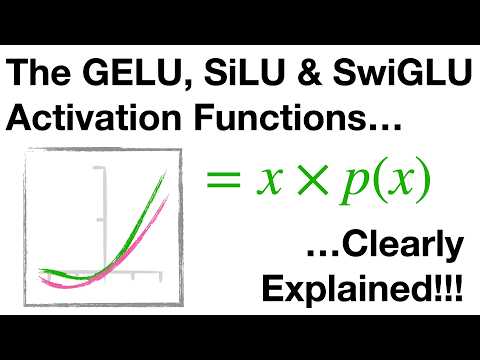
The GELU, SiLU and SwiGLU activation functions, clearly explained!!!
 Watch on YouTube →
Overview
Josh Starmer explains the evolution of activation functions in neural networks, moving from the limitations of sigmoid and ReLU to the more advanced GELU, SiLU, and SwiGLU. These newer functions, derived from concepts like input-dependent dropout, offer smoother curves and better generalization, reducing overfitting compared to ReLU. GELU and SiLU are closely related, while SwiGLU introduces additional trainable parameters for greater flexibility.
Key takeaways
- The GELU activation function is derived from the concept of input-dependent dropout, using the Gaussian CDF to determine the probability of a neuron firing.
- SiLU is a related activation function derived similarly to GELU, but uses the sigmoid function instead of the Gaussian CDF for its probability calculation.
- SwiGLU introduces additional trainable weights (W and V) and a gating mechanism, allowing for more complex activation shapes and potentially smaller, less overfitting models.
- The evolution from Sigmoid to ReLU, and then to GELU, SiLU, and SwiGLU, reflects a trend towards smoother, more adaptable activation functions that better handle generalization and reduce overfitting in neural networks.
- Dropout, initially a technique to combat overfitting, provided the conceptual basis for input-dependent activation functions like GELU and SiLU.
- The development of activation functions like SwiGLU highlights the ongoing experimentation in neural network architectures, where increased flexibility and reduced human constraint often lead to better performance.
Chapters
0:00
Introduction to GELU, SiLU, and SwiGLU vs. ReLU
- GELU (Gaussian Error Linear Unit) and SiLU (Sigmoid Linear Unit) offer a dip for negative inputs and a smoother curve at zero compared to ReLU.
- ReLU outputs zero for negative inputs and the input value for positive inputs, with an angular bend at zero.
- GELU and SiLU have slightly smaller outputs than positive inputs due to a subtle curve.
- These functions reduce overfitting compared to ReLU, leading to better post-training predictions.
5:27
Evolution from Sigmoid to ReLU and the Problem of Overfitting
- Early neural networks used sigmoid, but its derivative close to zero for large inputs hindered training of deep networks.
- ReLU replaced sigmoid around 2010, enabling deeper, trainable networks due to its simple computation and derivative of 0 or 1.
- However, large ReLU networks tend to overfit training data, leading to poor generalization.
- Dropout was introduced as a technique to mitigate overfitting by randomly removing neurons during training.
18:37
Deriving GELU and SiLU from Input-Dependent Dropout
- GELU is derived by replacing fixed dropout with input-dependent probabilities, using the Gaussian cumulative distribution function (CDF) for p(x).
- The GELU function is the weighted average: x * p(x), where p(x) is the probability of avoiding dropout.
- SiLU is derived by using the sigmoid function instead of the Gaussian CDF for p(x), resulting in a similar but distinct activation function.
- Both GELU and SiLU offer improvements over ReLU by incorporating input-dependent dropout principles.
Summary, takeaways, and chapters were generated by AI from the video's transcript and may contain errors. The video belongs to its creator, StatQuest with Josh Starmer.