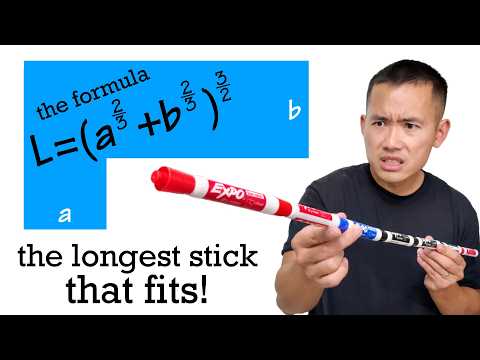
The formula for the “Moving Stick Problem”
 Watch on YouTube →
Overview
blackpenredpen derives the minimum length of a horizontal stick that can turn through a right-angle hallway with widths A and B. Minimizing L(θ) = A csc θ + B sec θ gives tan θ = (A/B)^(1/3) and the limiting length L = (A^(2/3) + B^(2/3))^(3/2); the closing question asks how the problem changes if the stick can be lifted under a ceiling of height C.
Key takeaways
- For hallway widths A and B, a horizontal stick of length greater than (A^(2/3) + B^(2/3))^(3/2) cannot make the right-angle turn.
- The stick length at angle θ is the sum of two geometric contributions: A csc θ along one corridor and B sec θ along the other.
- The optimal orientation is determined by tan θ = (A/B)^(1/3), balancing the two corridor constraints.
- A cube-root right triangle converts the optimal-angle condition into the compact minimum-length formula.
- The derived formula assumes the stick remains horizontal; allowing it to lift beneath a ceiling of height C introduces a new three-dimensional constraint.
Chapters
0:00
Modeling the Horizontal Stick in a Hallway with Widths A and B
- The hallway has perpendicular corridor widths A and B, and the stick stays horizontal while turning.
- The limiting stick touches the outer wall edges at the corner; finding the longest stick that can pass reduces to finding this minimum limiting length.
- At orientation angle θ, the stick divides into segments L1 = A csc θ and L2 = B sec θ.
3:00
Minimizing L(θ) to Find the Critical Turning Angle
- The total limiting length is L(θ) = A csc θ + B sec θ, with θ between 0 and π/2.
- Differentiating and setting the numerator equal to zero gives B sin³ θ = A cos³ θ.
- Therefore tan³ θ = A/B, so the unique critical angle satisfies tan θ = (A/B)^(1/3).
7:20
Deriving the Optimal Length and Extending the Problem to a Ceiling
- A right triangle with opposite side A^(1/3) and adjacent side B^(1/3) gives hypotenuse √(A^(2/3) + B^(2/3)).
- Substituting the triangle ratios into A csc θ + B sec θ yields the minimum limiting length (A^(2/3) + B^(2/3))^(3/2).
- blackpenredpen ends by asking how the result changes if the stick can be lifted and a ceiling of height C restricts its motion; no solution is provided.
Summary, takeaways, and chapters were generated by AI from the video's transcript and may contain errors. The video belongs to its creator, blackpenredpen.