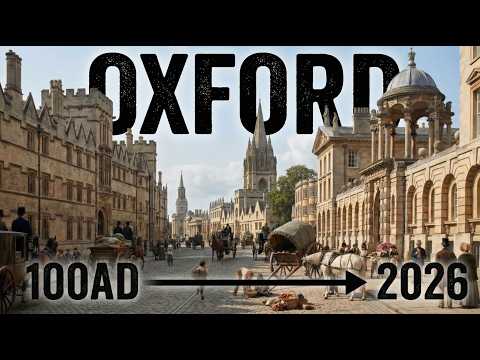
The Entire History of Oxford in 32 Minutes
 Watch on YouTube →
Overview
This historical overview traces Oxford's evolution from a Saxon settlement to a world-renowned university city, highlighting key events such as the St. Bryce's Day Massacre in 1002, Matilda's escape from Oxford Castle in 1142, and the religious executions under Mary I in the 1550s. It also covers Oxford's contributions to penicillin development during WWII and Roger Bannister's 4-minute mile in 1954.
Key takeaways
- Oxford's name originates from its role as a ford where oxen crossed the River Thames in the 8th century.
- The St. Bryce's Day Massacre in 1002, where Danes were burned alive in St. Friedwide's Church, triggered a retaliatory invasion by Swain Forkbeard.
- Empress Matilda's daring escape from Oxford Castle in 1142, dressed in white to blend with the snow, is a legendary moment in English history.
- The St. Scholastica's Day riot in 1355 resulted in the deaths of 63 students and 30 townspeople, leading to a 470-year annual penance imposed on Oxford's mayor and council.
- During World War II, Oxford scientists Howard Flory and Erns Chain purified and mass-produced penicellin, revolutionizing medicine.
- Roger Banister's sub-4-minute mile in 1954 at Oxford's Ifley Road track captured global attention and symbolized breaking perceived human limits.
Chapters
0:00
From Saxon Ford to Fortified Town: Oxford's Origins (8th-11th Centuries)
- Oxford began as a Saxon settlement, named for a ford where oxen crossed the River Thames.
- Princess Friedwide founded a priory around 727 AD, establishing Oxford's first significant religious building.
- King Etheld the Unready ordered the St. Bryce's Day Massacre in 1002, resulting in the burning of Danes seeking sanctuary in St. Friedwide's church.
7:13
Norman Conquest and the Birth of the University (11th-12th Centuries)
- William the Conqueror ordered the construction of Oxford Castle after 1066 to assert Norman control.
- Scholars began gathering in Oxford by the early 12th century, with documented lectures by the 1120s.
- Empress Matilda escaped Oxford Castle in 1142 during the Anarchy, fleeing across the frozen Thames.
13:47
The Rise of Colleges and Town-Gown Conflict (13th Century)
- Oxford's first colleges, including University College, Bale, and Mertton, were founded in the 1260s and 1270s.
- A scholar killed a local woman in 1209, leading to the hanging of two innocent scholars and a temporary exodus of scholars to Cambridge.
- Mertton College established the first formal academic structure in 1284 with fellows, statutes, and a curriculum.
17:26
Plague, Riot, and Religious Upheaval (14th-16th Centuries)
- The Black Death reached Oxford in 1349, killing between a third and half of the population.
- The St. Scholastica's Day riot in 1355 resulted in the deaths of 63 students and 30 townspeople.
- Henry VIII's break with Rome in 1534 led to the dissolution of monasteries and religious turmoil in Oxford.
23:48
Civil War and the Age of Reason (17th-18th Centuries)
- Oxford served as the royalist capital during the English Civil War from 1642 to 1646 under Charles I.
- Christopher Ren designed the Shelonian Theater in 1664, marking a cultural resurgence after the Civil War.
- The 18th century saw Oxford produce influential thinkers like John Lock and Adam Smith, though the university remained conservative.
32:21
Industrialization, Innovation, and Modern Challenges (19th-21st Centuries)
- The Oxford Canal (1790) and the Great Western Railway (1844) transformed Oxford into an industrial city.
- William Morris founded Morris Motors in 1896, which became a major automobile manufacturer.
- Oxford scientists developed the Oxford-Astroenica vaccine in 2020, playing a crucial role in the global response to the coid9 pandemic.
- Roger Bannister broke the 4-minute mile in 1954 at Oxford's Ifley Road track.
Summary, takeaways, and chapters were generated by AI from the video's transcript and may contain errors. The video belongs to its creator, Majestic Studios.