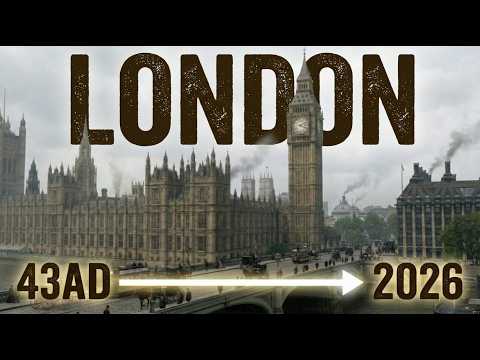
The Entire History of London in 24 Minutes
 Watch on YouTube →
Overview
This historical overview traces London's evolution from a Roman settlement in 43 AD to a global metropolis, highlighting key events such as Queen Buudaca's burning of Londinium, the rebuilding of London by Christopher Ren after the Great Fire of 1666, and the impact of the Windrush generation on London's diversity.
Key takeaways
- Queen Buudaca's army burned Londinium to the ground in 60 AD, leaving a layer of red ash beneath the modern city.
- King Alfred the Great abandoned Londonvvic in 886, moving the population back inside the Roman walled city to defend against Viking raids.
- The Magna Carta in 1215 granted London the right to elect its own mayor and freedom from arbitrary taxes.
- The Great Fire of 1666 destroyed 85% of London, leading to rebuilding with brick and stone and Christopher Ren's reconstruction of St. Paul's Cathedral.
- London's sewage system, built by Joseph Basiljette after the Great Stink of 1858, is still in use today.
- The Windrush generation from the Caribbean in 1948 and subsequent immigration waves have made London a diverse city with over 300 languages spoken.
Chapters
0:00
Londinium: From Roman Outpost to Saxon Settlement (43 AD - 1066)
- In 43 AD, Romans establish Londinium as a strategic crossing point on the Thames, which becomes a bustling port town.
- Queen Buudaca of the Isini tribe burns Londinium to the ground in 60 AD, but the Romans rebuild it with a massive wall.
- After the Romans leave in 410 AD, the Saxons establish Londonvvic a mile west of the old Roman city around the 670s.
- King Alfred the Great abandons Londonvvic in 886 and moves the population back inside the Roman walled city, renaming it Londenberg.
6:50
Norman Conquest and Medieval London (1066 - 1500)
- William the Conqueror builds the Tower of London after 1066 to assert Norman control.
- London Bridge is rebuilt in stone between 1176 and 1209, becoming a city unto itself with shops and houses.
- The Black Death arrives in 1348, killing between a third and half of London's population within two years.
- In 1381, peasants led by Wat Tyler march on London, demanding an end to serfdom and unfair taxes.
18:31
Growth, Fire, and Rebuilding (1500 - 1800)
- London's population explodes from 50,000 in 1500 to nearly 400,000 by 1650, becoming the largest city in Europe.
- Henry VIII's break with Rome in the 1530s leads to the seizure of monastic lands, allowing London to expand.
- The Great Fire of 1666 destroys 85% of the city within the walls, leading to rebuilding with brick and stone.
- Christopher Ren rebuilds St. Paul's Cathedral, which takes 35 years to complete.
Summary, takeaways, and chapters were generated by AI from the video's transcript and may contain errors. The video belongs to its creator, Majestic Studios.