The Deepest Point in the World: Crash Course Geology #12
 Watch on YouTube →
Overview
Crash Course Geology explores the diverse topography of the ocean floor, from continental shelves to abyssal plains and deep-sea trenches, highlighting how plate tectonics shapes these features and creates unique habitats like hydrothermal vents. The video emphasizes the critical role of ocean currents, driven by temperature and salinity, in distributing nutrients, influencing climate, and supporting marine life, while also noting the impact of climate change on these systems.
Key takeaways
- The ocean floor's bathymetry is highly varied, featuring continental shelves, slopes, rises, abyssal plains, seamounts, canyons, and deep trenches, all shaped by geological processes.
- Plate tectonics is the primary driver of marine geological features, creating divergent boundaries (mid-ocean ridges with hydrothermal vents) and convergent boundaries (trenches).
- Hydrothermal vents support unique ecosystems based on chemosynthesis, where bacteria utilize chemicals from vents as their energy source, forming the base of the food web.
- Ocean currents are crucial for global climate regulation, nutrient distribution, and the dispersal of marine life, acting as a 'global conveyor belt'.
- Climate change is impacting ocean currents by warming Arctic temperatures and accelerating glacier melt, which slows down the density-driven conveyor belt.
- Oceans serve as a vital carbon sink, absorbing atmospheric CO2, but this capacity is threatened by warming surface waters and reduced absorption rates.
Chapters
0:00
Introduction to Oceanography and Seafloor Topography
- Oceanography studies the physics, chemistry, biology, and geology of oceans, utilizing tools like sonar and submersibles.
- The ocean floor is not uniform, exhibiting varied bathymetry including continental shelves, slopes, rises, and abyssal plains.
- Continental crust is thicker and more buoyant than oceanic crust, influencing shelf depth and features.
6:38
Plate Tectonics: Shaping Marine Features and Habitats
- Active margins, characterized by earthquakes, contrast with passive margins where continental and oceanic crust meet on the same plate.
- Hydrothermal vents form at divergent boundaries (mid-ocean ridges) and convergent boundaries, supporting chemosynthetic life.
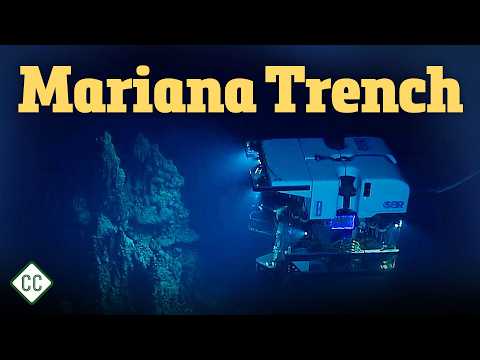
- Trenches, like the Mariana Trench containing the Challenger Deep (nearly 11,000m deep), form at convergent boundaries where plates collide.
Summary, takeaways, and chapters were generated by AI from the video's transcript and may contain errors. The video belongs to its creator, CrashCourse.