The Complete 5,000-Year History Of The World's Religions In 47 Minutes
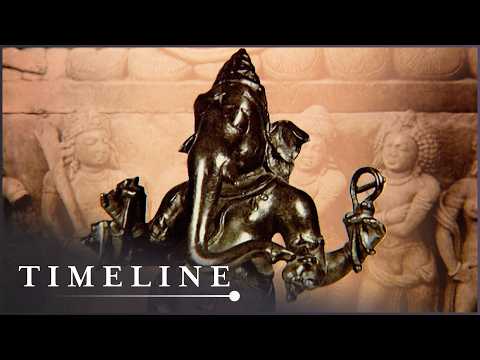 Watch on YouTube →
Overview
Timeline - World History Documentaries traces the 5,000-year development of major world religions, beginning with Hinduism's emergence ~3,500 years ago through Buddhism, Judaism, Christianity, Islam, Sikhism, and modern humanism. The documentary emphasizes how each tradition shares conceptual lineage with predecessors — Buddhism arising from Hindu reform, Christianity and Islam extending the Abrahamic Jewish foundation, and Sikhism reforming Hinduism in 15th-century India — while developing distinct doctrines around karma, monotheism, prophets, and scripture.
Key takeaways
- The term 'Hinduism' is an 18th–19th century colonial construct — the tradition itself has no single founder, unified doctrine, or orthodoxy, functioning instead as an umbrella over thousands of regional sub-traditions.
- Buddhism and Hinduism appear similar but diverge fundamentally on the self: Buddhism denies any continuing soul, so Buddhists technically speak of 'rebirth' rather than 'reincarnation,' and karma counts only willfully intended actions.
- Abraham is the single shared patriarch of Judaism, Christianity, and Islam, but each tradition traces a different lineage — Christians and Jews through Isaac, Muslims through Ishmael — producing both common ground and theological conflict.
- The Christian New Testament canon wasn't finalized until roughly the 320s AD at the Council of Nicaea, coinciding with Constantine's conversion and the Roman Empire's embrace of Christianity.
- Sikhism teaches that 'truthful living' ranks higher than truth itself — truth must be flexibly applied to context, and the religious, social, and political realms are inseparable.
- New religious movements typically face a crisis at the generational transition: the founding converts' enthusiasm must be institutionalized into transmissible structures, or the movement fragments into subgroups.
Chapters
0:00
Origins of Religious Perception in Early Humans
- Early humans attributed natural phenomena — weather, fire, herds — to distinct gods tied to places and events
- Scholars debate whether religion originated in divine revelation or as a naturalistic response to the unexplainable
- Modern technology hasn't eliminated the same existential fears that drove early belief systems
3:36
Hinduism: A 3,500-Year-Old Umbrella Tradition
- Name derives from Sanskrit 'Hindu' used by Persians to describe people of the Indus River region
- The label 'Hinduism' is itself an 18th–19th century colonial construction over diverse sub-traditions
- Major deities include Vishnu (protector), Shiva (destroyer), Brahma (creator), and Devi
- Governs daily life through dharma — food, marriage, occupation, and the four-caste social structure
8:11
Hindu Scripture, Karma, and Reincarnation
- The Vedas (~3,300 years old) form the canon; the Smriti compendium contains the practical epic tales
- The Bhagavad Gita teaches Nishkama Karma — disinterested action, where outcomes belong to Krishna
- Karma operates as a moral law: 'you reap what you sow' across lifetimes; in Jainism it's treated as near-physical residue
- Yoga is prescribed as a reversal of the habit-cycles that bind individuals to repeated actions
13:28
Buddhism: Siddhartha Gautama's Break from Hindu Orthodoxy
- Founded in northeast India by Siddhartha Gautama, who rejected caste, sacrifice, and priestly authority
- Unlike Hinduism, Buddhism denies a continuing self — uses 'rebirth' rather than 'reincarnation'
- Karma in Buddhism counts only willful, conscious actions — not subconscious ones
- Gautama achieved enlightenment under a bodhi tree at age 29 after renouncing royal luxury
17:21
The Four Noble Truths and the Eightfold Path
- Core teaching: life is suffering, caused by ignorance and craving, ended by overcoming attachment
- The Eightfold Path covers right understanding, attitude, speech, action, livelihood, effort, mindfulness, and meditation
- The Buddha framed his Dharma as a 'raft' — a provisional tool to be abandoned after crossing, not a fixed doctrine
- Spread from India into Sri Lanka, Burma, Cambodia, Thailand, China, and Japan, adapting to local conditions
21:21
Judaism: From Canaanite Polytheism to Yahwism
- Likely evolved from broader Canaanite religion toward exclusive worship of Yahweh
- Exodus narrative — escape from Egyptian slavery under Moses — forged Jewish peoplehood and the 'chosen people' concept
- King David captured Jerusalem and organized the priesthood, consolidating the Israelite kingdom
- Written records only emerge around 500 BC, making earlier history archaeologically unverifiable
25:25
Torah, Festivals, and the Messianic Hope
- Torah is celebrated as a joyful gift — Jews literally dance with Torah scrolls in synagogue festivals
- Key observances include Passover (commemorating the Exodus) and Yom Kippur (Day of Atonement)
- Repeated oppression — Babylonian captivity, Alexander's invasions — fueled prophecies of a coming Messiah
28:10
Christianity: Jesus and the Expansion Beyond Judaism
- Emerged under Roman occupation of Palestine; Jesus proclaimed as Messiah by his followers
- Reduced Jewish law to three commands: love God, love neighbor, spread the message
- Paul's conversion on the road to Damascus opened the mission to Gentiles
- New Testament canon was effectively closed around the 320s AD at the Council of Nicaea under Constantine
32:28
Islam, Sikhism, and Modern Humanism
- Islam (7th century AD) reveres Jesus as prophet but treats the Quran as God's final word, embodied through Muhammad
- Five Pillars: witness, prayer, Ramadan fasting, pilgrimage to Mecca, and alms-giving
- Sikhism founded by Guru Nanak in 15th-century India; Guru Granth Sahib became eternal guru after Guru Gobind Singh, the tenth guru
- Humanism arose in 14th-century Renaissance Italy, holding that human rationality alone — without divinity — can secure ethics and meaning
- New movements like Jehovah's Witnesses, Mormons, and the Unification Church face the challenge of institutionalizing beyond first-generation enthusiasm
Summary, takeaways, and chapters were generated by AI from the video's transcript and may contain errors. The video belongs to its creator, Timeline - World History Documentaries.