The City (1939 Documentary)
 Watch on YouTube →
Overview
The City (1939) contrasts close-knit historic towns and polluted, overcrowded industrial cities, arguing that urban form is a public choice with consequences for health, work, and family life. It presents a planned alternative: compact green communities linked to industry and transportation, with homes near schools, markets, parks, and jobs, and farmland and open space protected from sprawl.
Key takeaways
- The film treats city size as a planning decision: communities should remain compact enough to manage and close enough to farmland and open space.
- Industrial production alone does not guarantee prosperity for workers; the film connects factory growth and coal smoke with polluted water, unhealthy housing, and childhood disease.
- The proposed city separates heavy industry from residential areas while keeping factories near rail and motor roads and placing lighter industry closer to homes.
- Schools, public meeting halls, markets, parks, and homes are planned as connected neighborhood facilities rather than scattered destinations.
- A permanent belt of public land is presented as a way to contain urban expansion and keep fields, woods, and gardens accessible.
- The closing appeal frames planned housing and neighborhoods as prevention: the cost of disorder includes illness, institutional care, and years of damaged childhood.
Chapters
0:00
From Historic Town Life to the Industrial Turning Point
- The opening montage leads into a portrait of towns organized around a church, common, town hall, and school.
- Neighbors share work and community activities, including quilting, blacksmithing, harvest labor, and dances.
- The town’s scale keeps fields nearby and makes civic life and cooperation manageable.
4:00
The Older Town’s Balance of Work, Community, and Land
- Water wheels and local machines supplement hand labor by sawing wood and grinding corn.
- The film links daily work, family life, and nearby farmland to a sense of balance between settlement and nature.
- It presents limits on town size and the distance to open land as essential to that balance.
6:54
Steam, Steel, and the Costs of Industrial City Growth
- Steam power, steel, and factory production replace the older town economy with mass output and rapid expansion.
- Workers describe smoke, polluted rivers, crowded housing, and children exposed to diseases including rickets, typhoid, and tuberculosis.
- The film argues that industrial workers’ contributions—from mining coal to assembling cars and tractors—do not justify unsafe homes and neighborhoods.
11:41
Overcrowded Metropolises and the Human Cost of Disorder
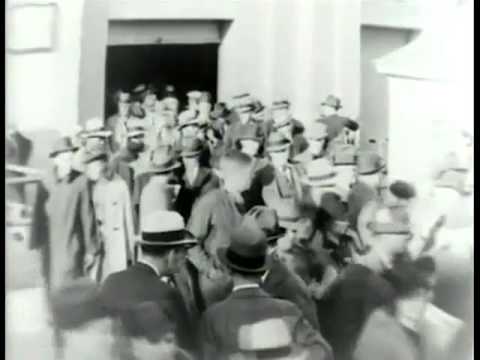
- The city is portrayed as growing from one million to two million and five million residents, with people treated like commodities in a crowd.
- Rapid hospital dispatches for severe injuries convey the pressure placed on urban services and the dangers of congested streets.
- The contrast between industrial productivity and unhealthy housing raises the question of whether smoke and overcrowding are an unavoidable price of prosperity.
22:05
A Planned Green City Links Homes, Industry, and Open Land
- The proposed city is bounded by trees, fields, gardens, and public land to prevent unlimited growth and preserve its shape.
- Factories are separated from homes but placed near railways and motor roads; lighter industry is closer, and some residents can walk to work.
- Homes cluster around schools, meeting halls, markets, and recreation, while sunlight, clean air, safe streets, and green space are built into the plan.
26:58
Family Life and the Choice to Rebuild Cities
- The planned neighborhood gives parents time with children and puts playgrounds, schools, and libraries within the community.
- Shared facilities and machines ease household routines, while markets supplied by nearby farms connect daily life to regional agriculture.
- The closing argument asks whether society will accept urban blight or invest in clean, well-planned cities, weighing that choice against hospitals, jails, and lost childhoods.
Summary, takeaways, and chapters were generated by AI from the video's transcript and may contain errors. The video belongs to its creator, American Planning Association.