The Art of True Happiness | Dr. Arthur Brooks
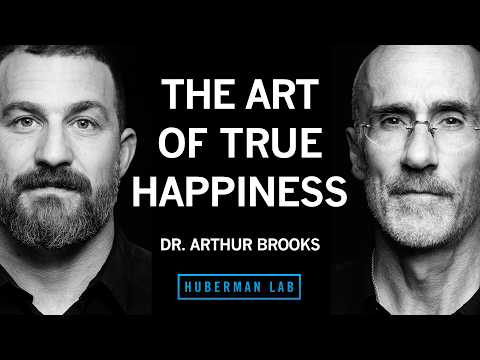 Watch on YouTube →
Overview
Dr. Arthur Brooks, in conversation with Andrew Huberman, outlines the three macronutrients of a happy life: enjoyment, satisfaction, and meaning. Brooks differentiates enjoyment from fleeting pleasure, emphasizing its connection to moral aspirations and social connection. Satisfaction is defined as the joy derived from accomplishment after struggle, while meaning is the 'why' of existence. Brooks also discusses the role of 'idols' like money, power, pleasure, and honor as potential pitfalls that can hinder true happiness, advocating for a focus on love, faith, family, friends, and work as sources of genuine fulfillment.
Key takeaways
- True happiness stems from enjoyment (moral aspiration + pleasure), satisfaction (earned accomplishment), and meaning (purpose).
- Avoid 'idols' like money, power, pleasure, and fame, which promise happiness but lead to misery and regret.
- Leisure time reveals true values; proper leisure involves relationship deepening, learning, and spiritual/philosophical development.
- Suffering is essential for growth, meaning, and discovering one's true self; it's not to be avoided but understood.
- Faith is a practice, not just a feeling; consistent practice builds belief and eventually leads to emotional connection.
- The 'why' questions (coherence, purpose, significance) are crucial for orienting life choices towards meaning and away from idols.
Chapters
- Happiness is composed of enjoyment, satisfaction, and meaning.
- Enjoyment is distinct from pleasure; the pursuit of pleasure alone leads to rehab.
- Satisfaction is the joy of accomplishment after struggle.
- Meaning is the 'why' of existence.
- Unhappiness, discontent, and frustration exist within the macronutrients of happiness.
- Actively trying to avoid unhappiness paradoxically leads to missing happiness.
- Happiness is not incompatible with unhappiness.
- Andrew Huberman introduces Dr. Arthur Brooks, a professor at Vanderbilt and Harvard.
- Brooks specializes in the science of human happiness, drawing on data, philosophy, and experience.
- Huberman praises Brooks' honesty, generosity, and humility.
- Most people incorrectly define happiness as a feeling or emotion.
- Feelings of happiness are evidence of happiness, not happiness itself.
- The field of nutrition provides a useful metaphor: breaking down happiness into macronutrients.
- Analysis of people with high life satisfaction reveals three macronutrients.
- Enjoyment: requires moral aspiration, not just pleasure.
- Satisfaction: joy from accomplishment after struggle.
- Meaning: the 'why' of your existence.
- Pleasure is a limbic phenomenon, driven by brain reward circuits (VTA, nucleus accumbens).
- Pleasure is fundamentally animalistic, shared with other species.
- Enjoyment is a quintessentially human experience, involving moral aspiration, people, and memory.
- Humans possess a large prefrontal cortex, enabling conscious choice between impulses and aspirations.
- Pleasures become enjoyment when infused with moral aspiration and conscious management.
- Doing things alone, especially those wired into dopamine systems, often leans towards pleasure, not enjoyment.
- Ambitious individuals ('strivers') may fear that enjoying life will diminish their drive.
- They prioritize being 'special' and putting points on the board over happiness.
- Enjoyment requires integrating animal impulses with moral aspirations.
- Proper enjoyment involves doing what is prudent, natural, and good, aligning pleasure with moral aspiration.
- The best moments in life are both pleasurable and deeply enjoyable.
- Struggle arises when animal impulse and moral aspiration diverge; aligning them is a key life strategy.
- Mother Nature does not prioritize happiness; negative emotions serve as alarm systems.
- Suffering is necessary for personal growth and learning.
- Reactions to negative emotions, not the emotions themselves, determine well-being.
- Our Place offers non-toxic, PAS-free cookware.
- The Titanium Always Pan Pro uses pure titanium, avoiding harmful chemicals.
- Products are durable, easy to clean, and aesthetically pleasing.
- Helix Sleep offers customized mattresses and pillows based on a two-minute sleep quiz.
- Mattress comfort (softness/firmness) significantly impacts sleep quality.
- The Dusk mattress is recommended for optimal sleep.
- Moral aspiration involves doing what you want to see yourself doing.
- This differs from seeking external approval; it's about positive self-reflection.
- Sharing accomplishments can be beneficial if ego is managed, providing positive feedback.
- Declaring moral aspirations publicly creates commitment bias, making them path-dependent.
- Weddings serve as an example: public promises are rewarded, creating a commitment.
- Wedding vows acknowledge potential future difficulties, implicitly accepting unhappiness within happiness.
- Public commitments, like wedding vows, acknowledge that happiness includes unhappiness.
- This is a declaration of independence from the world and dependence on each other.
- Embracing the full spectrum of life, including suffering, is part of a well-lived life.
- Modern internet culture facilitates a movement towards aspiration for excellence.
- People seek an 'edge' to be better, more successful, and better liked.
- Freedom comes from accepting that animal impulses do not always lead to excellence.
- Societal friction may stem from differing lines drawn between animal impulse and moral aspiration.
- Moral foundations include care, fairness, loyalty, purity, and authority (Haidt's framework).
- Differing definitions of care, fairness, loyalty, and purity contribute to political divides.
- Loyalty: Stronger in conservatives (national identity, military), less emphasized in liberals (flag burning seen as inadvisable, not evil).
- Purity: Profound in sexual matters; conservatives emphasize traditional morality, liberals may prioritize consent and love.
- These differences lead to each side viewing the other as immoral, though they are differently moral.
- Leisure is what you do when not compensated, reflecting true priorities.
- Josef Pieper's 'Leisure: The Basis of Culture' argues leisure reveals a culture's values.
- Proper leisure is not about meeting animal appetites but for personal betterment, not career advancement.
- Proper leisure, according to Aristotle and Aquinas, is done for its own sake, not for worldly rewards (money, power, pleasure, honor).
- It leads to ultimate enjoyment and greater happiness.
- Three areas of proper leisure: deepening relationships, learning something unnecessary, and metaphysical/spiritual development.
- The concept of 'enrichment' reshapes the question of 'what do you do for fun?'.
- Enrichment implies coming out of an activity better, with something carried forward.
- Going to the beach with a loved one enriches the relationship, making the beach itself incidental.
- Motivation behind activities like drinking or buying a beach house requires clarification.
- Is it animal impulse (social comparison, scoreboard effect) or moral aspiration (creating space for family)?
- The 'why' behind an action determines if it leads to pleasure or enjoyment.
- Suffering together, as in military bonds or intense sports sparring, creates deep connections.
- Compassion (Latin: 'to suffer with') is a primordial human need, moving beyond animal impulse.
- Shared suffering forges bonds that are nonverbal, lifelong, and based on mutual respect.
- Trauma bonding can create intense, albeit sometimes unhealthy, connections.
- Relationships forged through challenge and contention, like Johnny Cash and June Carter's, can achieve deep peace.
- Marriage vows acknowledge potential suffering, signifying a commitment to endure together.
- The goal is not constant peace and ease, but a full life lived across the entire emotional spectrum.
- Utilizing all parts of the brain's emotional systems (amygdala, insula, ACC) is part of being fully alive.
- Suffering, grief, fear, and anger are natural responses to loss, exclusion, or threat.
- AG1 Pro is a new formulation with creatine monohydrate, Calcium HMB, and Zinc Carnosine.
- Creatine supports muscle strength and brain health; HMB aids muscle recovery; Zinc Carnosine supports gut lining.
- Huberman has taken AG1 daily for 14 years.
- Satisfaction is the joy derived from an accomplishment after struggle.
- The satisfaction from a PhD is proportionate to the suffering endured.
- Humans are wired to earn their success; satisfaction comes from the struggle, not just accolades.
- The joke about doubling money highlights that true satisfaction comes from earning success.
- Politicians promising more back from Social Security than paid in fail because they undermine the sense of earning.
- Progress toward goals, not just arrival, drives purpose and satisfaction.
- The Marshmallow Test showed children who deferred gratification performed better later in life.
- A key problem for 'strivers' is not knowing their 'marshmallow' (goal).
- The goal is the golden mean: enough struggle, then reward, then starting again.
- Retirement often fails the satisfaction component of happiness by abruptly stopping struggle without reward.
- A life of only suffering followed by only reward is neurophysiologically and philosophically unsound.
- Maintaining satisfaction involves finding work that is both hard and rewarding, evolving over a career.
- Mother Nature's 'trick' is the hedonic treadmill: the pursuit of external rewards like cars or marriage for lasting happiness is flawed.
- Deathbed regrets are rarely about working more; they focus on relationships, experiences, and personal growth.
- Focusing on present choices (today, this week, this month) is more effective than dwelling on deathbed regrets.
- Meaning is the most philosophical macronutrient of happiness.
- David Brooks' 'resume virtues' vs. 'eulogy virtues' framework is relevant.
- Chasing worldly rewards (money, power, pleasure, honor) as ends in themselves leads to trouble.
- Aquinas identified five 'beguiling idols' that promise happiness but don't deliver: money, resources, power, pleasure, and honor/fame.
- Pursuing these as primary objectives, endowing them with mythical power, leads to misery and regret.
- The cost of pursuing these idols is almost always love.
- Brooks plays a game with students to identify their primary idol (money, power, pleasure, honor/fame).
- The exercise involves eliminating idols one by one, starting with the easiest.
- The remaining idol is the one most likely to beguile and lead astray.
- Love, and being loved, is the ultimate goal.
- Pursuing non-living 'idols' sacrifices opportunities for love.
- Knowing your idol helps avoid errors, though mistakes and misery are still possible.
- Brooks identifies honor/adoration as his most challenging idol, stemming from a desire to earn love.
- Huberman identifies power/control as his most challenging idol, linked to a desire to help people and manage circumstances.
- Both acknowledge the difficulty of overcoming these deeply ingrained 'animal impulses'.
- Money (resources) provides freedom and the ability to help others.
- Power (influence) can be benevolent, enabling positive impact.
- Honor/prestige can be a byproduct of virtuous work, but problematic if pursued as the primary goal.
- The 'human doing' phenomenon, driven by a need to earn love and prove worth, leads to workaholism and success addiction.
- This contrasts with 'human being,' which focuses on intrinsic worth and relationships.
- The ultimate goal is to pivot from the animal impulse of 'doing' to the moral aspiration of 'being' and loving.
- The four pillars of a meaningful life, according to Vedic wisdom and Brooks' framework, are faith, family, friends, and work.
- These provide a deep sense of meaning and satisfaction, transcending worldly idols.
- Unique expression and service within these pillars are key to excellence.
- Admired figures like James Q. Wilson embody unique intellectual entrepreneurship and service.
- The goal is not to imitate but to find one's own unique expression, like Cajal's blend of art, exercise, and neuroanatomy.
- This pursuit of unique excellence, driven by love for humanity, is the ultimate power.
- Understanding the science behind concepts (e.g., coffee's effect on adenosine receptors) aids habit change and dissemination.
- The 'watch one, do one, teach one' model applies to learning complex skills and life principles.
- Explaining concepts repeatedly, like advanced calculus or life protocols, solidifies understanding and mastery.
Summary, takeaways, and chapters were generated by AI from the video's transcript and may contain errors. The video belongs to its creator, Andrew Huberman.