The Ancient History of Carthage - The Ascent of Civilization - Full Historical Documentary
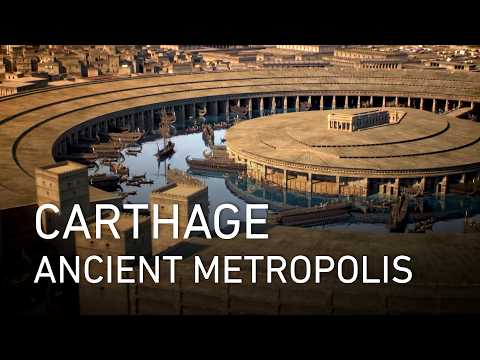 Watch on YouTube →
Overview
Get.factual traces the rise and fall of Carthage from its Phoenician origins in Lebanon around 3000 BC through its founding by settlers from Tyre in the 8th century BC to its destruction by Rome in 149 BC. The documentary highlights Carthaginian innovations including modular prefabricated warship construction, the murex-derived Tyrian purple dye, transatlantic exploration by Hanno and Himilco, and most importantly the 22-character Phoenician alphabet that became the ancestor of Hebrew, Arabic, Greek, Cyrillic, and Latin scripts.
Key takeaways
- Carthaginian shipwrights pioneered industrial modular construction: the 3rd-century BC Marsala wreck shows planks individually labeled with Punic letters so any worker could assemble prefabricated warships at scale.
- The 22-character Phoenician alphabet, developed around 1000 BC, is the direct ancestor of Hebrew, Arabic, Greek, Cyrillic, and Latin scripts — making it arguably the single most consequential Carthaginian export.
- Tyrian purple required harvesting glands from murex sea snails and fermenting them in urine or potash for days, with the liquid passing through lilac, blue, green, and yellow stages before yielding shades from red to violet.
- Hanno sailed past Gibraltar down the West African coast with 60 ships in the early 5th century BC, while Himilco headed north to the Bay of Biscay — making Carthaginians history's first systematic ocean explorers centuries before Greek or Roman equivalents.
- Rome and Carthage coexisted peacefully for centuries with formal treaties; conflict erupted only when Rome grew powerful enough to challenge Carthaginian dominance in Sicily, leading to the Punic Wars.
- Although Rome razed Carthage in 149 BC, Phoenician colonies in Sardinia, Sicily, and Spain survived and were absorbed into the Roman world — meaning Carthaginian urban and commercial DNA persisted within the empire that destroyed it.
Chapters
0:00
Phoenician Origins in Lebanon and Tribute to Assyria
- Phoenicians settled the Lebanese coast around 3000 BC in city-states Byblos, Berytus, Sidon, and Tyre
- Homer coined 'Phoenicians' (purple people) in the Iliad — they had no unified country
- From 1200–700 BC the Assyrian Empire extorted silver and copper tribute; Egypt also demanded tribute from rulers like King Zakar-Baal of Byblos
4:00
The Wenamun Account and Phoenician Independence
- Around 1100 BC the Egyptian priest Wenamun traveled to Byblos seeking free cedar for Amun's cult ship
- King Zakar-Baal refused, demanding gold, silver, ropes, lentils, and 30 baskets of fish
- Marks the moment Egypt's grip weakened and Phoenician traders began dictating terms
7:36
The Founding of Carthage by Elissa (Dido)
- Founded 8th century BC on the Gulf of Tunis at a Mediterranean maritime crossroads
- Legend: Princess Elissa fled her brother Pygmalion of Tyre and tricked a Berber chieftain by cutting a cowhide into thin strips to enclose a large area — Kart-Hadasht ('new city')
- By the 7th century BC cemeteries indicate ~30,000 inhabitants, large by ancient standards
11:00
Carthaginian Government and Trade Network
- Governed by annually elected suffetes (chief magistrates) and a senate, with citizen assembly votes on laws and trade
- Imported silver and salted fish from southern Spain, tin from Galicia and possibly Britain, slaves, and gold/ivory from sub-Saharan Africa via Berber routes
- Exported Tyrian purple cloth, metalware, ceramics, and carved ivory found in graves from Iraq to northern Italy
15:00
Founding of European Cities and Carthaginian Religion
- Phoenicians founded Cadiz (~1100 BC), Malaga, Granada, Cagliari, Trapani, Palermo, and Sorrento
- Pantheon led by El (creator), Astarte (war/love/seafaring), and Baal, with adopted deities Isis and Demeter
- Tophets contained stelae depicting child sacrifice rituals; Greek historian Diodorus reported wealthy families burning newborn sons alive for Baal — debated as fact versus Greek propaganda
21:40
Carthage's Harbor and Modular Warship Construction
- The ring-shaped military harbor housed at least 200 warships around an admiralty island still visible today
- A 3rd-century BC Carthaginian warship found at Marsala in 1969 bore Punic letters marking prefabricated parts for industrial assembly
- Triremes and quinqueremes used multiple banks of rowers, bronze rams, and painted eyes on the bow
27:00
The Battle of the Aegates Islands and Roman Naval Imitation
- 241 BC naval battlefield off Sicily discovered in 2013 yielded 11 bronze rams, helmets, and amphorae across 2 km²
- One ram bears a Punic inscription invoking Baal to destroy enemy ships — Rome won anyway
- Romans were landlubbers who copied a captured Carthaginian ship, later naming the tongue-and-groove plank joint the 'Punic joint'
30:00
Hanno and Himilco: Atlantic Exploration
- Early 5th century BC: Hanno the Navigator sailed 60 ships past Gibraltar down the West African coast, encountering 'fire mountains,' fur-clad attackers, and hairy 'gorillas'
- Carthaginians adopted West African silent trade — laying out goods without direct communication
- Admiral Himilco sailed north into the Bay of Biscay, English Channel, and possibly Scandinavia seeking tin
36:40
Tyrian Purple Dye Production
- Dye extracted from murex sea snail glands, first produced in Lebanon in the 2nd millennium BC
- Pliny the Elder described steeping glands in urine or potash for days; liquid shifts from lilac-blue through greenish to yellow before dyeing
- French artist Inge Boesken Kanold has reproduced the process for 20 years — every batch yields a unique shade from red to deep violet
41:20
The Phoenician Alphabet's Global Legacy
- 22 phonetic characters developed from Ugaritic cuneiform around the end of the 2nd millennium BC replaced complex Egyptian hieroglyphs and Mesopotamian cuneiform
- Spawned Hebrew, Arabic, Greek, Cyrillic, and Latin alphabets — democratizing literacy beyond elite scribes
- Enabled Greek and Roman philosophical and literary works and ultimately all Western written knowledge
45:20
The Punic Wars and Rome's Destruction of Carthage
- Conflict ignited over Sicily as Syracuse allied with Rome against Carthaginian-held western Sicily
- Hannibal crossed the Alps with war elephants in the Second Punic War but was defeated at Zama when his elephants stampeded back into Carthaginian ranks; he later took his own life in exile
- Cato the Elder ended every senate speech with 'Carthage must be destroyed' — in 149 BC Rome besieged, burned, and razed the city
Summary, takeaways, and chapters were generated by AI from the video's transcript and may contain errors. The video belongs to its creator, Get.factual.