The 2025 Nobel Prize in Economics: Explained
 Watch on YouTube →
Overview
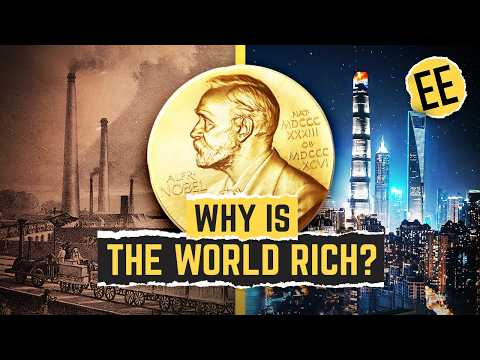
The 2025 Nobel Prize in Economics was awarded to Joel Mokyr, Philip Azion, and Peter Howard for their work explaining innovation-driven economic growth. Mokyr's research highlights that sustained growth requires understanding *why* innovations work, not just discovering them, contrasting pre-industrial "engineering without mechanics" with modern scientific understanding. Azion and Howard developed a framework showing growth is a product of innovation scale and frequency, emphasizing that market competition, intellectual property rights, and social safety nets (like Denmark's flexicurity) are crucial for fostering "creative destruction" and continued progress, particularly relevant for navigating the AI revolution.
Key takeaways
- Sustained economic growth is driven by technological innovation, but requires understanding *why* innovations work, not just their discovery, as highlighted by Joel Mokyr.
- Philip Azion and Peter Howard's framework posits economic growth as a function of the scale of innovations multiplied by their frequency, facilitated by 'creative destruction'.
- Fostering innovation requires a balance: intellectual property protection to incentivize creation, coupled with anti-trust measures to prevent stifling monopolies.
- Social insurance policies, like Denmark's 'flexicurity', are essential for managing the societal impact of creative destruction, making workers more adaptable and supporting innovation.
- The work of the laureates is highly relevant to AI policy, emphasizing the need for understanding, managing disruption, and ensuring fair competition in its development and deployment.
- The Nobel Prize structure, limited to three recipients and not awarded posthumously, struggles to reflect modern collaborative, long-term scientific endeavors.
Chapters
- Nobel Prize in Economics awarded to Joel Mokyr, Philip Azion, and Peter Howard for work on innovation-driven growth.
- Technological innovation since the Industrial Revolution has driven economic output, wealth, and living standards.
- Key contribution: identifying compounding technological progress as an anomaly and understanding its requirements.
- Pre-industrial innovations (printing press, naval architecture) did not lead to sustained growth due to a lack of scientific understanding.
- Mokyr's research shows pre-industrial societies excelled at discovery but not at understanding underlying principles (e.g., metallurgy, soil science).
- The Enlightenment fostered the blending of theoretical knowledge with practical skills, enabling sustained progress.
- Azion and Howard's framework models economic growth as innovation scale multiplied by frequency, enabled by 'creative destruction'.
- Market competition, intellectual property rights, and trust-busting are crucial for balancing innovation incentives and preventing monopolies.
- Social safety nets (e.g., Denmark's flexicurity) are vital for managing job displacement from creative destruction, especially with AI.
Summary, takeaways, and chapters were generated by AI from the video's transcript and may contain errors. The video belongs to its creator, Economics Explained.