Superconducting Qubit Devices, Large-Scale Integration, and Relationship to the Semiconductor -QCE26
 Watch on YouTube →
Overview
Hiu-Yung Wong explains how superconducting qubits work, from Cooper pairs and Josephson junctions to transmon gates, resonator readout, and error correction. He argues that scaling beyond today’s devices depends on solving materials and fabrication problems while applying semiconductor-style design automation, wafer testing, yield management, and modular integration; he discusses chiplets, interposers, and wafer-scale proposals as routes toward systems with hundreds of thousands or millions of physical qubits.
Key takeaways
- A transmon suppresses charge-noise sensitivity by increasing capacitance and lowering charging energy, but this also reduces anharmonicity; a typical design balances those effects around 200 MHz of anharmonicity.
- Superconducting-qubit coherence depends strongly on defects at metal–air, substrate–air, metal–substrate, and Josephson-junction interfaces, so standard semiconductor etching or passivation can harm performance unless adapted to limit defect coupling.
- Quantum-chip scaling requires semiconductor-style control of wafer uniformity, automated junction testing, yield management, and design automation—not just adding more qubits to a layout.
- Resonator-based dispersive readout identifies a qubit state through a state-dependent phase shift, while Purcell filters preserve qubit lifetime by suppressing leakage at the qubit frequency.
- Modular chiplets, tunable couplers, transmission-line links, flip-chip bonding, and silicon interposers offer ways to expand connectivity and yield beyond a single monolithic qubit chip.
- Higher gate fidelity can substantially reduce the number of physical qubits needed for each logical qubit, making materials, fabrication, and calibration improvements directly relevant to the total scale and cost of fault-tolerant machines.
Chapters
0:00
Tutorial Roadmap: Superconducting Qubits and Semiconductor Integration
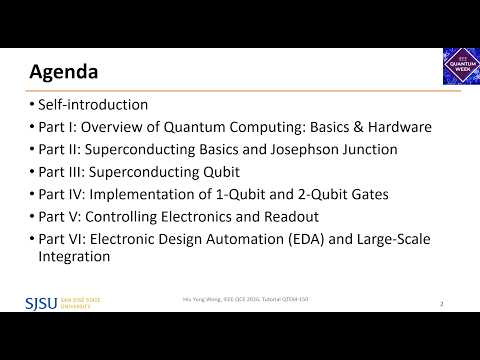
- Hiu-Yung Wong frames the tutorial around superconducting-qubit physics, device realization, integration bottlenecks, and semiconductor-industry connections.
- The program covers qubit fundamentals, Josephson junctions, one- and two-qubit gates, control electronics, and electronic design automation.
- Wong notes that the tutorial has two sessions and includes hands-on demonstrations and design examples.
4:27
Quantum Computing: Gate-Based Circuits, Annealing, and Applications
- Gate-based systems apply a programmed sequence of quantum operations; quantum annealers such as D-Wave systems target energy-minimization problems.
- The tutorial highlights potential applications including molecular and materials simulation, fluid dynamics, secure communication, machine learning, and finance.
- Quantum computing relies on superposition, entanglement, and interference—not simply on representing more bit strings.
7:45
Superposition and the Exponential State Space
- An n-qubit state can be a superposition of 2^n computational basis states, unlike a classical register that stores one basis string at a time.
- Wong uses 300 electron spins to illustrate the scale: 2^300 basis states require roughly 10^90 complex amplitudes for a general state description.
- Quantum parallelism alone does not guarantee a useful answer; algorithms must arrange amplitudes so interference makes measurement informative.
11:17
Measurement Limits and Why Quantum Algorithms Need Interference
- Measurement returns a basis state with probability set by the squared magnitude of its amplitude and does not reveal all amplitudes in one run.
- Repeated measurements can estimate outcome probabilities, but not directly recover the complex phase of every state coefficient.
- Algorithms such as Shor’s and Grover’s exploit interference to concentrate useful outcomes before measurement.
13:14
Entanglement: Correlations That Cannot Be Factored
- A two-qubit state is entangled when it cannot be expressed as independent states for the two subsystems.
- Entanglement creates correlations beyond a simple product-state description and is a resource for quantum computation.
- Wong links entanglement to the need for two-qubit operations in practical quantum circuits.
15:01
Bloch-Sphere Rotations, Hadamard, and CNOT Gates
- Single-qubit gates can be pictured as rotations of a state on the Bloch sphere; the NOT gate exchanges |0⟩ and |1⟩.
- The Hadamard gate turns basis states into superpositions, while CNOT flips the target only when the control is |1⟩.
- Applying CNOT to a superposition can create entanglement, making it a central two-qubit gate.
20:33
Quantum Gates as Timed Microwave Pulses
- A superconducting processor implements gates by applying microwave pulses with selected frequency, phase, amplitude, envelope, and duration.
- A long algorithm is a sequence of control pulses over time, not a chip containing one physical gate circuit for every logical operation.
- Quantum gates are reversible unitary operations; measurement is the step that produces a classical outcome.
25:00
Syndrome Measurement and the Criteria for a Useful Qubit
- The no-cloning theorem prevents copying an unknown quantum state for classical-style repetition-code correction.
- Quantum error correction entangles data qubits with ancillas and measures syndromes to diagnose errors without directly measuring the encoded data.
- Wong lists key hardware requirements: controlled energy levels, initialization, long coherence, universal high-fidelity gates, and accurate measurement.
27:51
Dilution Refrigerators, Thermal Noise, and Scaling Pressure
- Aluminum becomes superconducting below about 1.2 K, but qubits operate near 10 millikelvin because their energy splittings are small and thermal excitation must be suppressed.
- Microwave pulses initialize, manipulate, and read out superconducting qubits; pulse engineering determines operation accuracy.
- Wong cites projections associated with John Martinis to emphasize that qubit-count growth requires innovations in integration and wafer uniformity.
33:06
Superconductor Properties: Critical Temperature and Magnetic Screening
- Superconductors transition to near-zero resistance below a critical temperature; examples include aluminum at roughly 1.2 K and niobium near 9 K.
- The Meissner effect expels magnetic fields through screening currents, distinguishing a superconductor from an ideal zero-resistance conductor.
- Critical magnetic field and penetration depth matter for chip design, including strategies to manage ambient fields and flux.
36:15
Cooper Pairs, Energy Gaps, and Kinetic Inductance
- Electrons form Cooper pairs with opposite spin and momentum; the collective superconducting state is described by a complex order parameter with amplitude and phase.
- Breaking a pair requires energy associated with the superconducting gap, which is linked to critical temperature.
- Superconducting circuits have kinetic inductance from Cooper-pair motion; thinner films and greater penetration depth can increase it.
40:31
Josephson Junctions: Phase-Dependent Current and Inductance
- A Josephson junction is a superconductor–insulator–superconductor structure, commonly aluminum–aluminum oxide–aluminum.
- Its supercurrent depends on the phase difference across the barrier, while voltage drives phase evolution and can produce oscillating current.
- The junction’s nonlinear inductance and Josephson energy make it useful for qubit circuits; normal-state resistance can help screen junction fabrication.
45:10
Quantum Chip Anatomy and the Dolan Bridge Junction Process
- A superconducting chip combines patterned metal, microwave resonators and feedlines, and nanoscale Josephson junctions.
- The Dolan bridge process uses suspended resist, angled aluminum evaporation, in-situ oxidation, a second angled deposition, and lift-off.
- The junction is tiny compared with the surrounding circuit—features are typically on the order of 100–400 nanometers.
49:05
Manhattan Junctions and CMOS-Compatible Fabrication Tradeoffs
- The Manhattan process forms a junction where two angled aluminum depositions cross, with oxidation between depositions.
- Trilayer and other CMOS-like processes can improve dimensional control, but etching and plasma exposure may create defects that reduce coherence.
- Wong stresses that fabrication changes must be evaluated by qubit performance, not only lithographic precision or process familiarity.
53:31
Alternative Junction Processes, Substrates, and Fabrication Questions
- A scaffold-assisted process can shield the junction region during plasma cleaning and later remove the protective material with buffered HF.
- Researchers have explored deposited insulators, two-dimensional materials, and epitaxial barriers to improve interface uniformity and reduce defects.
- High-resistivity silicon is attractive for cost and 300 mm manufacturing compatibility; sapphire is another substrate, with thermal expansion also relevant.
1:04:39
Superconducting Qubit Families and Noise Tradeoffs
- The device landscape includes transmons, fluxonium, Cooper-pair boxes, and other circuit designs with different inductance-capacitance balances.
- Charge noise shifts qubit frequency, while magnetic-flux noise can affect tunable devices and contribute to crosstalk.
- Qubit selection is a tradeoff among noise sensitivity, anharmonicity, gate performance, and integration needs.
1:06:21
Why an LC Oscillator Is Not a Qubit
- At low temperature, an LC resonator has quantized photon-number energy levels, but its harmonic potential spaces those levels equally.
- A microwave pulse addressing the |0⟩→|1⟩ transition can also drive transitions involving higher levels when the spectrum is equally spaced.
- Leakage out of the computational states makes a linear LC oscillator unsuitable as a qubit without added nonlinearity.
1:10:44
Josephson Nonlinearity Creates the Transmon Artificial Atom
- Replacing a linear inductor with a Josephson junction creates a nonlinear, approximately cosine-shaped potential and unequal energy-level spacings.
- The difference between the 0→1 and 1→2 transitions is the anharmonicity; it helps confine control pulses to the computational levels.
- A transmon is an artificial atom whose frequency can be designed by choosing junction energy and circuit capacitance.
1:15:40
From Charge Qubit to Transmon: Suppressing Charge Sensitivity
- A Cooper-pair box encodes information in charge states but is sensitive to background-charge fluctuations that shift its transition frequency.
- Adding a large capacitor lowers charging energy and exponentially suppresses charge sensitivity, producing the transmon regime.
- The tradeoff is reduced anharmonicity; typical designs balance this with a separation on the order of 200 MHz.
1:21:02
Cooper-Pair-Box Simulation and the Charge Sweet Spot
- Wong demonstrates a Cooper-pair-box Hamiltonian simulation and compares energy levels as the ratio of Josephson energy to charging energy changes.
- At a background charge of 0.5, the transition frequency is at a sweet spot with a small first-order response to charge noise.
- In the charge basis, the lowest transmon eigenstates are superpositions of neighboring Cooper-pair-number states rather than simple fixed-charge states.
1:26:31
Flux-Tunable Transmons and Measuring T1 and T2
- A SQUID loop with two Josephson junctions lets magnetic flux tune effective junction energy and qubit frequency.
- T1 measures energy relaxation by preparing |1⟩, waiting, and measuring the decay; T2* characterizes phase coherence through Ramsey-style measurements.
- Wong gives a typical comparison of roughly 50 ns gate times and tens of microseconds of coherence, leaving time for many operations but not eliminating error.
1:30:18
Two-Level-System Defects and Amorphous-Material Loss
- Two-level-system defects can arise from atoms tunneling between configurations in amorphous materials at millikelvin temperatures.
- Their electric dipole moments couple to qubit fields, causing energy loss and decoherence; defect frequencies are random and broadly distributed.
- Because the defects are not confined to a predictable frequency, simply choosing a different qubit frequency cannot reliably avoid them.
1:34:54
Where Qubit Loss Occurs: Interfaces and Junction Barriers
- Important defect regions include metal–air, substrate–air, metal–substrate, and Josephson-junction interfaces.
- Etching, plasma processing, surface oxides, and junction-barrier quality can change how strongly electric fields interact with defects.
- Reducing electric-field participation in lossy interfaces—for example, by removing material from high-field regions—can improve resonator quality factor.
1:40:03
Universal Gate Sets, Fault Tolerance, and Magic-State Distillation
- A universal gate set combines arbitrary single-qubit rotations with an entangling operation such as CNOT.
- Fault-tolerant protocols do not treat every gate equally; the non-Clifford T gate typically requires a magic-state resource.
- Magic-state distillation consumes many lower-fidelity states to produce fewer, higher-fidelity states suitable for fault-tolerant computation.
1:43:55
Driving Single-Qubit Gates with Microwave Phase and Amplitude
- An arbitrary Bloch-sphere rotation can be decomposed into rotations about selected axes, commonly expressed through Euler angles.
- A shaped microwave drive couples to the transmon and produces Hamiltonian terms that implement rotations about X and Y.
- Drive frequency, amplitude, pulse envelope, and phase determine the rotation; the I and Q components set the control axis in the rotating frame.
1:51:07
Direct Transmon Coupling and the iSWAP Gate
- Capacitively coupled transmons can be brought into resonance by tuning one qubit’s flux, enabling excitation exchange.
- Waiting for the required interaction time implements an iSWAP-family operation, which can be combined with single-qubit gates to realize CNOT.
- Frequency sweeps can cross two-level-system defects and expose the qubit to leakage and decoherence.
1:55:09
Resonator Couplers and Long-Range Superconducting Links
- A bus resonator or tunable coupler can mediate interactions without requiring two data qubits to be tuned directly into resonance.
- Switchable coupling can support faster gates and reduce unwanted idle interactions, at the cost of added circuit complexity.
- Transmission lines can connect qubits separated by hundreds of microns or millimeters; a tunable coupler can control when the link is active.
2:04:01
Dilution-Refrigerator Control Stack and Thermal Attenuation
- Room-temperature FPGA and arbitrary-waveform-generator hardware produces low-frequency envelopes that mixers convert to microwave signals, typically in the 2–10 GHz range.
- Signals pass through temperature stages such as 300 K, 4 K, and millikelvin levels, where attenuation reduces thermal noise as well as signal power.
- Readout signals return through cryogenic amplification; scaling this wiring and electronics stack is a major challenge for large qubit counts.
2:07:11
I/Q Modulation for Calibrated Microwave Qubit Pulses
- An arbitrary waveform generator supplies baseband I and Q envelopes, while an IQ mixer combines them with a local oscillator.
- The two channels control microwave amplitude and phase, which set the rotation axis and angle for a single-qubit gate.
- Pulse shaping and calibration are required to deliver the desired signal at the qubit after cryogenic attenuation and filtering.
2:08:26
Dispersive Readout: Inferring Qubit State from Resonator Phase
- A transmon is coupled to a microwave resonator whose effective resonance frequency shifts depending on whether the qubit is in |0⟩ or |1⟩.
- Rather than sweeping frequency during a measurement, the system probes at a selected frequency and distinguishes the state from the phase shift in the transmitted signal.
- I/Q demodulation converts the returning microwave signal into coordinates that can be classified; overlapping noisy distributions cause readout errors.
2:15:41
Quantum-Limited Amplification and Josephson Parametric Amplifiers
- Readout signals are weak, but every amplifier adds noise, so the first amplification stage has a disproportionate effect on signal-to-noise ratio.
- A Josephson parametric amplifier can provide near-quantum-limited first-stage gain, followed by higher-temperature amplifiers for additional gain.
- Parametric amplification pumps energy into a circuit by varying a parameter, analogous to adding energy to a swing at the right point in its cycle.
2:21:49
Purcell Filters and Automated Qubit-Layout Design
- A Purcell filter suppresses qubit-frequency energy leakage into the readout line while allowing the readout-resonator frequency to pass.
- Filter size, shared-line designs, and frequency multiplexing become important layout problems as qubit counts rise.
- Wong demonstrates scripted layout generation with KQCircuits and electromagnetic design workflows using HFSS.
2:29:19
Semiconductor-Style Wafer Testing, Yield, and Qubit Tuning
- Josephson-junction variation changes normal resistance, critical current, and qubit frequency; laser or voltage-pulse annealing can adjust junction properties.
- Wong describes semiconductor-style automated probing and characterization as tools for measuring large populations of junctions and improving uniformity.
- Large chips face yield and defect-management problems familiar from IC manufacturing, while exposed junctions can degrade: one cited process saw 10–20% resistance changes over days.
2:34:48
EDA and Multiphysics Simulation for Superconducting Chips
- The proposed design flow combines atomistic or first-principles studies of materials, defect modeling, and electromagnetic-field simulation.
- Electromagnetic simulations help predict frequencies, field distributions, crosstalk, and field participation at lossy interfaces.
- Black-box quantization and energy-participation-ratio methods connect simulated circuit modes to anharmonicity and qubit-resonator coupling.
2:40:45
From Circuit Parameters to Gate Fidelity and Scalable Design Automation
- Master-equation tools such as QuTiP can include loss mechanisms when simulating gate fidelity, extending ideal Hamiltonian-only calculations.
- Pulse-shape optimization and machine learning can improve readout separation and gate performance using simulated or measured noise.
- Wong argues for higher-level hardware description and automatic layout generation, analogous to semiconductor design automation.
2:44:50
Scaling Constraints: Coherence, Crosstalk, Cryogenic Power, and Throughput
- Higher gate fidelity reduces error-correction overhead: Wong contrasts roughly 250 physical qubits per logical qubit near 99.9% fidelity with much lower counts at 99.99% and above.
- Qubit density must rise without worsening crosstalk, coherence, or fabrication uniformity; long-range quantum interconnects are needed across modules.
- Cryogenic capacity is constrained by heat carried through control wiring, motivating more efficient wiring and control electronics closer to the qubits.
2:51:01
Chiplets, Wafer-Scale Proposals, and the Path to Million-Qubit Systems
- Rigetti’s modular approach uses four nine-qubit chiplets connected through a carrier and routing chip; Wong also notes subsequent demonstrations exceeding 100 qubits.
- Flip-chip bonding and silicon interposers can separate qubit fabrication from classical routing and draw on mature semiconductor packaging methods.
- A wafer-scale proposal targets about 2,000 transmons on a 300 mm wafer, with longer-term concepts reaching millions of physical qubits; Wong closes by emphasizing fabrication yield, quantum links, and semiconductor infrastructure.
Summary, takeaways, and chapters were generated by AI from the video's transcript and may contain errors. The video belongs to its creator, Quantum Computing, TCAD, Semicond by Hiu-Yung Wong.