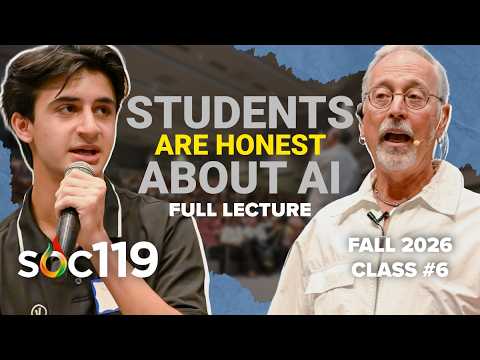
Students Cheating with AI: What a College Professor Really Sees | 26FA Class #06 Full Lecture
 Watch on YouTube →
Overview
SOC 119 examines academic cheating through a discussion with Penn State students Tim Letwin, Megan, Shahmeer, and Hassan, distinguishing small rule-breaking from high-stakes misconduct and exploring how students justify it through pressure, fairness, and the belief that some assessments teach little. The class connects AI tools such as ChatGPT, Claude, and Gemini to learning and academic integrity, citing estimates that 85–90% of undergraduates have cheated and arguing that cheating can disadvantage classmates through grades, curves, and job opportunities.
Key takeaways
- The class cites estimates that 85–90% of undergraduates have cheated and 33–39% have engaged in high-stakes cheating, showing why definitions must account for both minor violations and serious misconduct.
- Using AI to generate practice questions or explain difficult material can support learning, but relying on ChatGPT to produce assignment answers can leave students unprepared for exams and weaken independent skills.
- Cheating can affect classmates even when no direct victim is obvious: SOC 119 links unauthorized attendance codes to stricter grading and reduced curve benefits, with 75 students receiving a one-step grade increase in a prior spring term.
- Students often judge cheating contextually, weighing emergencies, workload, parental expectations, and whether an assessment seems educationally valuable against fairness and academic rules.
- A GPA gained through cheating can create consequences beyond a course by misleading employers and potentially helping one applicant cross a job cutoff at another applicant’s expense.
- SOC 119’s practical guidance is to use readings, videos, and AI as learning resources where allowed, but not to use AI or unauthorized help to answer quizzes and exams.
Chapters
0:00
Penn State Students Introduce Themselves Before Defining Cheating
- The discussion group includes Tim Letwin, a freshman; Megan, an HDFS junior; Shahmeer, a neuroscience freshman from the UK; and Hassan, an industrial engineering sophomore from Saudi Arabia.
- A brief guessing exercise reveals that Megan is from Kazakhstan, illustrating how classmates may make assumptions about one another.
2:33
Cheating as Unauthorized Help and Dishonesty
- Megan defines academic cheating as using outside resources that are not permitted; Shahmeer gives examples such as AI during a prohibited exam or notes hidden on a hand.
- Hassan frames cheating as gaining an unfair advantage through something a student was not allowed to use.
- Students distinguish cheating from dishonesty: falsely claiming attendance with a shared class code is dishonest, while the group debates whether it also counts as academic cheating.
8:41
When Cheating Seems to Benefit the Student
- Hassan argues that cheating can cheat students themselves by replacing learning with a grade and misleading future employers who rely on GPA.
- Shahmeer says an emergency—such as missing study time to take a cat to the vet—could make cheating seem justified, prompting a debate about personal circumstances versus rules.
- Students acknowledge that they have cheated, while the class cites estimates that roughly 90% of students have done so and distinguishes minor acts from buying or stealing academic work.
14:56
Student Identity, Shame, and the Professor’s AI Slide Hypothetical
- Tim says his reaction to cheating depends on context: he feels less troubled by memorization-heavy assessments but feels shame when he exploits a class he values.
- The professor asks whether using AI to generate 20 lecture slides and then testing students on them would amount to the instructor cheating students of meaningful instruction.
- Megan describes justifying cheating in the moment to avoid disappointing her parents, while recognizing that ChatGPT-generated answers do not provide the education she is paying for.
25:43
How One Cheating Incident Shapes the Label “Cheater”
- Megan says a person can honestly acknowledge having cheated without treating that act as their entire identity; she distinguishes a minor lie from stealing an exam.
- The group considers whether one past act makes someone a cheater, a former cheater, or simply a person who has cheated.
- Students also question whether widespread cheating reflects individual choices, a demanding educational system, or both.
27:22
Undergraduate Cheating Rates and Common Exam Misconduct
- The class presents an estimate that 85–90% of undergraduates have cheated, with 33–39% engaging in high-stakes cheating.
- One cited behavior is unauthorized phone or laptop use during exams, reported at 35%; paying someone to complete work is listed at 2%.
- The figures frame cheating as ranging from common low-stakes rule violations to serious misconduct such as stealing an exam or paper.
34:14
ChatGPT for Studying Versus AI-Generated Answers
- Shahmeer supports using AI to explain difficult homework but argues that it should be limited so students do not outsource an entire project.
- Hassan describes using AI to quiz him and generate practice questions, while warning that dependence can weaken students’ ability to work without it.
- Tim argues that AI can be intellectually productive when used to extend one’s thinking; he contrasts that with a classmate who used AI to write nearly all English assignments.
- Megan raises the environmental costs of AI, including the electricity and water used by data centers, and questions delegating routine skills such as writing emails or making grocery lists.
36:03
Old Exams as Study Resources and Instructor Responsibility
- Students say collecting legitimately available past tests and memorizing their answers is resourcefulness, not cheating.
- Hassan argues that if a new exam closely repeats an old one, responsibility lies with the instructor who failed to change the questions.
- The discussion acknowledges that instructors sometimes reuse questions and that creating new assessments takes additional work.
40:47
Political Dishonesty and the Standards Students Set for Themselves
- Students discuss whether dishonesty by powerful adults, politicians, and wealthy people normalizes cheating for younger generations.
- The class considers a political promise of $5,000 for every adult U.S. citizen, which would total about $1.2 trillion for 242 million adults.
- Megan distinguishes cheating on a test from tax fraud, arguing that educational misconduct and large-scale corruption differ in their effects and scale.
47:37
How Attendance-Code Cheating Can Affect SOC 119 Grades
- SOC 119 awards points for attendance, readings, exams, and assignments; the professor says the course is designed so students who complete the work can earn an A.
- After cheating was detected in a prior fall term, the course withheld a curve; in a later spring term, enforcement against attendance-code sharing contributed to 75 students receiving a one-step grade increase through a curve.
- The professor explains that successful cheating can tighten grading policies or reduce curve benefits, disadvantaging classmates who follow the rules.
- Students connect individual acts such as sharing attendance codes to broader consequences, including a classmate missing an A or scholarship threshold.
59:55
Integrity, Student Pressure, and Using AI Outside Exams
- Megan attributes normalized cheating to easy access to information, technology, heavy course loads, overlapping exams, and pressure to balance classes with clubs and social life.
- The professor urges students to complete SOC 119 readings and videos but not use AI to answer exam questions; students ask how that guidance fits with the professor’s own frequent AI use.
- The closing exchange frames integrity as accepting possible sacrifices, while distinguishing AI as a learning aid from prohibited assistance on quizzes and exams.
Summary, takeaways, and chapters were generated by AI from the video's transcript and may contain errors. The video belongs to its creator, SOC 119.