StudentQ&A jjPHY203 FA26
 Watch on YouTube →
Overview
Dr. Yaverbaum reviews one-dimensional kinematics, emphasizing that the five constant-acceleration equations apply separately to each time segment and that free fall has constant downward acceleration even when an object is moving upward. The Q&A clarifies what belongs in a physics solution’s Step 3 and outlines the Homework 5 “Big Old Duck” strategy: solve vertical motion for time, then use that time to determine the duck’s horizontal position, accounting for its initial half-second of constant velocity.
Key takeaways
- With upward defined as positive, gravity is −10 m/s² throughout an entire up-and-down free-fall trip, even while the object’s velocity is positive.
- For theoretical problems, 10 m/s² is a standard approximation for g; 9.8 m/s² and 32 ft/s² are unit-dependent alternatives, while labs should reflect instrument precision.
- In the course’s problem-solving method, Step 3 states a general definition, law, or principle; givens belong in Step 1, and problem-specific equation manipulation belongs in Step 4.
- A physics diagram should label every variable or constant used in Step 4; for an algebra-only exercise, a table of givens, goals, and principles can provide the needed visual structure.
- In the Big Old Duck problem, solve the projectile’s vertical equation for time first, then use that time to determine the duck’s horizontal displacement.
- The duck covers 10 m during its initial 0.5 seconds at 20 m/s; calculate its later accelerated motion using the remaining time, and evaluate both quadratic time roots.
Chapters
0:00
Class Check-In and Homework Revision Backlog
- Dr. Yaverbaum welcomes students and notes that the Wednesday homework is due soon.
- About eight students have submitted revisions that Dr. Yaverbaum has not yet returned; the delay is an instructor backlog, not a sign that the revisions were incorrect.
- Students may submit another revision later, even if an earlier revision does not yet recover all available points.
4:50
One-Dimensional Kinematics: Definitions and Constant-Acceleration Equations
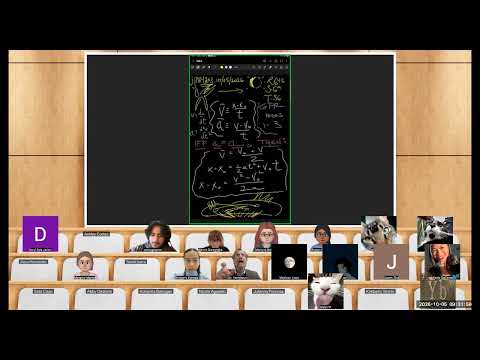
- Dr. Yaverbaum presents a board summary of one-dimensional kinematics rather than a numbered list to memorize.
- The first two white equations are definitions that remain true generally; the next three follow when acceleration is constant.
- Instantaneous velocity is defined as the derivative of position with respect to time, and instantaneous acceleration as the second derivative of position.
8:36
Free-Fall Acceleration: Why Constancy Matters More Than the Number
- Near Earth’s surface, an unattached object unaffected significantly by drag experiences approximately constant acceleration, labeled lowercase g.
- The familiar value 9.8 m/s² depends on units; equivalent approximations include 32 ft/s² and 22 miles per hour per second.
- For theoretical homework and exams, 10 m/s² is a standard rounded value; labs should use precision appropriate to the equipment.
- The upcoming “Big Old Duck” assignment problem is presented as a challenging application of existing concepts, not a source of new concepts.
13:40
Free Fall on an Up-and-Down Trip: Keep Acceleration’s Direction Fixed
- Free fall describes motion while an object is unattached near Earth, whether it travels upward, downward, sideways, or along an arc.
- If upward is chosen as positive, gravity is negative throughout the trip, including while an object is rising.
- An object thrown upward at +50 m/s can have velocity values that decrease through +40, +30, …, 0, then become negative while acceleration remains negative.
- Choosing positive and negative directions is part of the coordinate system, consistent with the course’s discussion of Galileo’s principle of relativity.
18:20
Breakout-Room Review: Turn Broad Confusion into Specific Questions
- Dr. Yaverbaum organizes a Q&A review and asks each breakout group to identify one concrete question.
- Students are encouraged to specify a particular homework part or concept rather than request a review of an entire assignment.
- Groups get roughly 10–15 minutes to compare questions, help one another, and choose an issue still worth bringing to the class.
26:10
Q&A Opens with the Big Old Duck and Diagram Questions
- A student asks how initial velocity, initial position, and displacement fit together when setting up the Homework 5 “Big Old Duck” problem.
- Dr. Yaverbaum calls the question appropriate for the course’s current level and says the problem is a useful exam-preparation example.
- Another student asks what counts as an acceptable diagram for the algebra-focused final part of Homework 4.
29:10
Physics Diagrams: Label Variables or Use a Table for Pure Algebra
- For a purely algebraic Homework 4 problem, a visual table of givens, goals, and mathematical principles can substitute for a conventional physical sketch.
- In general, a useful diagram should define the quantities used later: every variable or constant appearing in Step 4 should first appear as a diagram label.
- Dr. Yaverbaum says a diagram should clarify the setup and break up pages of equations and text.
34:15
Step 3 in the Problem-Solving Method: State the Physics, Not the Given Values
- Step 3 should state a fundamental definition, law, or principle that is true independently of the particular problem; listing problem givens belongs in Step 1.
- Starting to rearrange an equation for the problem—for example, turning a definition into a problem-specific velocity equation—is Step 4 work, not Step 3.
- The course’s equation summary is a guide to Step 3 choices; common constant-acceleration equations may be used if their underlying assumptions are stated.
- Dr. Yaverbaum recommends doing Steps 1 and 2 first, then selecting the relevant fundamental principle before beginning calculations.
44:20
Big Old Duck Setup: Use Vertical Projectile Motion to Find the Time
- The Homework 5, Problem 6 setup combines a projectile fired upward at 30 m/s with a duck moving horizontally; the two motions must coincide at the same place and time.
- With upward positive, use an initial vertical velocity of +30 m/s and gravitational acceleration of −10 m/s².
- For the projectile’s vertical motion, use the constant-acceleration displacement equation with the given 40 m height to solve for elapsed time.
- Once the time is known, use it to calculate the duck’s horizontal position; the horizontal and vertical motions can be treated as separate one-dimensional problems.
51:30
Big Old Duck Details: Account for the Duck’s First Half-Second and Both Roots
- The duck first travels at a constant 20 m/s for 0.5 seconds, covering 10 m before its acceleration phase begins.
- For the accelerated portion, use the projectile’s elapsed time minus 0.5 seconds, then add the initial 10 m to the duck’s later displacement.
- The vertical equation is quadratic and produces two valid times for reaching 40 m—one on the way up and one on the way down.
- Dr. Yaverbaum plans to work through the calculations and both resulting placements in the next class.
Summary, takeaways, and chapters were generated by AI from the video's transcript and may contain errors. The video belongs to its creator, Dr. Yaverbaum.