Story Problems, BIO105 Introductory Biology, David Champlin, USM
 Watch on YouTube →
Overview
David Champlin explains how to identify dominant–recessive inheritance, incomplete dominance, and codominance, emphasizing that genotype-to-phenotype rules determine what can be inferred from breeding problems. Sheep and hamster examples show when offspring probabilities are knowable, while true-breeding flower crosses introduce parental, F1, and later generations.
Key takeaways
- In dominant–recessive inheritance, a dominant-appearing organism may be homozygous or heterozygous, so its phenotype alone may not reveal whether it carries a recessive allele.
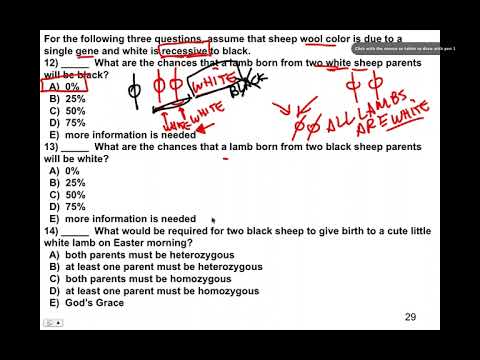
- Two white sheep with white fleece recessive to black must both be homozygous recessive, making black lambs impossible from that cross.
- A white lamb from two black sheep is possible only if both black parents are heterozygous carriers; without their genotypes, the probability cannot be specified.
- Incomplete dominance makes heterozygotes visibly intermediate, as in tan hamsters from brown and white alleles, so the heterozygote is not a hidden carrier.
- A cross between two tan heterozygous hamsters yields a 25% chance of white offspring under the stated single-gene inheritance model.
- True-breeding parental plants are homozygous, and crossing distinct true-breeding forms produces heterozygous F1 offspring.
Chapters
0:00
Three Allele Relationships and Other Inheritance Patterns
- Dominant–recessive inheritance makes a heterozygote resemble the dominant homozygote; incomplete dominance produces an intermediate phenotype such as pink flowers.
- Codominance expresses both alleles at once, illustrated by red-and-white coloration rather than a blended pink.
- Multiple alleles describe variation across a population, as with blood types, while pleiotropy occurs when one gene affects multiple traits.
2:08
Sheep Crosses: Hidden Recessive Alleles and Uncertain Outcomes
- If white fleece is recessive to black, a white sheep must have two white alleles; two white parents therefore have a 0% chance of producing a black lamb.
- Black sheep can be either homozygous dominant or heterozygous, and their matching appearance means two black parents’ chance of a white lamb cannot be determined without genotype information.
- A white lamb from two black parents requires both parents to be heterozygous carriers of the recessive white allele.
8:20
Incomplete Dominance, Hamster Fur, and True-Breeding Crosses
- With incomplete dominance, brown and white hamster-fur alleles produce tan heterozygotes, so there is no hidden allele or carrier phenotype.
- Two tan hamsters can produce brown, tan, or white offspring; a tan-by-tan cross has a 1-in-4, or 25%, chance of white offspring.
- Two brown hamsters cannot produce a white offspring in this example, unlike dominant–recessive crosses where a recessive allele may be hidden.
- True-breeding purple- and white-flowered plants are homozygous; crossing them produces heterozygous F1 offspring, setting up later-generation inheritance analysis.
Summary, takeaways, and chapters were generated by AI from the video's transcript and may contain errors. The video belongs to its creator, The New Evolution for Everyone.