Stanford AA203 Optimal and Learning-Based Control | Spring 2026 | Lecture 14: Intro to IL and RL
 Watch on YouTube →
Overview
Stanford Online's Lecture 14 introduces Imitation Learning (IL) and Reinforcement Learning (RL) as key components of modern control and autonomous systems, moving beyond classical methods. The lecture details how IL, particularly behavior cloning, learns from expert demonstrations, while RL learns through trial-and-error by maximizing rewards. It highlights their distinct approaches, applications in robotics and autonomous driving (e.g., Nvidia's AlphaFold), and their integration into complex training pipelines, contrasting them with traditional supervised learning.
Key takeaways
- Imitation Learning (IL) directly learns a policy from expert demonstrations, while Reinforcement Learning (RL) learns through trial-and-error by maximizing a reward signal.
- Behavior Cloning, a type of IL, maps states to actions by minimizing prediction error against expert data, but is limited by expert performance and compounding errors.
- Reinforcement Learning excels at discovering novel solutions and optimizing complex objectives, as demonstrated by successes in games (AlphaGo) and robot locomotion.
- RL algorithms operate within the Markov Decision Process (MDP) framework, aiming to maximize expected discounted future rewards.
- Value functions (state-value V and action-value Q) are central to RL, with optimal Q-functions providing a direct mechanism for selecting the best action.
- Modern autonomous systems often employ scaffolded training pipelines, integrating supervised learning, Imitation Learning, and Reinforcement Learning at different stages.
Chapters
0:00
Recap of Learning-Based Control: System ID and Adaptive Control
- Learning-based control relaxes assumptions about known system dynamics.
- System Identification (Sys ID) uses data to approximate system models.
- Adaptive Control, like MRAC, adjusts controller parameters to track a reference signal.
9:00
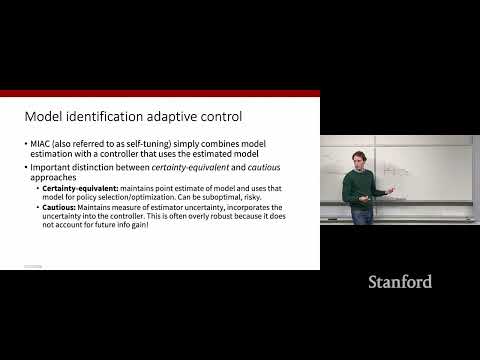
Model Identification Adaptive Control (MIAC)
- MIAC uses system identification as an inner loop for control.
- Combines model estimation with a controller that uses the estimated model.
- Distinguishes between certainty-equivalent (point estimate) and cautious (distributional estimate) approaches.
12:21
Comparison of MRAC and MIAC
- MRAC parameters update to minimize tracking error.
- MIAC parameters update to minimize data fitting error.
- MIAC offers flexibility but requires good parameter estimates; MRAC guarantees stability by design.
14:16
Introduction to Imitation Learning (IL) and Reinforcement Learning (RL)
- Transition from classical control to active research areas in control and autonomous systems.
- IL and RL are foundational for end-to-end pipelines in robotics and autonomous driving.
- Applications include robot manipulation, autonomous driving (Nvidia AlphaFold), and LLM alignment.
18:52
Framework for Learning Control: From State to Action
- Classical methods aim for optimal control by understanding system dynamics.
- IL and RL frame the state-to-action problem as a learning task.
- IL learns from demonstrations; RL learns from trial-and-error with reward signals.
21:48
Imitation Learning: Learning from Demonstrations
- Learns by approximating a mapping from states to decisions (actions).
- Requires data sets of state-decision tuples from an expert.
- Demonstrations represent examples of good behavior in specific states.
22:28
Reinforcement Learning: Learning by Trial and Error
- Learns by pairing states with a score or metric indicating action quality.
- No explicit teacher; relies on a measure of how good an action is.
- Goal is to try strategies and find the most rewarding one.
25:00
Limitations of Imitation Learning
- Performance is bounded by the quality of expert demonstrations.
- Small prediction errors can compound over time, leading to distribution shift.
- Requires careful consideration of data quality and potential for improvement.
27:34
Supervised Learning Fundamentals
- Learning a mapping f from input X to output Y.
- Uses data in the form of input-output pairs (x, y).
- Approximation often involves minimizing error (e.g., sum of squared errors) or maximizing likelihood.
38:54
Imitation Learning: Transferring Skills from Expert to Learner
- Expert is typically a human operator or existing policy; learner is the policy to be approximated.
- Data collected from expert actions (controls) in observed states.
- Goal is to map states to controls, minimizing error against expert actions.
41:43
Two Families of Imitation Learning Approaches
- Behavior Cloning: Directly learns the policy mapping states to controls.
- Inverse Optimal Control (Inverse Reinforcement Learning): Approximates the reward/objective function the expert optimizes.
- Behavior cloning minimizes state-control prediction error; IRL estimates a reward function.
48:21
Behavior Cloning: Mimicking Expert Behavior
- Trains a policy using supervised learning on expert demonstration data.
- Early example: 1980s CMU study mapping camera images to steering angles for autonomous driving.
- Problem: prediction errors compound over time, leading to distribution shift.
1:00:11
Inverse Reinforcement Learning (IRL) for Generalizable Goals
- Recovers the reward function from policy demonstrations.
- Example: Warehouse robot navigation; IRL learns a reward function (e.g., closer to goal is good) for generalizability.
- Contrast with behavior cloning, which directly imitates trajectories.
1:03:30
Reinforcement Learning (RL) Formalism
- Decision-making formalism for learning from experience via an agent-environment interaction loop.
- Agent observes state, takes action, environment returns new state and reward.
- Interaction unrolls into trajectories (states, actions, rewards) used to improve the policy.
1:07:05
Key RL Terminology: Policy, Environment, Reward, Value Functions
- Policy: State-to-action mapping (often a distribution over actions).
- Environment: System the agent interacts with (dynamics P(s'|s,a)).
- Reward: Scalar measure of immediate success (R(s,a)).
- Value Function: Long-term performance measure (expected future discounted reward).
Summary, takeaways, and chapters were generated by AI from the video's transcript and may contain errors. The video belongs to its creator, Stanford Online.