Solving an AIME functional equation (how do we "guess" a solution)
 Watch on YouTube →
Overview
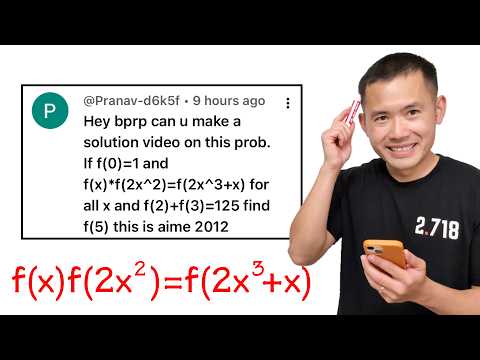
blackpenredpen solves AIME 2012 Problem 14 by using the factorization 2x³ + x = x(2x² + 1) to motivate a power-function guess, then adjusting the input to x² + 1 after an initial linear-shift guess fails. The resulting form f(x) = (x² + 1)^n gives 5^n + 10^n = 125, so n = 2 and f(5) = 676; the approach checks this candidate but does not formally rule out other functions.
Key takeaways
- Factoring the right-side input as 2x³ + x = x(2x² + 1) exposes the multiplicative pattern that motivates a power-function ansatz.
- The first shifted guess, (x + 1)^n, fails because multiplying its bases creates an extra 2x² term.
- The adjusted guess f(x) = (x² + 1)^n works because (x² + 1)(4x⁴ + 1) equals (2x³ + x)² + 1.
- The side condition reduces to 5^n + 10^n = 125, which is satisfied by n = 2.
- With the proposed function f(x) = (x² + 1)², the requested value is f(5) = 26² = 676.
- Matching a guessed formula and the given values establishes a candidate solution, but a complete uniqueness argument would need to exclude other functions.
Chapters
0:00
AIME 2012 #14: Factor the Functional Equation’s Input
- The equation is f(x)f(2x²) = f(2x³ + x), with f(0) = 1 and f(2) + f(3) = 125; the goal is f(5).
- Factoring 2x³ + x as x(2x² + 1) reveals a product structure resembling the two inputs on the left.
- blackpenredpen motivates trying a power function because multiplying powers combines their inputs, unlike multiplying logarithms or exponentials.
1:55
Why the Initial Guess (x + 1)^n Does Not Match
- A trial form based on shifting the input by 1 gives factors (x + 1)^n and (2x² + 1)^n.
- Their combined base introduces an unwanted 2x² term, so it does not match the base from f(2x³ + x).
- The mismatch suggests changing the input’s power rather than abandoning the power-function strategy.
5:00
The Square-Input Guess Determines f(5) = 676
- Trying f(x) = (x² + 1)^n produces the matching identity (x² + 1)(4x⁴ + 1) = (2x³ + x)² + 1.
- Evaluating at 2 and 3 gives f(2) = 5^n and f(3) = 10^n, so the condition becomes 5^n + 10^n = 125.
- Taking n = 2 yields 25 + 100 = 125, hence the proposed function is f(x) = (x² + 1)².
- Substitution at x = 5 gives f(5) = (25 + 1)² = 676; the presentation verifies the candidate but does not prove uniqueness.
Summary, takeaways, and chapters were generated by AI from the video's transcript and may contain errors. The video belongs to its creator, blackpenredpen.