SOC 220 - Sept 24
 Watch on YouTube →
Overview
Jeff Brassard explains survey and questionnaire design as a central method in sociology, comparing open-response questions with fixed-answer formats and showing how each affects data analysis, respondent effort, and completion rates. He gives practical rules for writing clear, answerable questions—including avoiding ambiguity, double-barreled or leading wording, checking respondents’ knowledge, and testing drafts—relevant to mini-assignment three and the larger survey assignment.
Key takeaways
- Closed questions are usually more efficient than open responses because they arrive pre-categorized, take less time to answer, and support higher completion rates.
- Use open-response items selectively: they can expose unanticipated views and inform answer choices in a pilot study, but they demand more respondent effort and researcher coding.
- Capture precise personal facts when possible: asking for age or year of birth preserves more information than broad age bands, while a full date of birth may be unnecessarily intrusive.
- A survey question should measure one clearly defined concept; split “interesting and informative” or “pay and working conditions” into separate items so respondents can answer each independently.
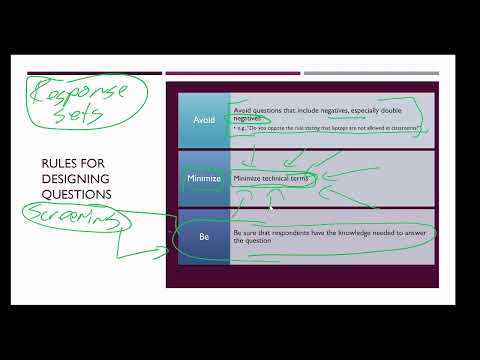
- Use screening and skip logic to ensure respondents can answer from experience, such as asking about a motor-vehicle accident before collecting opinions on Alberta’s insurance-claims process.
- Translate specialist language into plain terms and test questions with non-specialists; Brassard’s Catholic social teaching example became more accessible when “care for creation” was reframed as caring for the environment.
Chapters
0:00
Survey Research as a Core Sociological Method
- Jeff Brassard identifies surveys, also called questionnaires, as the most commonly used research method in sociology and political science.
- He notes that the class is ahead of schedule for covering quantitative methods before the midterm.
- Survey-question writing will be practiced in mini-assignment three and the larger course assignment.
3:30
Open Responses Versus Fixed-Answer Questions
- Open questions let respondents answer in their own words; in a structured interview, an interviewer might record the response to a prompt about lawn-mower noise near campus classrooms.
- Closed questions provide fixed alternatives for respondents to select, including Likert-scale items.
- Open responses typically require later transcription or coding, while closed responses arrive in a more analysis-ready form.
6:15
Why Surveys Usually Favor Closed Questions
- Closed questions are generally faster for both respondents and researchers because answers are already categorized.
- Long or demanding surveys increase dropouts; repeated response sets can help respondents move through questions quickly.
- Open questions can reveal unanticipated views and help pilot studies generate answer choices for a later main survey.
- Open responses can also be time-consuming, rambling, and harder to code, reducing completion rates.
15:23
Closed-Question Benefits and Common Sources of Error
- Fixed answers reduce variation between interviewers and can clarify what a question is asking; they also let researchers measure more indicators quickly.
- Poor wording and jargon can produce inconsistent answers, lowering reliability and validity.
- Respondents may misunderstand questions or misremember specific events; asking how often a behavior occurs in a typical week can be better than asking what someone ate on a particular Wednesday three weeks earlier.
- In interviewer-administered surveys, errors can arise from misreading questions, tapping the wrong iPad response, or entering paper answers incorrectly.
22:18
Where Fixed Answer Choices Fall Short
- Closed formats lose the spontaneity of open responses and cannot surface categories the researcher did not anticipate.
- Respondents may interpret complex answer choices differently or find that none applies to them.
- An “Other” option, sometimes paired with a text box, can capture answers missing from the fixed response set.
24:20
Personal Facts and Questions About Other People
- Personal factual questions can cover age, occupation, cars, marital status, and children; Brassard recommends collecting an exact age or year of birth rather than arbitrary age bands.
- Year of birth preserves more detail than categories such as ages 18–25 or 26–30, while avoiding the intrusiveness of asking for a full date of birth.
- Questions about other people’s facts, such as a neighbor’s age or when Mark Carney graduated from high school, risk asking respondents to guess.
- Opinions about other people, companies, or events are more appropriate than assuming respondents know specific facts about them.
29:50
Measuring Attitudes, Beliefs, and Knowledge
- Attitude surveys commonly present a statement and ask respondents to rate agreement, often on a strongly agree-to-strongly disagree Likert scale.
- Belief questions can address topics such as God, residential schools, or Canada’s free-trade agreement; religion surveys may use choices ranging from belief with absolute certainty to disbelief with doubts.
- Knowledge questions can measure awareness of a policy, brand, or campaign, especially in marketing and government research.
- A knowledge item can assess whether respondents have heard of an initiative, while a follow-up can measure what they know about it.
34:48
Keep Each Question Tied to the Research Goal
- For every item, ask what the research project needs to know and how that particular question helps answer the larger research question.
- Measure the specific concept: for household living costs, ask how many children live at home rather than how many children a respondent has.
- For standard of living, disposable income or whether a mortgage is still being paid can be more informative than total income or a simple home-ownership question.
- Test draft questions with a trusted, non-specialist respondent to check whether they understand the item and can choose an answer.
39:30
Avoid Ambiguity, Double Barrels, and Leading Wording
- Define potentially ambiguous terms such as income; specifying household income before taxes reduces confusion about whose earnings or which deductions count.
- Keep questions compact: multi-sentence prompts can work, but long paragraphs make the focus harder to follow and may increase survey dropouts.
- A double-barreled item such as “interesting and informative” cannot distinguish respondents who found a class informative but boring; split it into two questions.
- Avoid vague prompts such as “What do you think of the prime minister?” and leading wording such as asking whether the monarchy should end after emphasizing its taxpayer cost.
48:40
Use Screening and Survey Routing for Relevant Answers
- Do not ask respondents to rate an experience they have not had; someone who has never read a Stephen King novel cannot meaningfully rate the novels.
- First ask whether the respondent has read the novels, then route “yes” respondents to the rating item and “no” respondents past it.
- Online surveys can use “if yes, continue; if no, skip” logic to prevent irrelevant questions.
- For opinions about Alberta’s motor-vehicle insurance claims process, a screening item could establish whether someone had an accident in the last five years.
52:06
Negative Wording as a Check on Response Sets
- Positive statements are usually easier to interpret than negatively phrased or double-negative questions.
- A survey might state “I support rules banning cell phones from classrooms” and later include an inverse statement to compare responses.
- Contradictory answers to items about classroom phone bans can indicate a response set—such as rushing through with repeated answers or not paying attention.
- Statistical software such as SPSS, Stata, or R can help identify inconsistent responses when researchers design checks into the questionnaire.
56:12
Translate Jargon and Confirm Respondent Knowledge
- Brassard’s survey for Catholic organizations showed how insider language such as “care for creation” can confuse the general public; a clearer item asks how important it is to take care of the environment.
- To simplify specialist language, identify the core idea being measured and express it in the simplest words respondents are likely to understand.
- Screening questions establish whether respondents have the experience or knowledge needed for a later item.
- Brassard ends class early because he is losing his voice, noting that the course remains ahead of schedule and will resume the following Tuesday.
Summary, takeaways, and chapters were generated by AI from the video's transcript and may contain errors. The video belongs to its creator, Jeff Brassard.