SOC 220 - Sept 17
 Watch on YouTube →
Overview
The lecture finishes research ethics by explaining participant welfare, privacy, confidentiality, covert research, and the limits of a researcher’s duty to report. It then introduces quantitative operationalization: turning concepts such as religiosity, loneliness, and depression into measurable variables through carefully designed questions, validated instruments, multiple indicators, and correctly structured Likert scales.
Key takeaways
- Researchers should explain confidentiality limits in consent materials before data collection, especially when a study could reveal child abuse, self-harm risk, or a specific threat to another person.
- Online information is not automatically public: private messages and closed-group discussions require confidentiality protections, while public posts are treated differently.
- Operationalization is the step where an abstract concept becomes a measure; a study of loneliness can use the 20-item UCLA Loneliness Scale instead of asking only whether respondents feel lonely.
- Self-identification alone may be a weak measure: religious identity can persist without service attendance, so researchers can pair it with behavioral indicators such as prayer and attendance frequency.
- Multiple indicators make social-science data more nuanced and help identify response sets, misunderstandings, and differences in how individual behaviors relate to outcomes.
- A Likert agreement scale should follow a statement, not an open-ended question, and every response option must consistently describe the same dimension of agreement.
Chapters
0:00
Research Ethics: Welfare, Privacy, and Confidentiality
- The three central ethics principles are respect for persons, concern for welfare, and justice.
- Welfare includes avoiding harm and embarrassment, protecting privacy, and maintaining confidentiality.
- Qualitative researchers may need to alter locations, relationships, and other identifying details in write-ups.
4:00
Why Covert Research Raises Consent and Intrusion Concerns
- Covert research hides the researcher’s identity, which can elicit details participants might not share if they knew their activities were being studied.
- Past examples include researchers posing as gay men in spaces frequented by gay men, an approach now regarded as ethically problematic.
- Because covert participants cannot provide informed consent, the benefits must substantially outweigh potential harm and ethics-board approval can be difficult.
7:30
Duty to Report: Abuse, Vulnerability, and Specific Threats
- Researchers may have reporting obligations concerning child abuse, mistreatment of vulnerable people, and credible threats of self-harm.
- A general statement about past or possible crime is different from a specific plan that could put an identifiable person at risk.
- A plan to harm a named person may trigger a duty to report, while a vague statement about selling drugs may not.
13:30
Consent Letters, Confidentiality Limits, and Researcher Boundaries
- Information and consent letters should explain the circumstances in which confidentiality may be breached, such as specific threats or child abuse disclosures.
- Researchers working with incarcerated or criminally involved participants should refuse favors such as transporting items or messages.
- The lecture cautions researchers never to have sexual relationships with participants or conspire with them to commit crimes.
15:44
Online Research: Private Messages Versus Public Posts
- Email, direct messages, and text messages remain private communications and are covered by confidentiality expectations.
- Public social-media posts, YouTube comments, and publicly available message-board content can generally be studied without treating them as private communications.
- Researchers should not infiltrate closed WhatsApp groups or other private forums for covert research without ethics approval, and should consider encryption for stored data.
19:53
Justice, Risk-Benefit Review, and Researcher Misconduct
- Potential research harms should not outweigh potential benefits; participants should be warned in consent materials about upsetting content.
- The lecture recounts a graduate student being expelled after sleeping with a research participant, emphasizing the ethical boundary.
- A separate drug-related case illustrates that university discipline and criminal liability may be treated differently; researchers should not mistake that distinction for permission to participate.
28:08
Quantitative Research: Positivism, Hypotheses, and Measurement
- Quantitative research is described as positivist and objectivist: it assumes a measurable external world and uses data to test hypotheses.
- Its deductive process moves from theory to hypotheses, research design, measurement, data collection, and analysis.
- Measurement validity—whether a measure captures the concept it is intended to capture—is a central concern.
30:50
Operationalization: Turning Concepts into Survey Measures
- Operationalization converts an abstract concept into measurable variables or specific survey and interview questions.
- For a study of generational secularization, researchers must decide how to measure religious belief, adherence, or intensity.
- A usable operationalization specifies what information a survey will collect rather than leaving a concept as an abstract idea.
34:05
Religiosity’s Three B’s and the Limits of Self-Identification
- Sociology of religion commonly examines belief, behavior, and belonging as three dimensions of religiosity.
- Survey items can ask how religious respondents consider themselves or whether they identify with a religious group.
- Self-identification can be imprecise: someone may still identify as Catholic despite not attending church for decades.
38:30
Behavioral Indicators for Religiosity, Depression, and Student Commitment
- Religious-service attendance, prayer, sacred-text reading, and participation in religious activities provide behavioral measures alongside self-identification.
- Attendance questions should distinguish voluntary participation from weddings or funerals and use clear frequency options such as weekly or several times a month.
- For student commitment, attendance, study hours, and on-time assignment submission can be more informative than asking whether someone is a good student.
- Asking only “Are you depressed?” can misclassify respondents because people may misunderstand depression or fail to recognize clinical symptoms.
44:50
Concepts, Independent Variables, and Dependent Variables
- Concepts are ideas about social phenomena, including emotional labor, secularization, academic achievement, and charismatic leadership.
- In a question about religiosity’s effect on happiness, religiosity is the independent variable and happiness is the dependent outcome.
- Survey researchers usually measure these variables at different levels rather than manipulating them experimentally.
48:30
Nominal Definitions: State What a Concept Means
- A nominal definition gives the meaning of a concept, much like a dictionary definition, without specifying how it will be measured.
- Political-party identification can be defined as the party with which a person most closely associates.
- A nominal definition of happiness describes the concept; it does not yet identify survey questions or measurement procedures.
52:50
Operational Definitions and Validated Measures
- An operational definition states exactly how a study will measure a concept, such as asking a specific political-party identification question.
- For loneliness, a researcher can administer the 20-item UCLA Loneliness Scale rather than relying on a single question such as “Are you lonely?”
- Existing validated question sets for concepts such as loneliness, depression, or ADHD can improve measurement quality; researchers should cite the instrument they use.
- A proposed measure of depression based on showering or cooking frequency is less defensible than a validated psychological instrument.
1:00:00
Multiple Indicators, Response Sets, and Survey Quality Checks
- Each survey question can serve as an indicator: class attendance, weekly study hours, and reading time can each reflect study habits.
- Multiple indicators provide richer data, reduce misclassification from misunderstood questions, and support methods such as factor analysis and multivariate regression.
- Response sets occur when respondents rush, select the same option repeatedly, or answer randomly; online panels may encourage this when participants earn points or rewards.
- Survey checks can include attention items such as identifying which option is not an animal, or carefully designed reverse-worded statements.
1:12:06
Likert Scales: Use Statements and Consistent Response Options
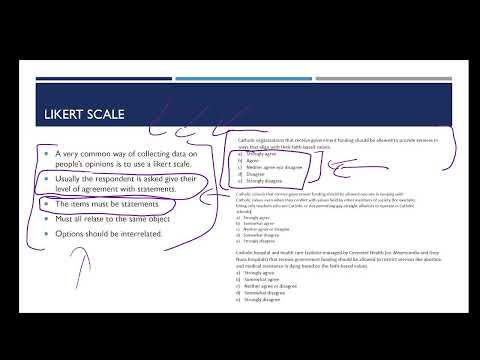
- Likert scales commonly measure agreement from strongly agree to strongly disagree and are widely used in political and social research.
- Items must be statements: “Danielle Smith is a charismatic leader” works with an agreement scale, while “How do you feel about Danielle Smith?” does not.
- Response choices must form a consistent scale and fit the statement; reading each item aloud with its answer options is a simple way to test whether it works.
Summary, takeaways, and chapters were generated by AI from the video's transcript and may contain errors. The video belongs to its creator, Jeff Brassard.