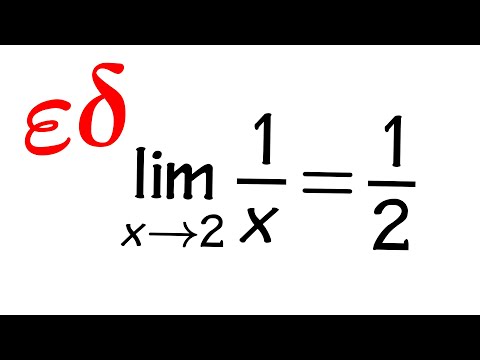
Simple limit but most students cannot prove it!
 Watch on YouTube →
Overview
blackpenredpen proves that \(\lim_{x\to 2}1/x=1/2\) directly from the epsilon-delta definition, without imposing the usual preliminary \(\delta\leq 1\) restriction. The proof uses the reverse triangle inequality to establish a lower bound on \(|x|\), then chooses \(\delta=4\epsilon/(1+2\epsilon)\) and verifies that the resulting error is less than \(\epsilon\).
Key takeaways
- For the limit of \(1/x\) at \(x=2\), the error simplifies to \(|x-2|/(2|x|)\), making a lower bound on \(|x|\) essential.
- The reverse triangle inequality \(||x|-2|\leq|x-2|\) yields \(|x|>2-\delta\) under the epsilon-delta assumption.
- Taking reciprocals in an inequality requires attention to signs; choosing \(\delta<2\) ensures the lower bound \(2-\delta\) is positive.
- Solving \(\delta/[2(2-\delta)]=\epsilon\) produces the explicit choice \(\delta=4\epsilon/(1+2\epsilon)\).
- The chosen delta is positive and strictly less than 2 for every positive epsilon, so the proof works without separately requiring \(\delta\leq1\).
Chapters
0:00
Rewrite the Limit Error and Identify the Denominator Problem
- Start with an arbitrary \(\epsilon>0\) and assume \(0<|x-2|<\delta\), aiming to bound \(|1/x-1/2|\).
- Algebra gives \(|1/x-1/2|=|x-2|/(2|x|)\), so the numerator is less than \(\delta\).
- The denominator requires a lower bound on \(|x|\); the ordinary triangle inequality only gives an upper bound, which is not useful after taking reciprocals.
4:00
Use Reverse Triangle Inequality to Bound \(|x|\) Below
- Apply \(||x|-2|\leq|x-2|\), the reverse triangle inequality with the values \(x\) and \(2\).
- The inequality implies \(|x|\geq 2-|x-2|>2-\delta\), using the assumption \(|x-2|<\delta\).
- When \(\delta<2\), the lower bound \(2-\delta\) is positive, allowing reciprocal inequalities to be used safely.
- Combining numerator and denominator bounds gives \(|1/x-1/2|<\delta/[2(2-\delta)]\).
9:00
Solve for Delta and Verify the Epsilon Bound
- Set \(\delta/[2(2-\delta)]=\epsilon\) and solve to obtain \(\delta=4\epsilon/(1+2\epsilon)\).
- For every \(\epsilon>0\), this delta is positive and less than \(2\), so the earlier denominator bound and reciprocal step are valid.
- Substitution gives \(\delta/[2(2-\delta)]=\epsilon\), establishing \(|1/x-1/2|<\epsilon\) whenever \(0<|x-2|<\delta\).
Summary, takeaways, and chapters were generated by AI from the video's transcript and may contain errors. The video belongs to its creator, blackpenredpen.