Shortest Paths
 Watch on YouTube →
Overview
Kent Quanrud develops shortest-path algorithms from first principles: breadth-first search (BFS) finds minimum-hop paths in O(m+n), while Dijkstra’s algorithm handles positive edge lengths by repeatedly settling the vertex with the smallest tentative distance. He derives Dijkstra’s correctness and runtime, including the O(m+n log n) bound with a Fibonacci heap, then shows how to reduce an even-edge-count shortest-walk problem to ordinary shortest paths using a two-layer graph with only 2n vertices and 2m edges.
Key takeaways
- BFS computes minimum-hop distances in O(m+n) by expanding vertices in layers; induction on layer number proves that each layer matches the true distance.
- Subdividing an integer-weight edge into unit edges preserves shortest-path answers but can be pseudo-polynomial because runtime depends on the weight’s numeric value, not just its O(log W)-bit encoding.
- Dijkstra’s correctness for positive edge lengths follows by induction on the order vertices are settled: the predecessor on a shortest path is settled earlier, so the next minimum tentative label is final.
- A binary heap gives Dijkstra an O((m+n) log n) bound, while Fibonacci-heap amortized O(1) decrease-key improves it to O(m+n log n).
- To enforce an even number of edges, duplicate each vertex into even and odd states and flip parity on every edge; the resulting graph grows only from n,m to 2n,2m.
- Expanded-state graphs generalize naturally: a path-length constraint modulo 5 uses five copies of each vertex, with transitions advancing between layers.
Chapters
0:00
Shortest Paths Begin with Minimum-Hop Routes
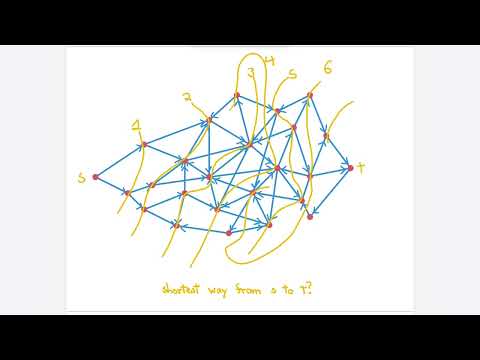
- The initial problem is to travel from S to T using as few edges as possible.
- A hand-picked route on the example graph has seven edges, but visual inspection does not certify that no shorter route exists.
- The challenge is to find a systematic method that also makes its answer verifiable.
4:28
Weighted Distance, Infinite Values, and the Triangle Inequality
- For a directed graph with edge lengths, a walk’s length is the sum of its edge weights, and distance is the infimum over S-to-T walks.
- Distance is positive infinity when no walk connects the vertices and can be negative infinity when walk lengths are unbounded below.
- Distances satisfy the triangle inequality: d(S,T) ≤ d(S,X) + d(X,T), since the two walks can be concatenated.
5:08
BFS Finds Minimum-Hop Distances in Layers
- BFS starts with S at distance 0, labels its outgoing neighbors 1, then expands the vertices at distance 1 to find distance 2.
- Each new layer is generated from the previous layer, and already-labeled vertices are not assigned a longer distance.
- With adjacency lists, each vertex and edge is processed only a constant number of times, giving O(m+n) time.
11:05
Proving BFS Correct with Induction on Distance
- Define Aₖ as the vertices whose true graph distance from S is k and Bₖ as the vertices BFS labels k.
- The base case is k=0: both sets contain only S.
- For k>0, a vertex is at distance k exactly when it is not closer and has an incoming edge from a vertex at distance k−1; BFS uses the same recurrence.
- Induction establishes Aₖ=Bₖ for every layer, certifying all BFS distance labels.
18:33
Positive Edge Lengths Replace Hop Counts
- The weighted version assigns positive lengths to edges, such as travel times or distances, and seeks the route with the smallest total.
- The example route’s edge lengths add to 15, illustrating why counting edges no longer suffices.
- A possible strategy is to adapt BFS’s expansion order from hop count to accumulated path length.
20:55
Why Subdividing Weighted Edges Can Be Too Slow
- For positive integer weights, an edge of length 5 can be replaced with a chain of five unit edges, making BFS return the weighted distance.
- This subdivision can take time proportional to the numeric edge weights, which may be exponentially larger than their O(log W)-bit input representation.
- The key improvement is to skip empty distance layers and identify the next closest original vertex directly.
25:40
Dijkstra’s Algorithm Selects the Next Closest Vertex
- Dijkstra’s algorithm begins with distance 0 at S and repeatedly selects the not-yet-settled vertex with the smallest candidate distance.
- Candidates come from a settled vertex u via an outgoing edge (u,v), with value d(u)+length(u,v).
- The method simulates BFS’s next-layer progression without iterating through every possible distance value, so it also works for non-integer positive lengths.
28:35
Dijkstra Correctness Uses the Algorithm’s Vertex Order
- Order vertices by when Dijkstra labels them, then prove by induction that each selected vertex is the next closest one and receives its true distance.
- The first vertex is S, correctly labeled 0.
- For the induction step, the predecessor on a shortest path to the next closest vertex was settled earlier; positive edge lengths ensure that predecessor is closer.
- Separating the algorithm’s tentative choice from the graph’s true closest vertex makes the correctness argument explicit.
36:20
Tentative Distances Avoid Recomputing Old Candidates
- A naive implementation scans all m edges to find the next vertex for each of up to n iterations, costing O(mn).
- For each unsettled vertex v, maintain its tentative distance: the best candidate found so far through a settled vertex.
- When a new vertex is settled, only its outgoing edges can introduce new candidates, avoiding repeated work on previously processed edges.
40:20
Binary Heaps Improve Dijkstra’s Runtime
- A min-priority queue stores unsettled vertices keyed by tentative distance and supports insert, decrease-key, and extract-min.
- With a binary heap, each queue operation takes O(log n); processing outgoing edges across the whole run accounts for O(m) edge updates.
- The resulting bound is O((m+n) log n), rather than the naive O(mn).
45:10
Fibonacci Heaps Reduce Decrease-Key Costs
- A Fibonacci heap supports insert and decrease-key in O(1) amortized time and extract-min in O(log n) amortized time.
- Amortized analysis bounds the total cost of an operation sequence, even if occasional individual operations take longer.
- Dijkstra performs O(m) decrease-key operations and O(n) extract-min operations, yielding O(m+n log n) total time.
54:45
Shortest Walks with an Even Number of Edges
- The new task is to find the minimum total length of an S-to-T walk using an even number of edges.
- A standard shortest-path run does not track whether a route reaches an intermediate vertex after an odd or even number of edges.
- Rather than complicating Dijkstra’s logic with backtracking, encode the constraint in a transformed graph and reuse a known shortest-path algorithm.
1:00:15
Two-Edge Shortcuts Work but Can Create a Dense Graph
- Create an auxiliary edge for each pair of consecutive original edges, with weight equal to their combined length.
- Paths in the auxiliary graph map to even-edge walks in the original graph, and even-edge walks map back by grouping edges in pairs.
- A high-degree intermediate vertex can produce Θ(n²) shortcut edges, increasing Dijkstra’s cost to roughly O(n²+n log n).
1:04:50
Why a Sparse Reduction Needs to Track Route State
- Removing some vertices or pruning shortcut edges does not generally eliminate the Θ(n²) blowup in the worst case.
- The useful idea is to remember extra information about a route’s state—whether its edge count is currently odd or even.
- Representing that state explicitly avoids adding every possible two-edge shortcut.
1:09:55
Parity Layers Generalize to Modulo-5 Path Constraints
- Make two copies of every vertex, labeled even and odd; each original edge from a to b becomes transitions from a-even to b-odd and from a-odd to b-even.
- Run Dijkstra from S-even to T-even; reaching T-even corresponds exactly to an even-edge walk, and the transformed graph has 2n vertices and 2m edges.
- For a walk whose edge count must be divisible by 5, use five copies of each vertex and advance one layer per edge, wrapping around modulo 5.
- This expanded-state construction is a reduction: prove the transformed paths correspond to valid original walks, then apply the already-proved shortest-path algorithm.
Summary, takeaways, and chapters were generated by AI from the video's transcript and may contain errors. The video belongs to its creator, Kent Quanrud.