SHM of simple pendulums | AP Physics | Khan Academy
 Watch on YouTube →
Overview
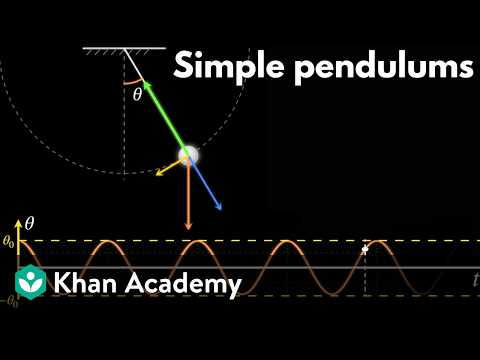
Khan Academy explains the physics of simple pendulums, defining them as point masses on massless strings. The analysis shifts from forces to torques to derive the restoring torque, which is proportional to the sine of the angular displacement. For small angles (under 30 degrees), this torque approximates proportionality to the angular displacement, enabling simple harmonic motion (SHM) and a predictable period.
Key takeaways
- A simple pendulum is defined by a negligible string mass and a point mass bob.
- The restoring torque on a pendulum is proportional to mg sin(theta), where theta is the angular displacement.
- For angles less than 30 degrees, the approximation sin(theta) ≈ theta allows the pendulum to exhibit simple harmonic motion.
- The period of oscillation for a simple pendulum in SHM is given by T = 2π√(l/g).
- In a simple pendulum system without drag, total mechanical energy (kinetic + potential) is conserved.
- Maximum potential energy occurs at the extreme points of the swing, while maximum kinetic energy occurs at the equilibrium position.
Chapters
0:00
Defining Simple Pendulums and Equilibrium
- A simple pendulum models a point mass on a massless string/rod.
- The equilibrium position is where the pendulum hangs at rest (zero angle to vertical).
- A coordinate system with counterclockwise as positive is established.
6:50
Torque Analysis and Restoring Force
- Tension and radial gravity components produce no torque about the pivot.
- The tangential component of gravity (mg sin(theta)) creates a restoring torque.
- Torque is proportional to the length (l) and mg sin(theta), directed towards equilibrium.
11:46
Approximating Simple Harmonic Motion (SHM)
- Pendulum motion is not true SHM because torque is proportional to sin(theta), not theta.
- For small angles (< 30 degrees), sin(theta) approximates theta in radians.
- This approximation makes the restoring torque proportional to angular displacement, resulting in SHM.
Summary, takeaways, and chapters were generated by AI from the video's transcript and may contain errors. The video belongs to its creator, Khan Academy.