Section 6.4 Combination, Composition of Functions, Inverse Functions - Part 2 - Questions 11 - 17
 Watch on YouTube →
Overview
Monica Brannan works through Section 6.4 problems 11–17, demonstrating how to evaluate and simplify compositions by applying the inner function first. She also finds composition domains, including a square-root restriction that gives x ≥ -11 and examples with unrestricted real domains, and shows that function composition is not generally commutative.
Key takeaways
- For f(g(a)), evaluate g(a) first and then substitute that result into f; this yields 4 in problem 11 and −4 in problem 12.
- A real-valued square-root composition is undefined wherever its radicand is negative; in problem 13, g(f(−5)) requires √(−330).
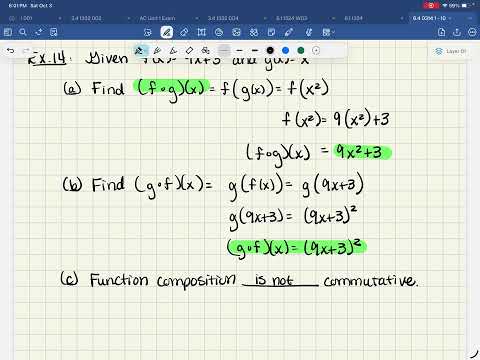
- Composition order matters: with f(x) = 9x + 3 and g(x) = x², f(g(x)) = 9x² + 3 while g(f(x)) = (9x + 3)².
- For m(x) = √(x + 8) composed with n(x) = x + 3, the combined expression √(x + 11) has domain [−11, ∞).
- Polynomial and linear compositions such as (x + 7)∘(x² + 6x) have domain (−∞, ∞) because they introduce no denominator or even-root restrictions.
- The composition (x + 7)∘|7x − 9| remains defined for every real x; the absolute value affects outputs but imposes no domain restriction.
Chapters
0:00
Problems 11–12: Evaluate f(g(2)) Inside-Out
- For problem 11, g(x) = √(2x), so g(2) = 2; substituting into f(x) = x³ − 2x gives f(g(2)) = f(2) = 4.
- For problem 12, the same inner function gives g(2) = 2; with f(x) = x³ − 6x, the composition evaluates to f(2) = −4.
- The procedure in both examples is to evaluate the innermost function first, then use that result as the input to the outer function.
5:11
Problems 13–14: Undefined Compositions and Noncommutativity
- In problem 13, f(−5) = (−5)³ − 3(−5) = −110; applying g(x) = √(3x) requires √(−330), so g(f(−5)) is undefined over the real numbers.
- For problem 14, f(x) = 9x + 3 and g(x) = x² produce f(g(x)) = 9x² + 3.
- Reversing the order gives g(f(x)) = (9x + 3)², which differs from 9x² + 3; composition is therefore not commutative in this example.
12:10
Problems 15–16: Simplify Compositions and Find Their Domains
- With n(x) = x + 7 and p(x) = x² + 6x, problem 15 gives n(p(x)) = x² + 6x + 7.
- The functions n, p, and their composition are defined for every real x, so the interval domain is (−∞, ∞).
- For problem 16, m(x) = √(x + 8) and n(x) = x + 3 give m(n(x)) = √(x + 11).
- The composed radical requires x + 11 ≥ 0, so the domain of m(n(x)) is [−11, ∞).
20:39
Problem 17: Absolute-Value Composition Has an Unrestricted Domain
- With n(x) = x + 7 and r(x) = |7x − 9|, composing gives n(r(x)) = |7x − 9| + 7.
- The absolute value is defined for every real input, and adding 7 creates no restriction, so the composition's domain is (−∞, ∞).
- Monica Brannan concludes the Section 6.4 exercises by distinguishing domain restrictions from changes to a function's range.
Summary, takeaways, and chapters were generated by AI from the video's transcript and may contain errors. The video belongs to its creator, Monica Brannan.