Searching and sorting
 Watch on YouTube →
Overview
Kent Quanrud introduces algorithm analysis through binary representation, binary search, and sorting, showing how structure can turn an apparently large search into logarithmic work. He builds merge sort from a recursive specification, analyzes its O(n log n) running time with a recursion tree, and proves that comparison-based sorting requires Ω(n log n) comparisons using a decision-tree counting argument.
Key takeaways
- Binary search finds a value among n ordered possibilities in O(log n) guesses because each midpoint comparison eliminates about half the remaining candidates.
- Repeatedly selecting the smallest remaining item requires Θ(n²) work, while merging sorted halves takes O(n), enabling merge sort to run in O(n log n).
- A recursive specification states the input-output contract that recursive calls can rely on and that induction uses to establish correctness.
- The merge-sort recurrence T(n) = 2T(n/2) + O(n) has O(n) work per recursion-tree level and about log₂(n) levels, yielding O(n log n).
- In the comparison model, K binary comparisons distinguish at most 2^K cases, while sorting n distinct elements must handle n! orders; thus K ≥ log₂(n!) = Ω(n log n).
- Merge sort’s O(n log n) upper bound matches the comparison-sorting Ω(n log n) lower bound, certifying its asymptotic optimality within that model.
Chapters
0:00
Ada Lovelace, Alan Turing, and the Algorithms Course
- Kent Quanrud connects Ada Lovelace’s interest in Charles Babbage’s mechanical calculations with Alan Turing’s effort to formalize computation.
- He directs students to fundamentalgorithms.com for course materials and describes weekly homework, two midterms, a final, and Tuesday problem-solving sessions.
- Quanrud recommends struggling with homework rather than using chatbots, citing lower midterm scores among chatbot users in the prior semester.
8:00
Finger Counting Shows the Power of Binary Representation
- Ten fingers can represent 10 through unary counting, but treating each finger as an on/off bit gives 2^10 possible patterns.
- The contrast between unary, decimal, and binary representations illustrates how a compact encoding can represent many values.
- Each additional independent bit doubles the number of representable combinations.
11:00
Binary Search Solves the 1-to-100 Guessing Game
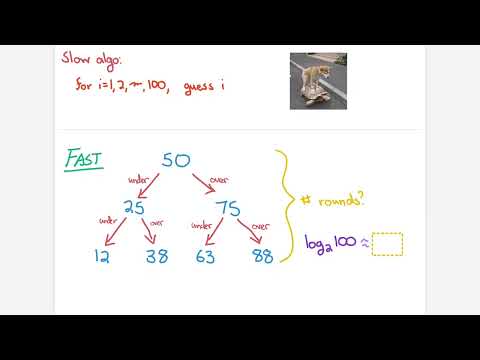
- Starting at 50 divides 100 possible secret numbers into two groups, and each over-or-under response eliminates about half.
- Repeatedly guessing the midpoint takes about log₂(100) comparisons, or roughly seven guesses including the final identification.
- Binary search deduces the answer by exploiting order; it does not rely on guessing the secret number directly.
15:00
Logarithms Contrast with Exponential Search Spaces
- Quanrud contrasts exponential growth, such as 2^n combinations, with logarithmic growth, which reverses repeated doubling.
- He estimates log₂ of the roughly 10^82 atoms in the universe at about 272, then applies the logarithm again to get about 8.
- The examples frame algorithm analysis around distinguishing combinatorial explosion from problems with exploitable structure.
20:15
Human Selection Sort Takes Quadratic Time
- The class sorts a list by repeatedly finding the smallest remaining value, the basic idea behind selection sort.
- For n values, the repeated scans examine lists of sizes n, n−1, down to 1, totaling n(n+1)/2 comparisons.
- A quick bound shows the sum is Θ(n²): at least n/2 terms are each at least n/2, so the total is at least n²/4.
27:15
Big-O Hides Constants to Reveal Growth Rates
- Big-O describes an asymptotic upper bound while setting aside constant factors that depend on the machine, compiler, and definition of a step.
- For selection sort, the important feature is quadratic growth, not whether the implementation takes exactly n² operations or a constant multiple.
- Ignoring low-level constants makes algorithm comparisons more portable and focuses attention on the dominant growth rate.
30:25
Checking Sortedness and Merging Two Sorted Lists
- A sorted list can be verified by checking its n−1 adjacent pairs, since transitivity ensures the entire sequence is ordered.
- To merge two sorted halves, compare their first unprocessed elements and append the smaller one, advancing that list’s pointer.
- Merging takes O(n) time; any elements left when one list runs out must be copied into the result.
34:45
Merge Sort Uses Divide and Conquer
- Merge sort recursively sorts the first half and second half of an array, then merges the two sorted results.
- The merge routine supplies the key subproblem operation: two sorted lists become one sorted list in linear time.
- The recursive design replaces selection sort’s repeated full scans with progressively smaller subproblems.
36:17
Recursive Specifications Define an Algorithm’s Contract
- Quanrud asks students to state a recursive specification by naming the procedure and making its input and output explicit.
- For merge sort, the contract is to take an array of comparable numbers and return those values in sorted order.
- The contract lets each recursive call be treated as a reliable operation and provides the inductive hypothesis for correctness proofs.
41:00
Merge Sort Pseudocode and Inductive Correctness
- The pseudocode handles a small-array base case, finds the midpoint, recursively sorts both halves, and merges their results.
- Quanrud uses one-based indexing in the presentation and notes that zero-based indexing is also valid if specified consistently.
- Correctness follows by induction: the base case is sorted, both smaller halves are sorted by induction, and merging preserves sorted order.
44:30
Modeling Merge Sort’s Running Time
- Define T(n) as an upper bound on the work for an input of size n, then derive a recurrence from the pseudocode.
- Two recursive calls process inputs of about n/2, while splitting and merging contribute O(n) additional work.
- The resulting recurrence is T(n) = 2T(n/2) + O(n); floor and ceiling details do not change the asymptotic result.
48:20
A Recursion Tree Derives the n log n Bound
- At depth i, the recursion tree has 2^i subproblems of size n/2^i.
- Each level performs O(n) total merge work because 2^i subproblems each contribute work proportional to n/2^i.
- There are about log₂(n) levels before the subproblems reach size 1, yielding O(n log n) total work.
53:35
Why Sorting Lower Bounds Require an Algorithmic Model
- Quanrud shifts from proving that merge sort is fast to asking whether any correct sorting algorithm can be faster.
- A lower bound of Ω(n) is immediate because an algorithm must inspect the input, but it does not close the gap to merge sort’s n log n.
- The comparison model abstracts algorithms to comparisons between pairs of elements, allowing a claim about all algorithms in that model.
59:00
Comparison Outcomes Form a Decision Tree
- If an algorithm makes K comparisons, each with two possible outcomes, its comparison transcript can encode at most 2^K outcomes.
- Sorting n distinct values must distinguish among n! possible input orderings, so a correct algorithm needs 2^K ≥ n!.
- Taking logarithms gives K ≥ log₂(n!), establishing a lower bound without examining any particular sorting implementation.
1:05:00
The Ω(n log n) Bound and an Inversion-Counting Challenge
- At least n/2 factors in n! are at least n/2, giving n! ≥ (n/2)^(n/2) and therefore log₂(n!) = Ω(n log n).
- Together with merge sort’s O(n log n) upper bound, the lower bound proves that comparison-based sorting is asymptotically optimal.
- Quanrud introduces inversion counting as a practice problem: count out-of-order pairs and consider exploiting already-sorted halves to improve on O(n²).
Summary, takeaways, and chapters were generated by AI from the video's transcript and may contain errors. The video belongs to its creator, Kent Quanrud.