Searching and Sorting Graphs
 Watch on YouTube →
Overview
Kent Quanrud develops graph-search techniques from topological sorting through depth-first search (DFS) to strongly connected components (SCCs). He shows how DFS finishing order yields a second linear-time topological sort for directed acyclic graphs, then derives the two-pass Kosaraju algorithm, which finds every SCC in O(n + m) time by searching the reversed graph first and the original graph next.
Key takeaways
- For a DAG, repeatedly removing zero-indegree sources computes a topological order in O(n + m) time when indegrees and newly available sources are maintained incrementally.
- DFS requires visited marks because recursion alone does not shrink a graph containing cycles; with marks, each vertex and edge is processed at most once.
- In a DAG, DFS postorder is reverse topological order: reversing the list gives a topological ordering in O(n + m) time.
- A vertex’s SCC is the intersection of vertices reachable from it in the original graph and vertices reachable from it in the reversed graph.
- Kosaraju’s algorithm finds all SCCs in O(n + m) time by computing DFS postorder in the reversed graph, then searching the original graph in decreasing finishing-time order.
- Contracting SCCs always yields a DAG, because any cycle among contracted components would make those components mutually reachable and therefore part of one SCC.
Chapters
0:00
Graph Basics: Vertices, Edges, and Representations
- The lecture uses n for the number of vertices and m for the number of edges.
- Directed edges have an orientation; undirected edges represent mutual connections.
- Adjacency lists store each vertex’s outgoing neighbors, while adjacency matrices use an n × n table.
1:36
DAGs, Circuit Evaluation, and Topological Order
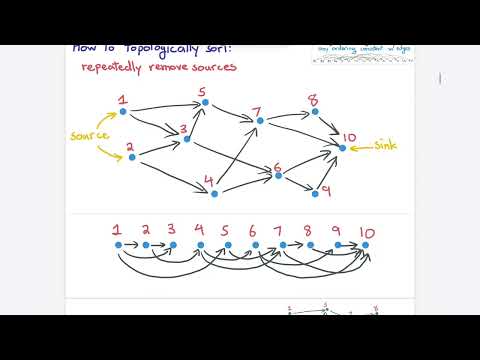
- A directed acyclic graph (DAG) has no directed cycle; vertices with no incoming edges are sources, and vertices with no outgoing edges are sinks.
- Boolean circuits form DAGs: inputs flow through gates such as AND, OR, and NOT toward outputs.
- A topological ordering puts each vertex before the vertices it points to, allowing circuit gates to be evaluated in order.
6:50
Topological Sorting by Repeatedly Removing Sources
- Every nonempty DAG has a source: following incoming edges indefinitely would repeat a vertex and create a cycle.
- Repeatedly output and remove a source; update the indegrees of its neighbors and add any newly zero-indegree vertices to a queue.
- With indegrees maintained as bookkeeping, source removal computes a topological ordering in O(n + m) time.
10:00
The Cat Maze as a Graph-Reachability Problem
- The maze asks whether a path connects the starting cat to the goal while alternating between cats facing toward and away from the viewer.
- Modeling locations and permitted moves as vertices and directed edges turns the puzzle into a reachability question.
- A second example asks whether a directed graph’s start vertex S can reach every other vertex; a cycle with no incoming edge demonstrates why the answer can be no.
16:57
Why Naive Recursive Reachability Can Loop Forever
- A natural recursive procedure tests each outgoing neighbor V to see whether it can reach the target T.
- On a cycle, recursive calls can revisit the same vertices indefinitely because the graph does not shrink between calls.
- The missing ingredient is memory of visited vertices, which prevents repeated work and breaks recursive cycles.
23:40
DFS Marks Vertices to Search Without Repeating Work
- DFS marks a vertex when first visited, explores its neighbors, and returns immediately if it encounters a marked vertex.
- The marks act like breadcrumbs in a maze, preventing the search from cycling forever.
- Each vertex is marked once and each outgoing edge is examined at most once, so a search takes O(n + m) time.
29:40
Proving DFS Reaches Every Vertex It Can Reach
- Assume a vertex W is reachable from the DFS start but remains unmarked; a path from the start to W must cross from marked vertices to unmarked ones.
- At that crossing, DFS has marked a vertex A with an edge to an unmarked vertex B.
- DFS examines A’s outgoing edges, so it must visit B—a contradiction that proves all reachable vertices are marked.
35:24
DFS Finishing Times Order Reachable Vertices
- DFS finishes a vertex only after its recursive exploration of reachable unmarked vertices returns.
- If V can reach W but W cannot reach V, any DFS that visits both finishes W before V.
- The claim follows by considering whether DFS marks V or W first: either W is explored inside V’s call, or W’s search cannot reach V.
40:26
Topological Sorting by Reversing DFS Postorder
- A DFS driver calls DFS from every still-unmarked vertex so disconnected portions of the graph are included.
- Appending each vertex when its DFS call finishes produces postorder; in a DAG, this is reverse topological order.
- Reversing the postorder list gives another O(n + m) topological sort, using visited marks and finishing order.
44:49
Strong Connectivity and Component Equivalence Classes
- Two vertices are strongly connected when each can reach the other; mutual reachability is transitive and therefore partitions vertices into equivalence classes.
- Each class is a strongly connected component (SCC), so vertices in one SCC have identical pairwise reachability relationships to vertices outside it.
- Contracting each SCC into one vertex produces a DAG: a cycle among contracted components would mean they belong to one larger SCC.
48:52
Finding One SCC with a Reversed-Edge Graph
- A forward DFS from vertex V finds all vertices reachable from V; a DFS from V in the reversed graph finds all vertices that can reach V in the original graph.
- The intersection of those two reachable sets is exactly V’s SCC.
- Building the reversed adjacency lists and running both searches takes O(n + m) time, unlike checking reachability separately from every vertex.
56:04
Why Repeated SCC Searches Need a Better Processing Order
- Running the one-component procedure repeatedly can still revisit large parts of the graph and take quadratic time.
- If an SCC is a sink in the condensation DAG, a forward DFS from any vertex in it cannot leave the component.
- Removing sink components one at a time would avoid redundant searches, so the challenge is to identify a sink SCC efficiently.
1:03:32
DFS Finishing Order Identifies Sink Components
- The DFS finishing-time relation orders vertices across SCCs: if one component can reach another, its vertices finish later when DFS searches the original graph.
- Running DFS on the reversed graph makes original-graph sink components appear at the end of the postorder list.
- After removing a sink component, the same ordering principle applies to the remaining graph, allowing the process to continue.
1:08:30
Kosaraju’s Two-Pass Algorithm Finds All SCCs
- First run DFS on the reversed graph and record vertices in postorder.
- Process the list from last to first, running DFS in the original graph from each still-unassigned vertex; each search returns one SCC.
- Mark or remove each discovered component so every vertex and edge is processed only a constant number of times, yielding O(n + m) total time.
Summary, takeaways, and chapters were generated by AI from the video's transcript and may contain errors. The video belongs to its creator, Kent Quanrud.