Rules for derivatives (Calc 1; Lecture 1-8; Fall 26)
 Watch on YouTube →
Overview
Calculus I differentiation rules replace repeated limit calculations with reusable building blocks: the constant, power, and exponential rules, plus linearity, product, reciprocal, and quotient rules. Beard Meets Calculus shows how to derive or apply these rules, use them to solve tangent-slope problems, and handle a complicated derivative by working from its outermost operation inward.
Key takeaways
- To make a piecewise function differentiable at a join, enforce both continuity and equal one-sided derivatives; for the example at x = 1, the resulting system gives a = 5 and b = -4.
- The power rule converts d(x^k)/dx to kx^(k-1); rewriting roots and reciprocals as powers lets the same rule handle √x, 1/x^4, and x^e.
- The derivative of e^x is e^x, while the derivative of e^100 with respect to x is zero because e^100 is constant.
- The product rule is (fg)' = f'g + fg', not f'g'; for three factors, each term differentiates exactly one factor.
- A horizontal tangent occurs where the derivative equals zero; for y = x^3 - 12x + 17, this gives x = ±2.
- For complicated derivatives, identify the outermost operation first, then apply its rule and work inward; a quotient containing x^2e^x requires both the quotient and product rules.
Chapters
0:00
Quickfire Review and Matching Piecewise Derivatives at x = 1
- The opening review checks arithmetic, solves 2|x| = x + 2 as x = -2/3 or x = 2, and evaluates a limit at infinity by dividing by the fastest-growing e^x terms.
- For a function defined by 2x^3 - 1 below x = 1 and ax^2 + bx above it, differentiability requires both continuity and matching one-sided slopes.
- Continuity gives a + b = 1; matching derivatives gives 2a + b = 6, so a = 5 and b = -4.
- At a piecewise join, derivative formulas initially apply only on their respective open intervals; the joining point must be checked separately.
9:03
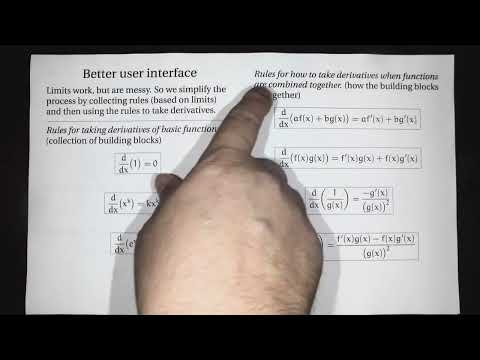
Why Differentiation Rules Replace Repeated Limit Work
- The main goal is to make derivatives easier to compute without directly repeating the limit definition for every function.
- Limits remain the underlying machinery, but rules provide a more efficient way to differentiate increasingly complicated expressions.
- The rules are organized as function building blocks and combination rules, and students are encouraged to learn and practice each one.
11:29
Constant, Power, and Exponential Rules from Limits
- A constant such as 1 has derivative 0 because its graph is horizontal and its value does not change.
- For a positive whole-number exponent k, factoring z^k - x^k cancels the z - x denominator in the limit definition; the remaining k terms each become x^(k-1), giving d(x^k)/dx = kx^(k-1).
- The derivative of e^x is e^x: factoring e^x from the difference quotient leaves the defining limit (e^h - 1)/h, which tends to 1.
- The number e is introduced as approximately 2.71828 and connected to the limit (1 + h)^(1/h) as h approaches zero.
21:32
Applying Power Rules to Constants, Roots, and Reciprocals
- The derivative of e^100 with respect to x is 0 because e^100 contains no x and is therefore a constant.
- Rewrite √x as x^(1/2) before differentiating; the power rule gives (1/2)x^(-1/2), or 1/(2√x).
- Rewrite 1/x^4 as x^(-4); its derivative is -4x^(-5), equivalently -4/x^5.
- The exponent can be any number in the power rule: d(x^e)/dx = e x^(e-1), which is distinct from the exponential function e^x.
25:57
Linearity Breaks Sums into Differentiable Pieces
- Linearity allows derivatives to distribute across addition and subtraction, while constant factors can be pulled outside the derivative.
- For a multi-term expression involving powers, 1/x, e^x, and a constant such as π^3, differentiate each term separately and use the relevant building-block rule.
- Rewriting expressions such as 1/x as x^(-1) makes them compatible with the power rule.
- The rationale is that limits themselves distribute over sums and allow constant factors to be pulled out.
30:06
Horizontal Tangents Become a Derivative-Zero Equation
- A horizontal tangent has slope zero, and the derivative gives the tangent slope at each point.
- For y = x^3 - 12x + 17, linearity and the power rule give y' = 3x^2 - 12.
- Solving 3x^2 - 12 = 0 yields x^2 = 4, so horizontal tangents occur at x = -2 and x = 2.
- The derivative rules turn a problem that would require a lengthy limit calculation into a short algebraic equation.
32:06
Product Rule: Differentiate One Factor at a Time
- For f(x)g(x), the product rule is (fg)' = f'g + fg'; differentiate one factor in each term while leaving the other unchanged.
- Differentiating both factors simultaneously is incorrect; the rule gives each factor a separate turn.
- The limit proof adds and subtracts an intermediate product so the change in f and the change in g can be separated.
- An area diagram offers another interpretation: the first-order change comes from two side strips, while the small corner formed by both changes is negligible.
37:36
Extending the Product Rule to Three Factors and e^x
- For f(x)g(x)h(x), grouping two factors and applying the product rule twice produces f'gh + fg'h + fgh'.
- The three-factor result follows the same pattern: differentiate one factor per term and leave the other two unchanged.
- For x^(1/3)e^x, the product rule gives (1/3)x^(-2/3)e^x + x^(1/3)e^x.
- When factoring the result, e^x and the smaller exponent x^(-2/3) are common factors; the expression becomes e^x x^(-2/3)(1/3 + x).
44:21
Reciprocal and Quotient Rules for Fractions
- For a reciprocal, d(1/g(x))/dx = -g'(x)/[g(x)]^2.
- Combining the reciprocal and product rules gives the quotient rule: (f/g)' = [f'g - fg']/(g^2).
- The mnemonic “low d high minus high d low over low squared” preserves the order of the numerator terms and the squared denominator.
- The minus sign in f'g - fg' is a common test point, so the quotient rule needs careful practice.
46:26
Differentiate a Layered Expression from the Outermost Rule Inward
- For a quotient with numerator x^(1/3) - 7x^4 and denominator 8 + x^2e^x, begin with the quotient rule because division is the outermost operation.
- Differentiate the numerator by linearity and the power rule: (1/3)x^(-2/3) - 28x^3.
- Differentiate the denominator by linearity and the product rule: the constant 8 contributes 0, while (x^2e^x)' = 2xe^x + x^2e^x.
- The final derivative places denominator times numerator derivative minus numerator times denominator derivative over (8 + x^2e^x)^2; the recommended method is to handle one rule-layer at a time.
Summary, takeaways, and chapters were generated by AI from the video's transcript and may contain errors. The video belongs to its creator, Beard Meets Calculus.