RL @ ECE-UofT - Lecture 05: Deep Bootstraping and epsilon-Greedy Improvement
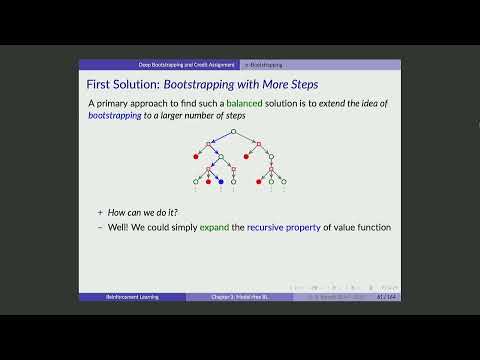 Watch on YouTube →
Overview
Ali Bereyhi develops n-step temporal-difference learning as a bridge between one-step TD and Monte Carlo, then introduces TD(λ), which geometrically combines returns of different depths to balance estimation bias and variance. He derives eligibility traces as an online, backward-time implementation of TD(λ), then shifts from policy evaluation to control, explaining why greedy improvement can prevent exploration and how ε-greedy action selection addresses that problem.
Key takeaways
- N-step TD interpolates between TD(0) and Monte Carlo: a larger horizon uses more observed rewards and less bootstrapping, but the best horizon depends on the environment and policy.
- TD(λ) combines available n-step returns with weights that sum to one: λ=0 yields TD(0), λ=1 yields Monte Carlo for episodic returns, and intermediate values trade off bias and variance.
- Eligibility traces implement TD(λ) online by updating each state in proportion to its trace, eₜ(S), using the current TD error; the backward and forward views agree after a trajectory when initialized identically.
- Greedy control can stop sampling alternatives: a first $150 reward from Company B may make a learner repeatedly choose B without ever finding out whether Company A pays more.
- Under uniform exploration across m actions, ε-greedy assigns ε/m probability to each action from exploration, giving the greedy action total probability 1−ε+ε/m.
- The lecture positions SARSA as on-policy TD control and Q-learning as off-policy control, distinguishing whether the learned action values correspond to the behavior policy or a different target policy.
Chapters
0:00
Model-Free Reinforcement Learning: Policy Evaluation and Improvement
- The setting assumes an MDP exists but its transition and reward model are unavailable.
- Generalized policy iteration alternates between evaluating a policy from samples and improving it, traditionally by choosing the highest-value action.
5:07
Monte Carlo and TD(0): Complete Returns Versus One-Step Targets
- Monte Carlo estimates a state value by averaging complete sampled returns after trajectories reach termination.
- TD(0) updates after one transition using the immediate reward plus the estimated value of the next state.
6:54
N-Step TD Extends the Bootstrap Horizon
- An n-step target sums the next n rewards, discounting each by its position, then adds a bootstrapped value for the state after those rewards.
- For n=1, the method uses a one-step TD target; increasing n incorporates more observed trajectory rewards before bootstrapping.
13:00
Why Deeper Bootstrapping Can Improve State-Value Estimates
- If a one-step target bootstraps from an unseen state initialized to zero, its estimate can be badly misleading.
- A deeper target can reach a better-estimated state—for example, replacing an unreliable value for S₂ with a more reliable estimate for S₃.
20:01
N-Step Returns and the Standard Value-Update Rule
- Bereyhi defines an n-step sample target as discounted rewards through the n-step horizon plus the estimated value beyond it.
- The update remains value ← value + α(target − value); Monte Carlo, TD(0), and n-step TD differ mainly in how they construct the target.
25:20
Applying N-Step TD Along a Sampled Trajectory
- For each state on a trajectory, the update uses the rewards available over the selected n-step window and the value at its endpoint.
- The trajectory must extend far enough to supply the n rewards and bootstrap state, so updates near its end have a shorter available horizon.
29:32
N-Step TD Connects TD(0) to Monte Carlo
- Setting n=0 recovers the shallow TD(0) target; letting n reach the end of an episodic trajectory removes bootstrapping and yields a Monte Carlo return.
- Intermediate n values trade off reliance on estimated future values against use of rewards actually observed in the trajectory.
35:32
Choosing N: The Bias–Variance Trade-Off
- In a 16-by-16 grid-world illustration, estimation error first improves and then worsens as the step size α changes.
- Increasing n can reduce TD(0)'s bias while increasing variance; even with α tuned for each n, an intermediate horizon can outperform both extremes.
40:40
Why One Fixed N Is Hard to Tune
- The best n depends on the environment, policy, and trajectory length, making a single fixed horizon inconvenient across sampled episodes.
- A trajectory provides targets at multiple depths, motivating an estimator that combines them rather than discarding all but one.
45:21
TD(λ) Geometrically Weights Returns of Different Depths
- The λ-return combines TD(0), TD(1), and deeper n-step returns using weights that decay geometrically with depth.
- For a maximum depth L, the weights are 1−λ, (1−λ)λ, through (1−λ)λ^(L−1), followed by λ^L; they sum to one.
52:03
λ-Returns Reuse Each Trajectory at Multiple Horizons
- Each state can receive a weighted average of all n-step estimates available from the same trajectory, increasing the amount of information used per sample.
- The final weight λ^L absorbs the deepest return, so the weighting remains normalized even when trajectory lengths differ.
56:01
TD(λ) Updates Values Using the λ-Return
- TD(λ) uses the same incremental update structure as TD(0) and n-step TD, substituting the λ-return for the target.
- At each trajectory position, the available returns have different depths; their geometrically weighted combination supplies the value estimate.
58:27
λ=0 and λ=1 Recover TD(0) and Monte Carlo
- With λ=0, all weight falls on the one-step target, recovering TD(0); with λ=1, only the full return remains in an episodic setting, recovering Monte Carlo.
- Intermediate λ values combine shallow and deep targets, and the choice must be tuned because it changes the bias–variance balance.
1:06:47
Forward-View TD(λ) Discounts Deeper Predictions
- The forward view assigns the immediate TD estimate weight 1−λ and progressively smaller weights to estimates that look farther into the future.
- A deep estimate may be less reliable because it depends on more future transitions and accumulated prediction uncertainty.
1:13:02
Credit Assignment: Weighing the Reliability of Future Outcomes
- As a trajectory extends, the number of possible state sequences grows, so one observed path represents a smaller fraction of possible futures.
- Geometric λ weights provide an intuitive way to reduce credit assigned to distant estimates, though Bereyhi notes that these weights are not proven optimal.
1:21:00
Why TD(λ) Needs a Backward, Online View
- In the forward view, an update to an earlier state can affect later estimates when those later states are visited.
- Eligibility tracing reverses the bookkeeping: a newly observed TD error can update earlier states immediately instead of waiting for the trajectory to finish.
1:25:00
Eligibility Traces Track Recently Visited States
- The backward-view motivation is to revise earlier value estimates when later observations improve the estimates on which they depended.
- An eligibility table assigns a trace to each state, decaying older traces by γλ and increasing the trace for the currently visited state.
1:31:41
Initializing and Updating the Eligibility Table
- At the start of a trajectory, each state's eligibility is zero; at each time step, existing traces are multiplied by the discount factor γ and λ.
- The currently observed state receives an additional one, marking its recent visit while retaining decayed traces for previous states.
1:33:42
Repeated Visits Accumulate State Eligibility
- A state's trace shrinks while it is not revisited and increases by one when it appears again.
- With γλ=0.1, a state visited two steps earlier retains a small trace, while a repeated visit can raise its eligibility slightly above one.
1:41:23
Use TD Errors to Update Every Eligible State
- At time t, the TD(0) error is δₜ = rₜ₊₁ + γV(Sₜ₊₁) − V(Sₜ).
- Instead of updating only Sₜ, the backward view updates each state S by αδₜeₜ(S), scaling its change by its current eligibility.
1:48:48
Eligibility Traces Make TD(λ) Updates Online
- A never-visited state has zero eligibility and receives no update; recently or repeatedly visited states receive larger trace-scaled updates.
- At the beginning of a new episode, traces are reset; in continuing tasks, traces can be maintained as observations arrive.
1:54:33
Forward and Backward TD(λ) Views Agree at Episode End
- Starting from the same value estimates, the forward λ-return updates and backward eligibility-trace updates produce the same final estimates after a trajectory.
- The backward view differs in timing: it applies TD errors online as they occur rather than waiting to process the completed trajectory.
1:58:44
Eligibility-Trace Limits Recover TD and Monte Carlo
- When λ=0, only the currently visited state has a nonzero trace, so the update reduces to TD(0).
- When λ=1 and γ=1, prior visits retain full eligibility, corresponding to the Monte Carlo-style accumulation described in the lecture.
2:04:30
Prediction Algorithms Versus Online Control
- Prediction evaluates a supplied policy by estimating its state or action values; control also changes the policy to improve behavior.
- Batch-style generalized policy iteration gathers trajectories to evaluate a policy before improving it, whereas online control updates from each new observation.
2:09:05
Control Updates Values and Policy During Interaction
- Online control aims to learn while interacting, updating action values and improving the policy rather than discarding experience after a policy change.
- Eligibility traces can propagate a new TD error to many previously visited states, allowing more of each observation to influence learning.
2:16:20
Monte Carlo Control Improves After Each Episode
- In the Monte Carlo example, a complete trajectory updates the action values for the state–action pairs encountered.
- After that episode, the policy is improved and the next trajectory is sampled under the revised policy.
2:18:22
Greedy Improvement Can Lock a Learner Into a Bad Action
- A purely greedy policy always selects the action with the highest current estimated value, even when those estimates are based on very few samples.
- Once the policy stops selecting alternatives, their values cannot be learned from new experience, so the learner may remain suboptimal.
2:25:06
Company A and Company B Show the Exploration Problem
- If the first sampled job is Company B and pays $150, a greedy learner may keep returning to B without ever measuring Company A.
- Later B rewards, such as $250, can strengthen that preference while leaving the alternative unevaluated; the same lock-in can start with A.
2:29:34
ε-Greedy Improvement Balances Exploration and Exploitation
- With probability 1−ε, ε-greedy selects the action with the highest estimated value; with probability ε, it explores by choosing an action randomly.
- Exploration collects evidence about actions that current estimates may undervalue, while greedy choices exploit the best estimate so far.
2:32:47
Action Probabilities Under ε-Greedy Selection
- For m available actions and uniform random exploration, each action receives ε/m probability from exploration.
- The currently greedy action therefore has total probability 1−ε+ε/m, while each other action has probability ε/m.
2:37:04
The ε-Greedy Improvement Guarantee
- Bereyhi outlines the ε-greedy improvement theorem: using action values for the current policy to form a new ε-greedy policy improves policy value under the stated setup.
- A larger ε encourages exploration early; reducing ε as estimates become more reliable shifts behavior toward exploitation.
2:39:57
Next Steps: SARSA, Q-Learning, and On- versus Off-Policy Learning
- SARSA will replace Monte Carlo returns with TD updates while learning the value of the policy that is actually being followed, making it on-policy.
- Q-learning will use off-policy learning, with importance sampling introduced as one route to evaluating a different target policy from sampled behavior.
Summary, takeaways, and chapters were generated by AI from the video's transcript and may contain errors. The video belongs to its creator, Ali Bereyhi.