Related rates (Calc 1; Lecture 2-4; Fall 26)
 Watch on YouTube →
Overview
Beard Meets Calculus reviews similar triangles, implicit differentiation, logarithmic differentiation, and inverse-trigonometric derivatives before introducing related rates as a three-step method: build an equation, differentiate with respect to time, then substitute known values. Two applications show how to interpret signs and units: a 10-foot ladder’s top descends at 1.5 ft/min when its base is 6 feet from the wall, and a rocket rises at 8 km/min when its observer’s angle is π/3 and increasing at 0.2 rad/min.
Key takeaways
- Related-rates problems follow a reusable sequence: identify a geometric or physical equation, differentiate with respect to time, then insert the values and rates that apply at the specified instant.
- A rate in a word problem is a derivative: “sliding away” at 2 ft/min means dx/dt = +2, while a ladder top moving down the wall produces a negative dy/dt.
- For a 10-foot ladder with its base 6 feet from the wall, the top is 8 feet high; if the base moves outward at 2 ft/min, the top descends at 1.5 ft/min.
- For a rocket viewed from 10 km away, h = 10 tan(θ); at θ = π/3 with angular rate 0.2 rad/min, the vertical speed is 8 km/min.
- Arcsecant is defined only for inputs x ≤ −1 or x ≥ 1, and its derivative is 1/(|x|√(x² − 1)); the absolute value ensures a positive derivative on both chosen inverse branches.
- Sketching a simple diagram and naming variables before writing equations helps translate verbal details into useful relationships, such as x² + y² = 100 for a ladder or tan(θ) = h/10 for a rocket.
Chapters
0:00
Quick Review: Similar Triangles and Implicit Differentiation
- A 10-foot tree casting a 3-foot shadow and a building casting a 15-foot shadow form similar right triangles, giving a building height of 50 feet.
- For x² + y² = 100, implicit differentiation gives 2x + 2y(dy/dx) = 0, so dy/dx = −x/y.
5:19
Logarithmic and Inverse-Trigonometric Derivative Review
- The review emphasizes simplifying complicated expressions before differentiating, using logarithmic differentiation as an example of that strategy.
- For f(x) = 4 ln(x² + 1) − arctan(x), apply the chain rule and d/dx[arctan(x)] = 1/(1 + x²) to obtain f′(2) = 3.
8:50
Mistakes, Learning Goals, and the Arcsecant Function
- An old Japanese proverb, “Even monkeys fall from trees,” frames mistakes as normal and encourages learning from them rather than giving up.
- Beard Meets Calculus also urges skepticism toward authority, instructors, and AI outputs because each can make mistakes.
- The lecture introduces arcsecant as the final inverse-trigonometric function, noting that its derivative is less important to memorize than understanding its domain and derivation.
11:35
Arcsecant’s Domain, Range, and Derivative
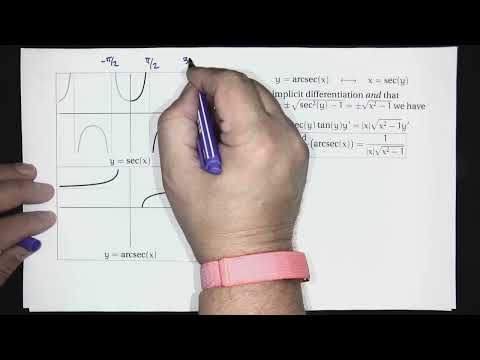
- Because secant never takes values strictly between −1 and 1, arcsecant has domain x ≤ −1 or x ≥ 1.
- Restricting secant to angles from 0 to π/2 and from π/2 to π makes it one-to-one and defines the corresponding arcsecant branches.
- Implicit differentiation of x = sec(y), together with sec²(y) − 1 = tan²(y), gives d/dx[arcsec(x)] = 1/(|x|√(x² − 1)); the absolute value keeps the derivative positive on both branches.
16:37
Two Ways to Differentiate tan(arcsec(x))
- For x > 0, the chain rule combines sec²(arcsec(x)) = x² with the arcsecant derivative to yield x/√(x² − 1).
- A right-triangle construction starts from sec(θ) = x = x/1, so the hypotenuse is x, the adjacent side is 1, and the opposite side is √(x² − 1).
- The triangle gives tan(arcsec(x)) = √(x² − 1); differentiating confirms the same result, x/√(x² − 1).
26:40
Related Rates: Link Quantities by Differentiating in Time
- Related rates begins with an equation connecting quantities that change over time, then differentiates that equation with respect to t.
- After differentiating, substitute the known measurements and rates and solve for the unknown rate.
- The distinction from implicit differentiation is the independent variable: implicit differentiation asks how y changes with x, while related rates treats both x and y as functions of time.
30:10
Set Up the Sliding-Ladder Relationship and Rates
- A 10-foot ladder, wall, and floor form a right triangle; define x as the base’s distance from the wall and y as the ladder’s height on the wall.
- The geometry gives x² + y² = 100, while the current base position is x = 6 feet and its outward motion is dx/dt = 2 ft/min.
- The question asks how quickly the top moves down, so the target is dy/dt; the word “quickly” signals that a rate, not a position, is required.
35:58
Solve the Ladder Problem and Interpret the Negative Rate
- Differentiating x² + y² = 100 with respect to time gives 2x(dx/dt) + 2y(dy/dt) = 0.
- At x = 6, the original equation gives y = 8; substituting x = 6, y = 8, and dx/dt = 2 yields dy/dt = −3/2 ft/min.
- The negative sign means the ladder’s top is descending, and the units follow from y measured in feet and t measured in minutes.
40:45
Rocket Launch: Convert Angular Motion to Vertical Speed
- An observer stands 10 km from the launch site and tracks a vertically rising rocket; define its height as h and the viewing angle as θ.
- The right-triangle relationship is tan(θ) = h/10, or h = 10 tan(θ); differentiating gives dh/dt = 10 sec²(θ)(dθ/dt).
- At θ = π/3 and dθ/dt = 0.2 rad/min, sec(π/3) = 2, so the rocket’s speed is 10 × 2² × 0.2 = 8 km/min.
Summary, takeaways, and chapters were generated by AI from the video's transcript and may contain errors. The video belongs to its creator, Beard Meets Calculus.