Reinforcement Learning with Neural Networks: Essential Concepts
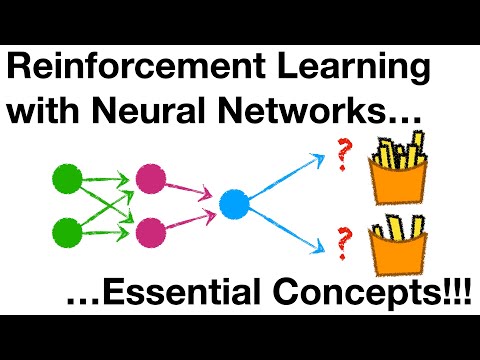 Watch on YouTube →
Overview
Josh Starmer of StatQuest explains reinforcement learning with neural networks using the policy gradients algorithm. This method trains models when explicit output targets are unknown by making a guess, calculating a derivative based on that guess, and then adjusting the derivative with a reward signal to guide parameter updates via gradient descent.
Key takeaways
- Reinforcement learning enables neural network training when explicit target outputs are unavailable, unlike supervised learning's reliance on labeled data.
- Policy gradients utilize a 'guess' of the optimal action to generate a derivative, which is then corrected by a reward signal.
- The reward signal (positive for good outcomes, negative for bad) is crucial for flipping the direction of the derivative if the initial guess was incorrect.
- Gradient descent, guided by the reward-adjusted derivative, iteratively updates neural network parameters (like bias) to optimize decision-making.
- The training process involves repeated cycles of action, outcome observation, reward assignment, and parameter adjustment until convergence.
- A trained reinforcement learning model can learn complex policies, such as consistently choosing Squatch's when not hungry and Norm's when hungry.
Chapters
0:00
Introduction to Reinforcement Learning vs. Traditional Training
- Traditional neural network training requires known input-output pairs for backpropagation.
- Reinforcement learning is used when ideal outputs are unknown, like choosing a snack place based on hunger.
- Policy gradients is a reinforcement learning algorithm for training neural networks.
6:43
Backpropagation Limitations and the Need for Guessing
- Backpropagation relies on calculating differences between network output and ideal output to find derivatives.
- Without known ideal outputs, differences and derivatives cannot be calculated directly.
- Reinforcement learning overcomes this by guessing the ideal output and using that guess to calculate derivatives.
12:00
Policy Gradients: Guessing, Derivatives, and Rewards
- The neural network outputs probabilities for actions (e.g., going to Norm's or Squatch's).
- A guess is made about the correct action for a given input (e.g., hunger level).
- This guess allows calculation of a derivative with respect to a parameter (e.g., bias).
- A reward (positive for correct guess, negative for incorrect) is assigned based on the actual outcome.
20:56
Updating Parameters and Training Completion
- The derivative is multiplied by the reward to create an updated derivative that points in the correct direction.
- The updated derivative is used in gradient descent to calculate a step size for parameter updates.
- The process repeats with new inputs and outcomes until the model's parameters (e.g., bias) stabilize.
- A trained model can then predict optimal actions based on input states (e.g., always go to Squatch's when not hungry).
Summary, takeaways, and chapters were generated by AI from the video's transcript and may contain errors. The video belongs to its creator, StatQuest with Josh Starmer.