Punnett Square, BIO105 Introductory Biology, David Champlin, USM
 Watch on YouTube →
Overview
David Champlin explains how Punnett squares use allele segregation and probability to predict offspring genotypes and phenotypes, illustrating the method with purple and white flowers. He compares dominant–recessive, incomplete-dominance, and codominance patterns, then connects inheritance predictions to homologous chromosome separation during meiosis.
Key takeaways
- A heterozygote crossed with another heterozygote predicts a 1:2:1 genotype ratio; with complete dominance, that becomes a 3:1 phenotype ratio.
- Punnett-square ratios are probabilities, not guaranteed counts: a population of nearly 1,000 flowers can approximate a 3:1 ratio without matching it exactly.
- Under incomplete dominance, heterozygotes have a distinct phenotype, so the 1:2:1 genotype ratio can also appear as a 1:2:1 phenotype ratio.
- Homologous chromosomes carry the same genes but can carry different alleles, and their separation during meiosis explains why gametes receive only one allele from each pair.
- Humans have 23 homologous chromosome pairs; meiosis produces haploid sperm or eggs with one chromosome from each pair.
Chapters
0:00
Mendelian Segregation and Random Allele Inheritance
- The law of segregation means an organism’s two alleles remain distinct rather than blending, even when its phenotype appears intermediate, as in a pink flower.
- Each parent passes one allele for a trait to each offspring; which allele is transmitted is random, so siblings can inherit different combinations.
- A Punnett square lists possible parental allele combinations and assigns probabilities, such as 25% for any one of four equally likely outcomes.
3:19
Flower Crosses, F2 Ratios, and Dominance Patterns
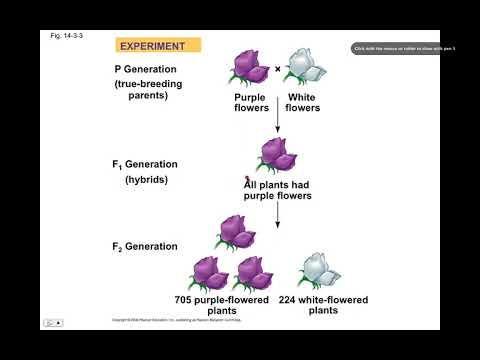
- Crossing true-breeding purple and white plants produces heterozygous F1 plants; crossing those F1 plants predicts an F2 phenotype ratio of 3 purple to 1 white under complete dominance.
- The same F2 cross has a 1:2:1 genotype ratio: one homozygous dominant, two heterozygous, and one homozygous recessive outcome.
- A breeding experiment with nearly 1,000 plants yielded roughly three-quarters purple and one-quarter white, while chance can make actual counts vary from predicted ratios.
- With incomplete dominance, heterozygotes have a distinct phenotype; codominance is another allele relationship, alongside complete dominance and recessiveness.
7:18
Meiosis Connects Chromosome Separation to Inheritance
- Human cells have 23 pairs of homologous chromosomes, with one chromosome in each pair inherited from each parent; homologs carry the same genes but may carry different alleles.
- After DNA replication, each chromosome consists of two sister chromatids; meiosis separates homologous chromosomes and then sister chromatids to form haploid gametes.
- In sperm formation, meiosis produces four haploid sperm, each carrying one chromosome from each homologous pair and therefore one allele for a given gene.
- Meiosis provides the cellular basis for allele segregation and independent assortment, concepts introduced in connection with chapters 13–15 of the textbook.
Summary, takeaways, and chapters were generated by AI from the video's transcript and may contain errors. The video belongs to its creator, The New Evolution for Everyone.