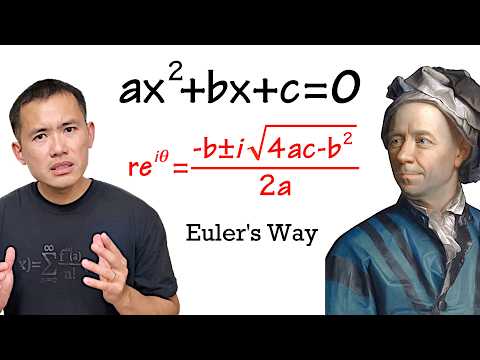
Proving the quadratic formula using Euler's formula!
 Watch on YouTube →
Overview
blackpenredpen derives the quadratic formula by writing a root as \(x=re^{i\theta}\), applying Euler's formula, and separating the quadratic equation into real and imaginary parts. Double-angle identities yield the real component \(-b/(2a)\) and an imaginary component involving \(4ac-b^2\); combining them and using \(i^2=-1\) produces \(x=(-b\pm\sqrt{b^2-4ac})/(2a)\).
Key takeaways
- Writing a quadratic root as \(re^{i\theta}\) lets Euler's formula convert the polynomial equation into separate real and imaginary conditions.
- The imaginary-part equation factors into \(r\sin\theta(2ar\cos\theta+b)=0\); its nontrivial factor directly gives \(r\cos\theta=-b/(2a)\).
- Using the real-part equation after substituting \(r\cos\theta=-b/(2a)\) cancels the \(b^2/(2a)\) terms and yields \(r^2=c/a\).
- The sine identity combines \(r^2=c/a\) with \(\cos\theta=-b/(2ar)\) to produce the term \(\sqrt{4ac-b^2}/(2a)\).
- Multiplication by \(i=\sqrt{-1}\) reverses the sign inside the radical, turning \(i\sqrt{4ac-b^2}\) into a form equivalent to \(\sqrt{b^2-4ac}\), the familiar discriminant term.
- The derivation initially sets aside \(r=0\) and \(\sin\theta=0\); these special cases require separate consideration even though the final quadratic formula covers them.
Chapters
0:00
Substitute \(x=re^{i\theta}\) and Separate Real and Imaginary Parts
- blackpenredpen substitutes \(x=re^{i\theta}\) into \(ax^2+bx+c=0\), using De Moivre's theorem to write \(x^2=r^2e^{i2\theta}\).
- Euler's formula expands the expression into cosine and sine terms, which are grouped into real and imaginary components.
- The goal is to find \(r\cos\theta\) and \(r\sin\theta\), since \(x=r\cos\theta+i r\sin\theta\).
3:17
Use the Imaginary-Part Equation to Find the Real Component
- Setting the imaginary part to zero and applying \(\sin 2\theta=2\sin\theta\cos\theta\) gives \(r\sin\theta(2ar\cos\theta+b)=0\).
- The derivation sets aside \(r=0\) and \(\sin\theta=0\) as special or real-root cases, then uses \(2ar\cos\theta+b=0\).
- This yields \(r\cos\theta=-b/(2a)\), the first component of the quadratic formula and the vertex's horizontal coordinate.
6:40
Use the Real-Part Equation to Recover the Discriminant
- The real-part equation uses \(\cos 2\theta=2\cos^2\theta-1\); substituting \(r\cos\theta=-b/(2a)\) cancels the two \(b^2/(2a)\) terms.
- The remaining equation gives \(r^2=c/a\), which is substituted into \(\sin\theta=\pm\sqrt{1-\cos^2\theta}\) to find \(r\sin\theta=\pm\sqrt{4ac-b^2}/(2a)\).
- Combining the components gives \((-b\pm i\sqrt{4ac-b^2})/(2a)\); replacing \(i\sqrt{4ac-b^2}\) with \(\sqrt{b^2-4ac}\) using \(i^2=-1\) produces the standard quadratic formula.
Summary, takeaways, and chapters were generated by AI from the video's transcript and may contain errors. The video belongs to its creator, blackpenredpen.