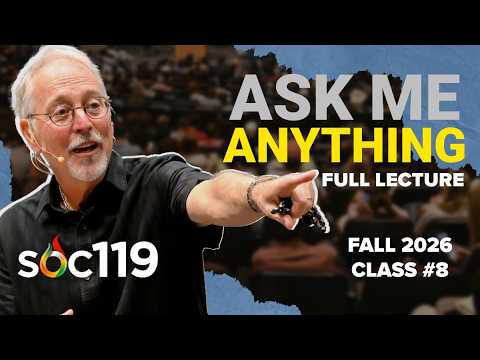
Professor’s Most Powerful Lesson: Learn How to Learn | 26FA Class #08 Full Lecture
 Watch on YouTube →
Overview
A central lesson from a live class Q&A is that effective teaching depends on learning from students: after years of questioning whether he belonged in the classroom, the professor understood a Zen Buddhist Roshi’s advice only eight years later. The discussion applies sociological thinking to exam expectations, Penn State football, fraternities and sororities, political viewpoints, religious encounters, and cultural borrowing—emphasizing both openness to varied perspectives and caution against generalizing from one experience.
Key takeaways
- The professor’s core teaching principle came from a Zen Buddhist Roshi: teachers must learn from students, and it took him about eight years to understand that advice.
- Exam preparation should prioritize basic comprehension of assigned readings and videos; the professor says students do not need to memorize minor character details.
- Affinity groups can provide belonging while also reinforcing conformity and narrowing viewpoints, as illustrated by a Panhellenic Council gathering of about 600 women.
- A classroom that includes competing perspectives on topics such as Charlie Kirk, affirmative action, and ICE can make political disagreement more substantive than online comment threads.
- A student’s experience with repeated calls from one local religious group does not establish how every Latter-day Saint congregation behaves; sociological analysis distinguishes a particular group from an entire institution.
- Penn State football games can be studied as social spaces where crowd behavior and shared energy make group identity visible.
Chapters
0:00
Exam Expectations, World in Conversation, and Penn State Football
- For readings and videos, exam questions test basic comprehension rather than memorization of character names or obscure details.
- World in Conversation prompts change every week; a student team develops open-ended questions that may connect to current or previous class topics.
- Attending a Penn State football game can be a sociological experience, especially for international students observing the crowd and shared energy.
5:00
Fraternities, Sororities, and the Tension Between Belonging and Conformity
- Affinity groups can help people connect with others who share identities or interests, including queer, Afro-Caribbean, Pakistani, and Puerto Rican communities.
- Large like-minded groups can also narrow perspectives and encourage people to follow group norms without questioning them.
- A Panhellenic Council gathering of roughly 600 women illustrated both the sociological appeal of group identity and visible conformity in clothing and style.
9:30
Political Diversity in Class and the Limits of Online Discussion
- The class makes room for differing perspectives on figures such as Charlie Kirk, affirmative action, and ICE, rather than presenting only a standard liberal viewpoint.
- The professor argues that students with conservative views may value hearing both conservative and left perspectives when each is represented in class.
- YouTube chats and Reddit threads can drift from analyzing a specific video or post into repeating pre-existing political opinions.
13:20
A Zen Buddhist Roshi’s Lesson: Learn From Your Students
- After teaching since age 24—including an early class on cybernetics—the professor questioned whether he belonged in the classroom.
- During a two-week stay at a Zen Buddhist monastery, he asked the Roshi how to resolve that doubt and was told to learn from his students.
- The Roshi insisted that he had not yet learned how to do that; the professor says it took about eight years to understand the advice.
- The resulting teaching principle is that teaching requires learning, because every student has something to teach.
20:30
Religious Encounters, Cultural Borrowing, and Avoiding Overgeneralization
- The professor describes golf as a recent passion and gives his handicap as 20 before discussing encounters with Latter-day Saint missionaries.
- He welcomes conversation with missionaries and recounts inviting two newly arrived missionaries into his home for an hour-long discussion about the Book of Mormon.
- A student describes repeated calls after leaving a local church; the professor distinguishes that group’s conduct from the entire Church of Jesus Christ of Latter-day Saints.
- Cultural exchange is increasingly widespread through the internet, making cultural appropriation difficult to define; individual encounters should not be treated as representative of a whole group.
Summary, takeaways, and chapters were generated by AI from the video's transcript and may contain errors. The video belongs to its creator, SOC 119.