Physics says 'now' isn't real... so do your choices even matter? | Jo Marchant
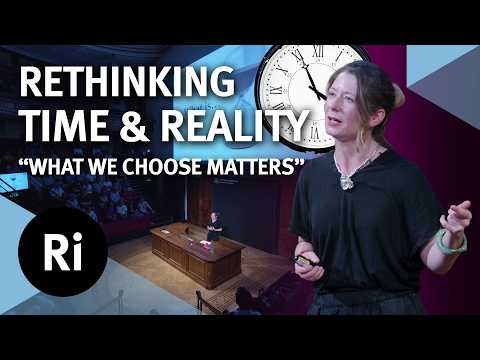 Watch on YouTube →
Overview
Jo Marchant explores the elusive nature of 'now,' contrasting its subjective, experiential reality with physics' depiction of a timeless 'block universe.' She synthesizes insights from cosmology, neuroscience, and psychology to argue that 'now' is not an objective external instant but a personal, predictive construction generated by the brain, deeply intertwined with bodily experience and past learning. This perspective challenges the notion of a predetermined reality, suggesting our choices and perceptions actively shape our lived experience and potentially the universe itself.
Key takeaways
- Physics, particularly Einstein's relativity, suggests a 'block universe' where past, present, and future coexist statically, challenging the notion of a distinct, flowing 'now'.
- Neuroscience reveals that our experience of 'now' is a predictive construction by the brain, integrating sensory data over time and incorporating past experiences, rather than a direct reflection of external reality.
- The brain functions as a 'prediction machine,' actively anticipating events (like Roger Federer hitting a tennis ball) rather than passively receiving signals, meaning our perception of 'now' is an informed guess.
- Our lived experience of time is not a series of discrete instants but a nested structure of 'functional moments' (~50ms) and 'experienced moments' (~3s), integrated over longer periods to form our sense of self.
- Quantum physics, particularly interpretations like QBism, offers a radical alternative to the block universe, suggesting a reality composed of interacting 'living nows' where observer perspectives actively shape what comes into existence.
- Over-reliance on linear, clock-based time leads to 'time famine,' stress, and a diminished quality of life; embracing the 'lived moment' as a creative, multi-layered process can lead to greater immersion and meaning.
Chapters
0:00
The Mystery of 'Now': Inner vs. Outer Experience
- Introduces 'now' as both the external world of events and the internal, subjective experience of awareness.
- Highlights the tension: 'now' is everything we can experience and influence, yet it's ephemeral and hard to pin down.
- Explains the book's journey to understand 'now' through cosmology, neuroscience, psychology, and philosophy.
6:10
Philosophical Perspectives on 'Now'
- Heraclitus's view of constant change: 'We can never step into the same river twice.'
- St. Augustine's questioning of 'now's' existence: 'If the present... must go into the past, how can we say that a thing is which can only be on the condition of no longer being?'
- William James's analogy of the rainbow on a waterfall: a stable quality amidst changing events.
14:04
Cultural Variations in Time Perception
- Western linear view: time as a line, 'now' as a moving point.
- Right-to-left writing cultures (Hebrew, Arabic) visualize time from right to left.
- Aymara people: time is static, the past is in front, the future behind.
- Amandawa people: time experienced only through change, no abstract timelines or clocks.
21:40
Physics and the Absence of a Cosmic 'Now'
- Einstein's theory of relativity: space and time are intertwined into spacetime, which can warp.
- 'Now' is relative; simultaneity is observer-dependent, leading to no universal 'now'.
- The 'block universe' model: the cosmos is a static four-dimensional block of spacetime, where past, present, and future coexist.
30:47
Neuroscience: The Brain as a Prediction Machine
- Perception of 'nowness' doesn't solely depend on external signals; the brain actively constructs it.
- Examples: akinetopsia (inability to perceive continuous movement) shows how brain differences create different 'nows'.
- Sensory signals (sight, sound) arrive at different times, yet are unified into a single experience.
38:33
Active Perception and the Flash Lag Effect
- Roger Federer's ability to hit a fast-moving ball implies active prediction, not just reaction to current visual data.
- The flash lag effect illusion demonstrates the brain correcting for perceived motion, showing a predicted rather than a purely signal-based perception.
- The brain is a 'prediction machine,' creating our 'now' based on past experience and probabilistic guesses.
47:21
The Temporal Structure of Lived Experience
- Our 'now' is not an instant but a 'functional moment' of ~50 milliseconds, the minimum distinguishable time interval.
- These moments are integrated into 'experienced moments' of ~3 seconds for coherent perception (e.g., words, music).
- These are further woven into longer spans (minutes, hours, days) creating a sense of self and continuity.
Summary, takeaways, and chapters were generated by AI from the video's transcript and may contain errors. The video belongs to its creator, The Royal Institution.