PHYS/OCSC 2300 - Fall 2026 - Midterm 1 Review Lecture
 Watch on YouTube →
Overview
The PHYS/OCSC 2300 midterm review connects ocean geography and Earth history to the physical properties and circulation of seawater. It covers Pangaea and plate tectonics, Milankovitch cycles and ice–albedo feedback, water’s hydrogen bonding and latent heat, seawater density and salinity, and the way ocean–atmosphere energy exchange drives climate; the final minutes also flag atmospheric layers, convection, and the Coriolis force for review.
Key takeaways
- Seafloor age patterns follow directly from plate tectonics: new crust forms at mid-ocean ridges, moves outward, and is eventually recycled through subduction.
- Milankovitch orbital variations can initiate climate shifts, while ice–albedo feedback amplifies them by making an expanding ice cover reflect more incoming solar radiation.
- Water's polarity and hydrogen bonding produce high latent heat, allowing evaporation to cool the ocean surface and condensation to release stored energy into the atmosphere.
- Seawater density depends on temperature, pressure, and salinity; fresh water is densest at about 4°C, while greater seawater salinity generally increases density and buoyancy of floating objects.
- Ocean salinity patterns reflect freshwater inputs and losses: rainfall and melting dilute seawater, whereas evaporation and sea-ice formation concentrate salt in the remaining liquid.
- Uneven solar heating between the tropics and poles supplies the energy for atmospheric and oceanic heat transport, while the ocean also moderates climate by absorbing about 90% of global-warming heat.
Chapters
0:00
Ocean Basins and Midterm Review Priorities
- Oceans cover about 70–71% of Earth's surface and contain roughly 97% of its surface water.
- The Pacific, Atlantic, and Indian Oceans average about 4,000 m deep; the smaller, shallower Arctic Ocean averages about 1,000 m.
- The Southern Ocean encircles Antarctica without east–west continental barriers, enabling circulation around the globe.
- For Friday's exam, the Brightspace study guide covers lecture and assignment topics; bring a hand calculator and arrive a few minutes early.
3:19
Nebular Hypothesis, Earth's Layers, and Ocean Formation
- In the nebular hypothesis, a rotating gas-and-dust cloud contracts into a disk, with the Sun forming at its center and planetesimals developing around it.
- As the early Earth cooled, dense iron and nickel sank to form the core, silicate material formed the mantle, and lighter material remained in the crust.
- Volcanic outgassing supplied an early atmosphere rich in water vapor, carbon dioxide, sulfur gases, and hydrogen; biological processes later transformed atmospheric composition.
- Water vapor condensed into rain that filled low-lying basins, while acidic rain dissolved crustal minerals and helped supply the ocean's salts.
7:35
Pangaea Evidence, Milankovitch Cycles, and Ice–Albedo Feedback
- About 200 million years ago, the continents were joined as Pangaea, surrounded by Panthalassa, with the Tethys Sea between continental regions.
- Geological similarities link the Appalachian Mountains and Newfoundland's Gros Morne region with the Caledonian Mountains of Scandinavia, supporting past continental connections.
- Glacial deposits in present-day South Africa, India, and Australia indicate that those regions were once positioned at colder latitudes.
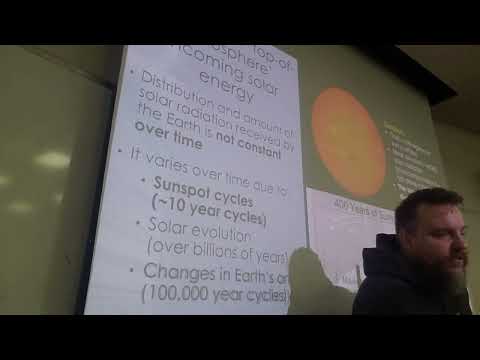
- Milankovitch cycles change orbital eccentricity, axial obliquity, and precession over tens to hundreds of thousands of years; ice–albedo feedback amplifies cooling as expanding ice reflects more sunlight.
14:09
Plate Tectonics and the Seafloor-Spreading Conveyor Belt
- Plate tectonics supplies the physical mechanism missing from continental drift: slow mantle convection moves the plates over millions of years.
- At mid-ocean ridges, rising mantle material produces magma that solidifies into new oceanic crust and pushes the seafloor outward.
- Because oceanic crust is denser than continental crust, it subducts at plate boundaries, forming deep trenches and returning seafloor material to the mantle.
- Seafloor age bands record this cycle: crust is youngest near mid-ocean ridges and grows older toward the subduction zones.
17:03
Water's Polarity, Hydrogen Bonds, and Latent Heat
- The bent H₂O molecule is polar because oxygen attracts the shared electron cloud, leaving oxygen slightly negative and the hydrogen ends slightly positive.
- Hydrogen bonds between water molecules help explain water's high boiling point, melting point, heat capacity, surface tension, and solubility; van der Waals forces also contribute to molecular attraction.
- During melting and vaporization, added energy changes water's phase rather than raising its temperature; vaporization stores latent heat that is released when water vapor condenses in clouds.
- Evaporation preferentially removes fast-moving molecules, cooling the remaining water; evaporation is prominent in the tropics, while condensation releases energy in atmospheric storm tracks.
27:17
Density, Salinity, and Methods for Measuring Seawater
- An equation of state relates density to thermodynamic properties; the ideal-gas example is ρ = p/(R T), while seawater density depends on pressure, temperature, and salinity.
- Fresh water reaches its maximum density at about 4°C; below that temperature, ice-like molecular structures make it expand as it cools.
- Oceanographic salinity is the mass of dissolved salts divided by the total mass of the sample; a typical kilogram of seawater contains about 35 g of salts.
- Salinity can be estimated by evaporating and weighing the residue, by measuring chlorinity and applying an approximately 1.8 conversion factor, or by conductivity—the standard approach in CTD instruments.
34:26
Linearized Seawater Density, Buoyancy, and Salinity Changes
- The linearized equation of state estimates density from temperature and salinity using reference values and coefficients for thermal expansion and haline contraction.
- Open-ocean salinity is typically about 35 parts per thousand, but brackish river-influenced water can be near 10 parts per thousand and hypersaline bodies such as the Dead Sea can exceed 280 parts per thousand.
- Archimedes' principle gives buoyant force as the weight of displaced fluid: Fᵦ = ρVg, where ρ is fluid density, V is displaced volume, and g is about 9.8 m/s².
- Precipitation, river runoff, and melting ice dilute seawater; evaporation and sea-ice formation raise the salinity of the remaining liquid, sometimes producing dense brine.
41:31
Salinity and Temperature Layers in the Ocean
- Zonal-average salinity is generally lower near the poles due to freshwater runoff and near the equator due to ITCZ rainfall, with higher values in subtropical regions where evaporation is strong.
- A turbulent surface mixed layer has relatively uniform salinity; beneath it, a halocline marks rapid salinity change before the more uniform deep ocean.
- In low latitudes, the ocean has a warm surface mixed layer, a thermocline where temperature drops rapidly, and a pycnocline where density increases.
- High-latitude water is comparatively cold and nearly isothermal from surface to depth; halocline, thermocline, and pycnocline describe different properties changing through overlapping layers.
44:48
Ocean–Atmosphere Coupling, Seasons, and Heat Transport
- Winds exert force on the ocean, while sea-surface temperature sets a lower-atmosphere boundary condition; the ocean also absorbs about 90% of the excess heat associated with global warming.
- Earth's seasons result from its approximately 23.5° axial tilt, not its slightly elliptical orbit; the Northern Hemisphere faces away from the Sun at its winter solstice and toward it at its summer solstice.
- The equator receives more solar energy per unit area than the poles because of Earth's curvature and photon geometry; atmospheric absorption and higher polar albedo further reduce polar heating.
- Atmospheric and oceanic circulation transport excess tropical heat toward the poles; the remaining review topics are atmospheric layers, convection, and the Coriolis force.
Summary, takeaways, and chapters were generated by AI from the video's transcript and may contain errors. The video belongs to its creator, JoeFitzgeraldPhysics.