PHYS/OCSC 2300 - Fall 2026 - Lecture 7
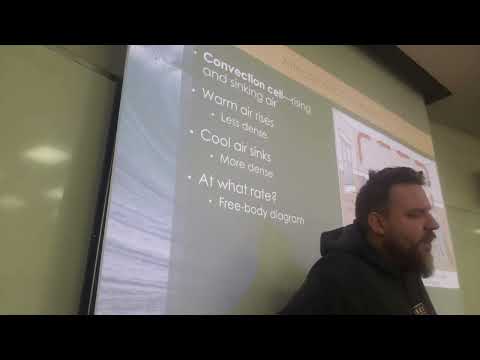 Watch on YouTube →
Overview
Joe Fitzgerald connects unequal solar heating to atmospheric circulation, first tracing how buoyancy and pressure gradients produce convection, then showing how Earth’s rotation changes that flow through the Coriolis effect. The lecture moves from a heated-and-cooled water-tank experiment and a nonrotating equator-to-pole circulation model to Coriolis formulas, vector components, and Northern Hemisphere wind patterns around low- and high-pressure systems.
Key takeaways
- Unequal solar heating creates an equator-to-pole energy contrast that can drive convection: air converges and rises near the warmer equator, then returns aloft and sinks toward colder regions.
- Pressure gradients are the direct mechanism behind buoyant circulation: neighboring fluid parcels exert unequal squeezing forces, producing net motion from higher toward lower pressure.
- Earth’s rotation makes its surface a noninertial frame even at constant rotational speed, because circular motion continually changes the direction of velocity.
- Coriolis deflection is rightward in the Northern Hemisphere and leftward in the Southern Hemisphere; its latitude dependence is proportional to sin(latitude), so it vanishes at the equator.
- In the Northern Hemisphere, low-pressure systems have counterclockwise inward flow and high-pressure systems have clockwise outward flow, as pressure forces and Coriolis deflection act together.
- For velocity components u east–west and v north–south, the lecture’s Coriolis components are proportional to (2mΩv sin(latitude), −2mΩu sin(latitude)), making each force component depend on the perpendicular velocity component.
Chapters
0:00
Midterm Scope and Review Schedule
- The midterm is next Friday, and material from this class is the final content included; Monday’s lecture will be assessed on the second midterm.
- Joe Fitzgerald plans to post a Brightspace bullet-point list of major topics and hold a Wednesday review focused on important diagrams.
- The material covered today also completes the concepts needed for the second assignment.
1:43
Solar Heating, Buoyancy, and Convection Recap
- Differential solar heating supplies energy to atmospheric and oceanic motion: the equator receives more energy than the poles because sunlight is more direct and less diluted.
- Incoming radiation also varies with day-night cycles and seasons; Earth’s axial tilt produces summer, winter, and the equinoxes.
- A warm air parcel is less dense than surrounding cool air, so Archimedes’ principle gives it upward acceleration proportional to the cold–warm density difference.
7:30
A Heated-and-Cooled Water Tank Demonstrates Convection
- A laboratory tank uses water as a fluid analogue for air, with a heating mat under one side and a cold bath cooling the other.
- Dye reveals warm water rising near the heated side, flowing across the top, sinking near the cooled side, and returning along the bottom.
- The resulting streamlines form a domain-wide circulation cell, showing how localized heating and cooling can organize fluid motion.
11:29
Pressure Gradients Produce Buoyant Fluid Motion
- Pressure forces arise because neighboring parcels of air or water squeeze one another; unequal pressures on opposite sides create a net force.
- A parcel experiences a stronger push from the high-pressure side than from the low-pressure side, so pressure forces tend to drive flow from high toward low pressure.
- Buoyant circulation can ultimately be understood through these pressure forces, although other forces—especially Coriolis—can alter the actual flow direction.
15:17
Equatorial Low Pressure Drives a Nonrotating Circulation Cell
- Average surface-pressure observations show relatively low pressure near the equator and higher pressure around roughly 30° north and south.
- Without Earth’s rotation, pressure gradients would push air from the subtropics toward the equator, where converging air rises; it would then return aloft and sink toward the poles.
- This planetary-scale convection model is a rough analogue for Venus, whose rotation period is about 243 Earth days, though Venus also has turbulence and other complexities.
21:09
Earth’s Rotation Makes the Surface a Noninertial Frame
- An inertial frame is stationary or moves at constant velocity; an accelerating frame requires apparent forces such as Coriolis and centrifugal forces.
- Even though Earth rotates at nearly constant speed, its direction continually changes, producing centripetal acceleration and making the rotating surface noninertial.
- The effect is negligible for many small laboratory experiments but important for large-scale weather and ocean-flow observations.
27:43
A Spinning Merry-Go-Round Reveals the Coriolis Effect
- In the National Geographic catch demonstration, people throw a ball across a rotating merry-go-round while a camera rotates with the platform.
- The ball travels approximately straight in an external frame, but the rotating observers see it curve relative to their intended target because the platform moves beneath it.
- For Earth-based observers, the apparent deflection is to the right in the Northern Hemisphere and to the left in the Southern Hemisphere.
33:57
Coriolis Strength Depends on Latitude and Scale
- The Coriolis effect is zero at the equator and strongest at the poles; its latitude dependence follows the factor sin(latitude).
- Hurricane tracks show a gap at the equator because storms rely on Coriolis deflection to develop rotation, although warm tropical water also supports hurricane formation.
- Earth’s surface speed from rotation is about 1,600 km/h at the equator and falls toward zero at the poles, creating the background velocity differences that matter for large-scale flows.
37:57
Coriolis Force Equations and East–North Velocity Components
- The force magnitude scales with mass, Earth’s rotation rate Ω, flow speed, and sin(latitude): the lecture gives component forms using 2mΩ and the flow’s latitude.
- For east–west velocity u and north–south velocity v, the east–west Coriolis component is 2mΩv sin(latitude), while the north–south component is −2mΩu sin(latitude).
- Velocity vectors can be written as (u, v) or as u x̂ + v ŷ; a flow with components 5 m/s east and 5 m/s north has a speed of about 7.07 m/s.
45:36
Northern Hemisphere Winds Around Lows and Highs
- Pressure forces drive air toward a low-pressure center and away from a high; Coriolis deflection bends both flows to the right in the Northern Hemisphere.
- Air spirals counterclockwise inward around a low and clockwise outward around a high; the low remains on the moving air parcel’s left.
- The competition between pressure-gradient and Coriolis forces is called geostrophic balance, a concept scheduled for further treatment in Monday’s class.
Summary, takeaways, and chapters were generated by AI from the video's transcript and may contain errors. The video belongs to its creator, JoeFitzgeraldPhysics.