PHYS/OCSC 2300 - Fall 2026 - Lecture 5
 Watch on YouTube →
Overview
JoeFitzgeraldPhysics explains how salinity, temperature, and pressure determine seawater density through the equation of state, connecting molecular properties to buoyancy, ocean circulation, and climate. The lecture covers salinity measurement by electrical conductivity, chlorinity titration, and refractometry; global salinity patterns from roughly 32–36 parts per thousand; and vertical structures including the mixed layer, halocline, thermocline, and pycnocline.
Key takeaways
- Ocean salinity averages about 35 parts per thousand, but its global zonal-average range is only about 32–36 parts per thousand because long-lived salt ions are thoroughly mixed over oceanic timescales.
- Electrical conductivity is the standard practical method for measuring salinity, while chlorinity titration uses constant ion proportions and refractometry uses salt-dependent changes in light refraction.
- Temperature and salinity dominate seawater density changes; warming lowers density through expansion, whereas adding salt raises density through haline contraction.
- Archimedes’ principle explains why removing submerged body volume reduces buoyancy and why the Dead Sea’s roughly 330 parts per thousand salinity makes floating unusually easy.
- Evaporation increases salinity by removing water while retaining salt, whereas precipitation, river runoff, and melting ice dilute surface seawater.
- Ocean layering arises from mixing and stratification: wind and convection produce a 50–100-meter mixed layer, the halocline and thermocline mark sharp salinity and temperature transitions, and the pycnocline marks the resulting density increase.
Chapters
0:00
Water’s Latent Heat and the Definition of Seawater Salinity
- Hydrogen bonding gives water unusually high heat capacity and large latent heats of melting and vaporization.
- Evaporation and precipitation transport latent energy between climate-system regions; some ocean areas lose enough water to represent 2–3 meters of sea level per year.
- Density is defined as mass divided by volume and depends on temperature, pressure, and salinity through an equation of state.
- Average ocean salinity is approximately 35 parts per thousand, meaning about 35 grams of dissolved salts per 1,000 grams of seawater.
5:00
Electrical Conductivity as the Standard Salinity Measurement
- Salinity represents the mass of salts divided by the total mass of a seawater sample, including both salt and water.
- Boiling or evaporating a sample can estimate salinity but is not sufficiently accurate for quantitative modern oceanography.
- Oceanographers commonly infer salinity from electrical conductivity because dissolved ions transport electric charge through seawater.
- Higher salinity generally produces higher conductivity because more ions are available to carry charge.
10:00
Constant Proportions and Chlorinity Titration
- The principle of constant proportions states that the relative amounts of major seawater ions, including chloride, sodium, and sulfate, remain nearly constant across the global ocean.
- Ocean mixing occurs on timescales of roughly 1,000 years, while individual salt ions can remain in the ocean basin for millions of years.
- Because chloride makes up about 55% of the salinity composition, chemical titration can measure chlorinity and infer total salinity.
- Using the approximate relationship S = 1.8C, salinity can be recovered by multiplying chlorinity by 1.8.
15:00
Refractometers and the Optical Measurement of Salinity
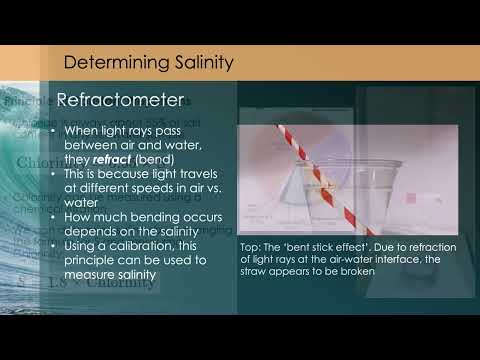
- Refraction bends light at boundaries between materials such as air and water because light travels at different speeds in each medium.
- Dissolved salts change water’s refractive properties, allowing salinity to be inferred from the optical boundary observed through a refractometer.
- A refractometer requires only a few drops of water and displays salinity in parts per thousand; the illustrated sample measured slightly above 40 parts per thousand.
- Refractometers are widely used to monitor salinity in saltwater aquariums, while electrical conductivity remains the main practical oceanographic method.
19:00
The Linearized Seawater Equation of State and Archimedes’ Principle
- The full seawater equation of state depends on temperature, salinity, and pressure and is represented by a highly complex, computer-based formulation rather than a one-line ideal-gas-style law.
- The linearized approximation uses a reference density, temperature, and salinity plus thermal expansion and haline contraction coefficients.
- Increasing temperature lowers density because seawater expands, while increasing salinity raises density because additional dissolved salt increases mass per volume.
- Archimedes’ principle gives buoyant force as F_b = rho V_submerged g; removing a person’s legs from the water reduces displaced volume and therefore reduces buoyant force.
- The Dead Sea’s salinity of roughly 330 parts per thousand produces unusually dense water and exceptionally strong buoyancy.
24:00
Freshening, Evaporation, and Regional Salinity Extremes
- Precipitation, river runoff, melting icebergs, and melting sea ice add relatively fresh water and dilute surface-ocean salinity.
- Evaporation removes water molecules but leaves dissolved ions behind, increasing the salinity of the remaining seawater.
- Sea-ice formation also raises nearby ocean salinity because the ice is composed mostly of fresh H2O and rejects salt into the remaining liquid.
- Brackish coastal water can be near 10 parts per thousand, while the Great Salt Lake reaches about 280 parts per thousand and the Dead Sea about 330 parts per thousand.
30:00
Latitude Patterns: Tropical Evaporation and Equatorial Rainfall
- Zonal-average salinity is calculated by averaging conditions around a complete latitude circle, removing longitude variations.
- Average ocean salinity spans only about 32–36 parts per thousand, with higher values generally between roughly 30°S and 30°N.
- Subtropical regions near 30° north and 30° south are saltier because strong evaporation removes water while retaining salt.
- The equator is a local salinity minimum because the Intertropical Convergence Zone brings intense precipitation that dilutes surface seawater.
- Polar and high-latitude regions are relatively fresh because of river runoff, precipitation, and melting ice.
35:00
Mixed Layers, Haloclines, Thermoclines, and Pycnoclines
- The upper 50–100 meters commonly form a surface mixed layer, where wind-driven turbulence and cooling-driven convection homogenize temperature and salinity.
- The halocline, typically between about 100 and 1,000 meters, is the depth range where salinity changes rapidly before becoming relatively uniform in the deep ocean.
- In tropical oceans, warm surface water transitions to deep water near 4°C through the thermocline, while density increases through the corresponding pycnocline.
- Polar oceans are comparatively cold and vertically uniform, described as approximately isothermal and isopycnal.
- Global circulation connects high- and low-latitude waters at depth, helping their salinity profiles converge below the surface transition zones.
Summary, takeaways, and chapters were generated by AI from the video's transcript and may contain errors. The video belongs to its creator, JoeFitzgeraldPhysics.