PHYS/OCSC 2300 - Fall 2026 - Lecture 4
 Watch on YouTube →
Overview
Joe Fitzgerald connects water’s molecular structure to its large-scale role in ocean and climate systems: hydrogen bonding helps explain water’s phase-change energy, high heat capacity, and unusual density behavior. The lecture follows energy and water through evaporation, condensation, and precipitation, then explains how temperature, pressure, and salinity determine seawater density and how salinity can be measured.
Key takeaways
- Water’s hydrogen bonds make phase changes energetically important: vaporization absorbs substantial latent heat, and condensation releases it to the surrounding air.
- Evaporation cools the ocean surface because high-speed molecules preferentially escape, while later condensation transfers that stored energy into the atmosphere and can strengthen storm updrafts.
- Freshwater is densest at about 4°C, so water colder than 4°C and ice float above warmer lake water, helping preserve liquid habitat through winter.
- Average seawater salinity is about 35 parts per thousand, calculated as dissolved salt mass divided by the total mass of salt plus water.
- Modern oceanographic salinity measurements commonly use conductivity because dissolved ions carry electrical current; more ions generally mean greater conductivity.
- The ITCZ is an equatorial convergence and rising-air zone associated with heavy rainfall, while tropical evaporation and midlatitude precipitation move latent heat between regions.
Chapters
0:00
Course Recap: Ice-Albedo Feedback and Plate Tectonics
- The ice-albedo feedback amplifies cooling: reduced sunlight grows reflective ice, which sends more solar radiation back to space; orbital changes include obliquity, eccentricity, and precession.
- Plate tectonics supplies a physical mechanism for continental movement: mantle convection creates seafloor at mid-ocean ridges, which spreads toward subduction zones and trenches.
- Ocean-floor ages are youngest near mid-ocean ridges and older toward the margins where crust is approaching subduction.
- Water molecules are bent and polar, allowing oppositely charged regions to attract through hydrogen bonding.
4:45
Hydrogen Bonds in Ice, Liquid Water, and Molecular Research
- In ice, hydrogen bonds organize water molecules into a regular hexagonal crystal lattice; liquid water retains bonds in a continually changing arrangement.
- Water vapor forms when molecules separate enough to break their intermolecular bonds.
- A Nature Physics study used machine learning to identify two local structural configurations in molecular-dynamics simulations of liquid water.
- The structures’ precise physical interpretation remains an open research question, illustrating that water’s molecular organization is still actively studied.
8:42
Water’s High Heat Capacity and Unusually High Phase-Change Temperatures
- At standard pressure, water melts at 0°C and boils at 100°C, temperatures unusually high for a small molecule because intermolecular attractions require energy to overcome.
- Water has a high heat capacity: it can absorb substantial energy before its temperature rises appreciably.
- Hydrogen bonds add intermolecular connections, or molecular degrees of freedom, that help explain water’s ability to store heat.
- Wet mud’s heat capacity is largely inherited from its water content, while metals generally have much lower heat capacity.
12:00
Heating Curve: Latent Heat of Melting and Vaporization
- When ice warms from −40°C to 0°C, added energy raises its temperature; at 0°C, energy instead breaks the crystal structure while melting proceeds at nearly constant temperature.
- The energy absorbed during a phase change without a temperature increase is latent heat; the melting plateau represents latent heat of melting.
- At 100°C, liquid water absorbs a much larger amount of energy to become vapor—the latent heat of vaporization—before steam’s temperature can rise.
- Condensation releases that stored latent heat into the surrounding air, warming rising cloud air and supporting buoyant updrafts.
17:29
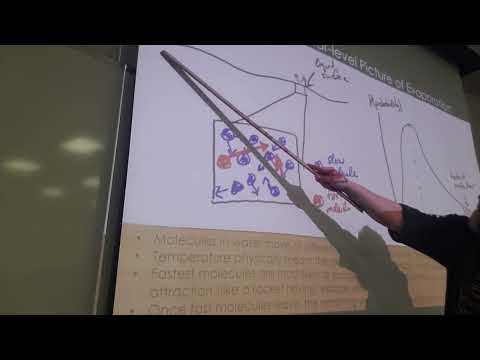
Evaporation Selects Fast Molecules and Transfers Climate Energy
- Molecules in liquid water have a range of speeds described by the Maxwell–Boltzmann distribution; a small fraction occupy its high-speed tail.
- Fast surface molecules can escape hydrogen-bond attractions, leaving slower molecules behind and cooling the remaining liquid—evaporative cooling explains why sweat cools skin.
- Evaporation takes latent heat from the ocean surface and stores it in water vapor; later condensation returns that energy to the atmosphere.
- This latent-heat transport contributes energy to atmospheric circulation and storms.
22:58
Tropical Evaporation, Storm Tracks, and the ITCZ Rain Belt
- Warm tropical regions generally favor evaporation, while midlatitude storm-track regions tend to receive precipitation and the associated release of latent heat.
- Global evaporation maps show strong evaporation over the Gulf Stream and the Kuroshio Current, as well as across much of the tropics.
- Evaporation is comparatively weaker along parts of the equator; weaker winds and cloud cover that reduces incoming solar radiation both contribute.
- The Intertropical Convergence Zone (ITCZ) forms where air from the Northern and Southern Hemispheres meets and rises, producing an equatorial rain belt visible in negative E−P values.
27:31
Water Density, Equations of State, and the 4°C Freshwater Anomaly
- Density is mass per volume, denoted by ρ; an equation of state relates density to properties such as temperature, pressure, and—in seawater—salinity.
- Unlike the ideal gas law, the seawater equation of state is too complex to express as a short elementary formula and is calculated using specialized methods.
- Freshwater reaches maximum density at about 4°C: cooling toward 4°C increases density, but cooling below 4°C makes freshwater expand and become less dense.
- In winter lakes, water below 4°C and then floating ice remain near the surface, insulating warmer water below so aquatic ecosystems can survive; this anomaly is specific to freshwater.
37:59
Seawater Salinity: Parts per Thousand and Dissolved Ions
- Salinity measures dissolved material in a water sample, including salts, other minerals, and dissolved gases.
- Typical open-ocean seawater contains about 35 grams of salts per 1,000-gram sample, or roughly 35 parts per thousand.
- The salinity calculation uses salt mass divided by total sample mass—not salt mass divided only by water mass.
- Chloride and sodium ions make up most of the dissolved salts; calcium, potassium, and magnesium ions are also present.
41:28
Measuring Salinity: Evaporation, Conductivity, and Assignment Guidance
- A basic salinity measurement weighs a seawater sample, evaporates its water, and weighs the salt residue; some salts can be lost, limiting the method’s precision for modern quantitative oceanography.
- Oceanographic salinometers commonly infer salinity from electrical conductivity: dissolved ions carry current, so saltier water is generally more conductive.
- Current through a wire produces a magnetic field, a foundational physical effect behind ways of measuring electrical quantities that can be calibrated to estimate salinity.
- The lecture covers the salinity formula needed for the first assignment; its stated deadline remains Wednesday at midnight, with extra time available by request.
Summary, takeaways, and chapters were generated by AI from the video's transcript and may contain errors. The video belongs to its creator, JoeFitzgeraldPhysics.