PHYS/OCSC 2300 - Fall 2026 - Lecture 3
 Watch on YouTube →
Overview
JoeFitzgeraldPhysics connects ocean-basin geography and continental drift to the physical processes that reshape Earth, including Milankovitch orbital forcing, ice-albedo feedback, and mantle-driven plate tectonics. The lecture then uses radiometric dating and seafloor-age patterns to support seafloor spreading before introducing water’s bent, polar H₂O structure, hydrogen bonding, solvent behavior, and van der Waals attractions.
Key takeaways
- Milankovitch forcing combines changes in eccentricity, obliquity, and precession; variations in sunlight at 65° north are linked to glacial growth and some deglaciations.
- Ice-albedo feedback amplifies climate changes: cooling expands reflective ice and reduces absorbed sunlight, while warming and melting can reinforce further warming.
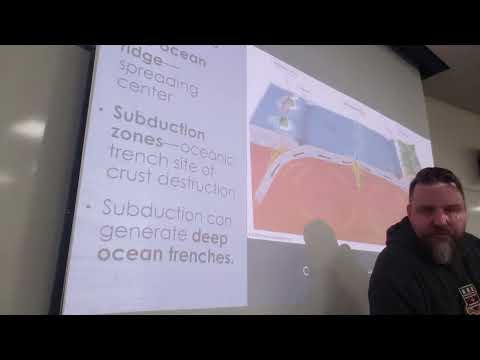
- Mantle convection drives new crust formation at mid-ocean ridges, outward seafloor spreading, and recycling of denser oceanic crust at subduction zones.
- Radiometric dating records how long a rock’s isotopic system has been closed since cooling below its closure temperature; the resulting age map places young seafloor at ridges and older crust near subduction zones.
- Water’s bent H₂O geometry and oxygen-driven electron imbalance create a dipole, enabling hydrogen bonds and explaining why water dissolves ionic salt much more readily than nonpolar oil.
- Quantum fluctuations can induce temporary dipoles in neighboring molecules, creating van der Waals attractions that help explain why water molecules cohere and can form liquid or solid phases.
Chapters
0:00
Ocean Basins, Earth’s Formation, and the Origins of Continental Drift
- The Southern, Indian, Atlantic, Pacific, and Arctic oceans form one connected world ocean; the Southern Ocean links the other basins.
- Earth’s early density stratification separated a metallic core from the silicate mantle and crust, while volcanic outgassing produced an atmosphere rich in water vapor and carbon dioxide.
- Continents have shifted from the supercontinent Pangaea to their present positions; glacial geology in now-tropical southern India supports the idea that continents once occupied different latitudes.
- Solar output and orbital geometry affect incoming radiation, with eccentricity, obliquity, and precession identified as the three Milankovitch-cycle components.
5:55
Milankovitch Forcing and the Record of Glacial Cycles
- A climate time series covering roughly 400,000 years shows repeated cold glacial intervals and warmer interglacials, with temperature swings of about 10°C in the plotted proxy.
- Ice cores and sediment cores preserve chemical evidence used to reconstruct past climate; the lecture identifies the last glacial maximum as the most recent major glaciation.
- The comparison curve represents incoming solar radiation at 65° north, where summer sunlight influences whether high-latitude ice melts or grows.
- Peaks in northern high-latitude insolation coincide with some transitions from glacial to interglacial conditions, supporting Milankovitch forcing as a major climate influence.
11:35
Snowball Earth and the Ice-Albedo Feedback
- The Snowball Earth hypothesis proposes that surface water may have frozen extensively about 650 million years ago, beyond the large but incomplete ice coverage of ordinary ice ages.
- Ice-albedo feedback amplifies initial cooling: more ice reflects more incoming sunlight, causing further cooling and additional ice growth.
- The same feedback can operate in reverse: increased sunlight melts ice, reduces reflectivity, and allows more solar energy to be absorbed.
- Namibian dropstones—large rocks embedded in seafloor sediment layers—may record rocks carried offshore by glaciers or floating ice before being deposited as the ice melted.
17:35
Mantle Convection, Mid-Ocean Ridges, and Subduction
- Plate tectonics supplies a geophysical mechanism for continental drift, explaining how Earth’s crust moves rather than merely documenting that continents were once elsewhere.
- At mid-ocean ridges, hot mantle material rises and volcanism creates new oceanic crust; the mantle itself is solid rock that can flow over geological timescales.
- Seafloor moves outward from ridges like a conveyor belt, while denser oceanic crust sinks beneath continental crust at subduction zones.
- Subduction recycles oceanic crust into the mantle and produces deep ocean trenches along plate boundaries.
23:35
Radiometric Dating and the Age Pattern of the Seafloor
- Deep-sea drilling programs in the 1960s used radiometric dating, which compares radioactive parent isotopes with their decay products, to establish seafloor ages.
- A rock’s radiometric age is tied to when its isotopic system cooled below its closure temperature, after which isotopes are largely locked in place.
- Seafloor-age maps show the youngest crust along mid-ocean ridges and progressively older crust farther away, matching the seafloor-spreading model.
- The oldest ocean floor is about 180 million years old because subduction recycles it; continental rocks can reach roughly 4 billion years because they are less readily recycled.
31:45
Atomic Structure and the Bent Geometry of H₂O
- Atoms contain positively charged protons and neutral neutrons in the nucleus, with negatively charged electrons around it; ordinary neutral atoms have equal numbers of protons and electrons.
- The periodic table orders elements by proton count: hydrogen has one proton and oxygen has eight, forming water as H₂O.
- Water has a bent molecular geometry rather than a straight one because four electron-pair regions around oxygen repel one another and arrange themselves to reduce repulsion.
- Molecular shape matters for physical behavior: water’s geometry differs from linear carbon dioxide and helps give water its distinctive interactions.
36:15
Water Polarity and Hydrogen Bonding
- Oxygen is more electronegative than hydrogen and draws shared electrons toward itself, creating a partial negative charge near oxygen and partial positive charges near the hydrogens.
- Because H₂O is bent, its charge separation produces a polar molecule with a dipole rather than canceling out.
- Hydrogen bonds form when the partially positive hydrogen of one water molecule is attracted to the partially negative oxygen of another.
- Hydrogen bonding underlies properties such as cohesion, high surface tension, and heat capacity; the lecture emphasizes the mechanism rather than memorizing a list.
39:43
Why Polar Water Dissolves Salt but Not Oil
- Water is an effective solvent for polar and ionic substances because its partial charges interact favorably with charged or polar particles.
- When table salt (NaCl) dissolves, water molecules orient their partially negative oxygen ends toward sodium ions and their partially positive hydrogen ends toward chloride ions.
- These surrounding water molecules stabilize separated ions, helping the salt dissolve into solution.
- Cooking oil does not dissolve well in water because its long carbon chains are nonpolar and cannot make comparable charge-based interactions.
42:00
Water’s Phases and van der Waals Attractions
- Water occurs as ice, liquid ocean water, and atmospheric vapor at Earth’s surface; hydrogen bonds help attract water molecules to one another.
- van der Waals attractions arise when quantum fluctuations in one molecule’s electron cloud induce a corresponding temporary polarization in a neighboring molecule.
- The induced opposite charge patterns attract, providing a mechanism for molecules to stick together even when the interaction is weaker than a covalent bond.
- The lecture closes by linking intermolecular attractions to water’s ability to exist in condensed phases, with thermodynamic properties and the hydrological cycle scheduled for the next lecture.
Summary, takeaways, and chapters were generated by AI from the video's transcript and may contain errors. The video belongs to its creator, JoeFitzgeraldPhysics.