Peptides: The Science, Uses & Safety | Dr. Abud Bakri
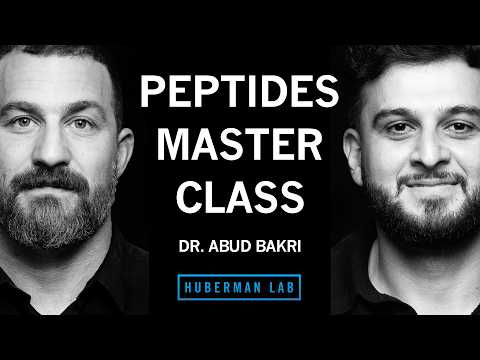 Watch on YouTube →
Overview
Andrew Huberman and Dr. Abu Bakri explore the science, uses, and safety of peptides, categorizing them by receptor presence and discussing specific compounds like BPC-157, thymosin alpha-1, and GLP-1 agonists. They delve into BPC-157's potential for tissue repair and gut health, its lack of known receptors, and the regulatory challenges. The discussion also covers pinealon (EDR) for cognitive function and sleep, thymosin alpha-1 and beta-4 for immune support, GHK-Cu for skin rejuvenation, and GLP-1s for metabolic health, highlighting the need for more human data and physician-led research.
Key takeaways
- BPC-157, a peptide derived from gastric juice, shows promise in animal studies for tissue repair and gut health but lacks identified receptors and extensive human data, leading to regulatory challenges.
- Peptides like thymosin alpha-1 and beta-4, pinealon (EDR), and GHK-Cu are being explored for immune support, cognitive function, and skin rejuvenation, with varying levels of research and anecdotal evidence.
- GLP-1 agonists (semaglutide, tirzepatide) represent a significant medical advancement for obesity and metabolic disorders, offering substantial weight loss but raising questions about long-term effects, dependency, and potential neurological impacts.
- The 'trinity stack' (GLP-1s, GH secretagogues, androgens) is used for rapid physique transformation, but its long-term health consequences remain largely unknown.
- The peptide market faces significant challenges in sourcing, quality control, and regulation, with physician-led access and clear nomenclature being crucial for safe and effective use.
- Assessing immune health via lymphocyte-to-monocyte ratios on standard CBC tests offers a simple, overlooked metric for disease risk stratification.
Chapters
- Celebrities and CEOs use a 'trinity stack' of GLP-1 agonists, growth hormone modulators, and androgen modulation therapies (TRT).
- This combination aims for rapid fat loss and muscle gain.
- The health implications of this 'celebrity protocol' are still being investigated.
- Andrew Huberman, a professor of neurobiology and ophthalmology at Stanford School of Medicine, hosts the podcast.
- Guest Dr. Abu Bakri is an internal medicine physician knowledgeable about peptides.
- The discussion will cover FDA-approved peptides (like GLP-1 agonists) and research peptides (like BPC-157).
- Peptides are described as one of the body's communication languages, alongside steroid hormones.
- They can be categorized by whether they have known receptors or not.
- Peptides with strong clinical effects (e.g., GLP-1s) often have well-defined receptors.
- BPC-157 is a 15-amino acid peptide derived from a larger 40 kDa protein found in gastric juice.
- It was discovered by a Croatian research group in the 1990s.
- Unlike some peptides, BPC-157's specific receptor is not yet identified.
- Some Russian peptides are described as epigenetic modifiers that bind to DNA grooves.
- These modifiers can open or close chromatin, influencing gene expression.
- This mechanism is compared to how steroid hormones bind to receptors to regulate gene transcription.
- Peptides can be broadly categorized into those with known receptors (like GLP-1s) and those without.
- Peptides without known receptors may still impact biology through other mechanisms.
- Much of the data for peptides like BPC-157 comes from animal studies.
- BPC-157's discovery is linked to early 20th-century research on gastric juices for healing and stress adaptation.
- Pavlov's work on gastric juices and Hans Selye's stress adaptation theory provided context.
- The Croatian group isolated BPC-157 from gastric juice extracts, identifying its 15-amino acid sequence.
- Studies involved inducing injuries in mice (tendon, ACL, burn wounds) and administering BPC-157 orally or via injection.
- Observed effects included faster healing times for tendons and wounds.
- Topical application prevented gastric ulcers in burn-injured mice, leading to its classification as an 'anti-stress' compound.
- BPC-157 appears to promote healing by modulating growth and healing pathways.
- It increases VEGF signaling, promoting angiogenesis (blood vessel formation).
- It can enhance cell migration, potentially when combined with TB-500.
- It also exhibits anti-stress effects, counteracting the negative impact of corticosteroids on wound healing.
- BPC-157 doesn't necessarily lower inflammation but rather supports regenerative processes.
- It helps 'call in' immune cells and healing factors, potentially by increasing growth hormone receptors on tendons.
- It modulates nitric oxide synthesis, crucial for vasodilation and cell recruitment in wound healing.
- Animal studies showed BPC-157 reduced intoxication effects from alcohol.
- It also mitigated alcohol withdrawal symptoms in mice.
- These effects suggest modulation of the gut-brain axis and potentially dopaminergic signaling.
- Some users report BPC-157 blunting the effects of ADHD medications like Adderall.
- Anecdotal reports on Reddit mention anhedonia (lack of pleasure) and low energy.
- These effects may relate to BPC-157's influence on dopaminergic and GABAergic pathways.
- Animal studies show very high doses (1000x therapeutic) of BPC-157 caused no adverse effects.
- The LD50 (lethal dose for 50% of animals) is unknown, making FDA approval difficult.
- The primary safety concern is the lack of extensive human clinical trial data.
- Two small trials (Phase 1 & 2) on rectal BPC-157 enemas for ulcerative colitis were conducted in Croatia.
- Full data from these trials are not publicly available, only abstracts.
- A key finding was that orally or rectally administered BPC-157 did not appear to become systemic, remaining localized to the gut lining.
- Injectable BPC-157 is expected to go systemic.
- Oral or rectal administration appears to stay localized to the gut, with no detectable levels in the blood in early trials.
- A 2024 paper could detect BPC-157 administration for doping purposes, suggesting some systemic detection is possible.
- BPC-157 is not FDA-approved and is legally available only for research purposes.
- It was moved to Category 2 ('do not compound') by the FDA in late 2024, but 'PDA' (a form of BPC-157) is still prescribed.
- There's skepticism regarding clinical trials conducted in Croatia compared to US-based research.
- Shortages of GLP-1 drugs (Ozempic, Wegovy) led to a surge in compounded versions.
- Compounding pharmacies were encouraged by the FDA to meet shortages but now face scrutiny.
- The 'gray market' for research-use-only peptides has grown significantly, with raw materials often sourced from China.
- Active pharmaceutical ingredients (APIs) for most peptides, including semaglutide and tirzepatide, are sourced from China.
- Compounding pharmacies vary in quality control; some have excellent testing, others do not.
- Batch-to-batch consistency is a major concern for both compounded and research-grade peptides.
- The veterinary community is reportedly open to using peptides like testosterone and BPC-157 on pets.
- The pet peptide industry is expected to grow significantly.
- The regulatory status of oral BPC-157 (supplement vs. medication) remains unclear, with potential for it to appear on supplement websites.
- Pinealon (renamed EDR) is a tripeptide discovered by Soviet researcher Dr. Vladimir Kavsin.
- It was developed to improve performance and combat aging effects in soldiers and astronauts.
- It has no known receptor but is thought to act as an epigenetic modifier, influencing gene transcription.
- Andrew Huberman reports increased REM sleep and vivid dreams with pinealon, though Kavsin's original research did not mention REM sleep.
- Pinealon is theorized to improve brain metabolism by modulating pathways like PPAR alpha/gamma.
- Users report reduced brain fog and improved cognitive performance, with some taking it pre-workout.
- The thymus gland, crucial for T-cell development, shrinks significantly after puberty due to hormonal influences (androgens, estrogens, corticosteroids).
- Residual thymus tissue in adults still plays a role in immune function.
- Removal of thymus tissue during surgery has been linked to increased mortality from cancer and autoimmune diseases.
- Thymosin alpha-1 is FDA-approved (as Zadaxin) for children with primary T-cell deficiencies and used adjunctively for hepatitis B/C and cancers in some countries.
- It enhances T-cell development and function, acting as 'jet fuel' for T-cells.
- Thymosin beta-4 is a 43-amino acid peptide involved in actin cytoskeleton organization, aiding immune cell movement and wound repair; it's a known doping agent in horse racing.
- GHK-Cu is a tripeptide with a copper ion, found in type I collagen fibers.
- Discovered by Dr. Lauren Pickart, it's believed to regulate collagen synthesis and breakdown.
- Serum levels decrease significantly with age; topical application shows promise for skin rejuvenation and wound repair, and is used adjunctively with red light therapy.
- GLP-1 agonists (semaglutide, tirzepatide) are revolutionizing treatment for obesity, pre-diabetes, and diabetes.
- They offer significant weight loss (10-30% body weight), unlike older drugs.
- The long-term effects and necessity of lifelong use are still under investigation.
- GLP-1 agonists may influence dopaminergic signaling, potentially reducing cravings for alcohol and other substances.
- They can improve fertility in overweight/obese women by modulating leptin sensitivity.
- Concerns exist about long-term effects on neuroplasticity and learning due to thousand-fold increases in GLP levels.
- A popular 'trinity stack' combines GLP-1 agonists, growth hormone secretagogues, and androgen modulation therapies (like TRT).
- This combination is used for rapid fat loss, muscle gain, and improved recovery.
- The long-term health implications of this stack are not yet fully understood.
- GHS like MK-677 and tesamorelin stimulate the pituitary to release growth hormone (GH), addressing somatopause (age-related GH decline).
- GH has benefits for skin, sleep, muscle recovery, and thymus regeneration.
- Concerns include potential cancer promotion, insulin insensitivity, and increased prostate size.
- The 'Wolverine Stack' typically refers to BPC-157 and TB-500.
- The 'Glow Stack' adds GHK-Cu to the mix, aiming for enhanced skin and collagen benefits.
- There's debate about whether mixing peptides can cause denaturation.
- Thymic size and function can be assessed via MRI, but a simpler indicator is the lymphocyte-to-monocyte ratio on a CBC.
- A low ratio is associated with poorer outcomes in cardiovascular disease, cancer, and diabetes.
- Most physicians are not aware of this metric's significance, highlighting a gap in standard medical education.
Summary, takeaways, and chapters were generated by AI from the video's transcript and may contain errors. The video belongs to its creator, Andrew Huberman.