PBS - Roman City - David Macaulay
 Watch on YouTube →
Overview
Roman cities combined regular street grids and central forums with durable engineering, including gravity-fed aqueducts, concrete construction, drainage, and vaulted public buildings. Through Pompeii, Herculaneum, Ostia, and a dramatized colony in Gaul, the account examines how these systems supported trade and civic life while relying on slavery and imperial power; Rome had over a million residents, and Nîmes’s amphitheater held about 24,000.
Key takeaways
- Roman aqueducts used carefully controlled gradients and arch construction to carry water across varied terrain; at Pompeii, reservoir channels prioritized public fountains during shortages.
- Roman urban life depended on a linked civic system: gridded streets, a central forum, water and drainage, baths, and public entertainment venues.
- Concrete, arches, and barrel vaults made Roman structures adaptable and durable, supporting reservoirs, apartment blocks, aqueducts, and large arenas.
- Roman public amenities and wealthy households rested on unequal labor arrangements: enslaved people performed domestic and industrial work, while most working residents had little leisure.
- Roman cities were designed for bounded populations, but many outgrew their original layouts and required expanded aqueducts, sewers, and other services.
- Theater and amphitheater design combined sophisticated crowd management with brutal spectacles, from efficient vaulted circulation to lethal games in the Colosseum.
Chapters
0:00
Pompeii and Herculaneum: Vesuvius Preserves Roman Daily Life
- In 79 AD, Mount Vesuvius buried Pompeii under roughly 12 feet of ash and overwhelmed Herculaneum with volcanic mud.
- The cities remained buried for more than 1,600 years, preserving evidence of ordinary Roman life.
- Roman urban features—public buildings, street layouts, and municipal water supplies—later influenced cities across three continents.
2:30
Rome’s Empire, City Grid, and Central Forum
- Rome had more than one million residents around the empire’s height, about 300 AD, and served as the cultural model for provincial cities.
- Roman towns typically used a regular grid, with the forum at the center and walls marking both defensive and sacred boundaries.
- Pompeii’s forum brought together markets, a cloth hall, a law court, government buildings, and the Temple of Jupiter, Juno, and Minerva.
7:30
Founding a Roman Colony in Gaul—and Negotiating Local Resistance
- After Julius Caesar’s conquest of Gaul, Augustus strengthened Roman control through new settlements built near sites of military victory.
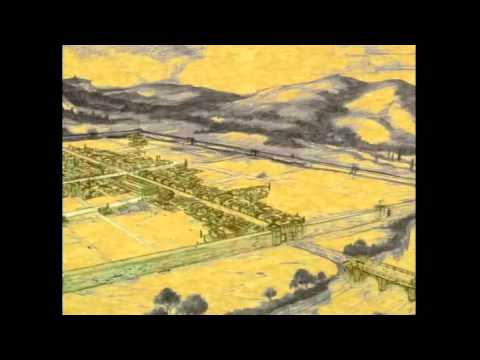
- A dramatized colony called Verbonia illustrates the planned mix of housing, a forum, market, baths, basilica, and theater.
- Roman engineers negotiated with local Celtic leaders for skilled labor and trade, while anti-Roman resistance—including a bridge fire—revealed the costs of occupation.
15:30
Pont du Gard: Aqueducts, Gravity, and Roman Water Systems
- The Pont du Gard carried water toward Nîmes along an aqueduct roughly 30 miles long, using a gentle gradient rather than pumps.
- Roman builders used arches of wedge-shaped stone blocks; a keystone locked each arch in place after its wooden support was removed.
- At Pompeii, a reservoir directed water to homes, baths, and public fountains, with public fountains intended to be the last supply cut during shortages.
- Public fountains and drainage systems supplied residents and removed wastewater, achieving an urban sanitation standard that was not widely matched for centuries.
20:30
Roman Baths and Concrete Reservoir Construction
- Bath complexes used furnaces and pipes beneath the floors to heat the hot room, or caldarium, and the warm tepidarium; the frigidarium offered a cold plunge.
- Baths served as places to exercise, socialize, and discuss business, although working people had limited leisure to use them.
- Roman concrete—stone aggregate mixed with cement—could be poured into forms to create structures with stone-like strength at lower weight and cost.
26:00
Pompeii’s Atrium Houses, Shops, and Enslaved Labor
- A Pompeian atrium house collected rainwater through an opening in the roof into an impluvium and underground storage tank.
- Wealthy homes often turned inward toward gardens and covered walkways, while street-facing rooms could earn rent as shops.
- Households and workshops depended heavily on enslaved labor; some enslaved people became skilled artisans or business owners, but such mobility was exceptional.
- In commercial Ostia, many residents lived in multi-story insulae—brick-faced concrete apartment blocks that could house a dozen or more families.
32:00
Water Shortages, Taxation, and an Appeal to Augustus
- A drought in the Gaulish colony led officials to restrict private water access and require residents to buy water from a central reservoir.
- The colony’s leaders challenged a procurator over additional taxes and suspected that revenue was being diverted.
- A delegation traveled to Rome, where Augustus heard the complaint during a visit to his comparatively modest residence on the Palatine Hill.
37:00
Ostia’s Trade Network and the Suppression of Celtic Resistance
- Ostia’s port and warehouses handled cargo for Rome, while its population reached about 100,000 at its peak.
- A plaza of shipping corporations displayed mosaics identifying businesses trading goods such as Egyptian wheat, Spanish oil and wine, and African animals.
- After unrest in Gaul, Roman reprisals targeted the Druids and local communities; a captured Celtic leader was sent to labor in quarries.
39:15
Roman Theaters and Amphitheaters: Engineering for Spectators
- Roman theaters adapted Greek dramatic forms and hosted comedies, tragedies, music, acrobats, and public oratory.
- The theater at Orange could seat 10,000 people, while the amphitheater at Nîmes accommodated about 24,000.
- Barrel-vaulted passages supported seating and moved crowds efficiently; the Nîmes structure could reportedly empty in about 15 minutes.
- A retractable canopy called a velarium shaded spectators, and sailors were assigned to operate its rigging.
45:15
The Colosseum’s Staged Combat and Public Executions
- The Colosseum’s underground staging areas used hoists, elevators, and trapdoors to raise people and animals into the arena.
- Games included gladiatorial combat, executions, and animal attacks, sometimes leaving hundreds of people and animals dead by nightfall.
- Public violence was tied to Roman custom, military culture, and the belief that visible punishment helped maintain order.
49:15
Roman Citizenship, Street Design, and the Limits of City Growth
- In the Gaul colony’s closing drama, Augustus grants citizenship to a local family and promotes the engineer who helped build the settlement.
- Roman streets used raised sidewalks, covered pedestrian areas, and stepping stones that helped people cross streets while slowing carts.
- Roman planners favored cities sized for a defined population, proposing new settlements rather than endlessly stretching old infrastructure; in practice, towns often outgrew their plans.
- Roads spread commerce and Roman customs, while the empire’s engineering and political organization declined when its governing order weakened.
Summary, takeaways, and chapters were generated by AI from the video's transcript and may contain errors. The video belongs to its creator, anthony223.