Overall Energetics, BIO105 Introductory Biology, David Champlin, USM
 Watch on YouTube →
Overview
David Champlin introduces cellular energetics by comparing glucose oxidation in cells with cellulose combustion: both release energy, but cellular respiration captures some of it in ATP through a sequence of reactions. He connects that process to redox chemistry, explaining how glucose is oxidized, oxygen is reduced, and photosynthesis runs the overall chemistry in the opposite direction using light.
Key takeaways
- Cellular respiration and wood combustion share the same overall glucose-oxidation chemistry, but cells release energy through multiple steps that allow some of it to be captured as ATP.
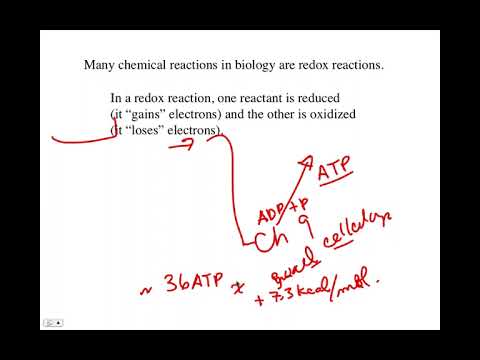
- The lecture estimates that 36 ATP at 7.3 kilocalories per mole each captures about 262.8 kilocalories per mole, or roughly 38% of the approximately 686 kilocalories released by glucose oxidation.
- In cellular respiration, glucose is oxidized to carbon dioxide while oxygen is reduced to water; biological redox can involve changes in electron sharing rather than complete electron transfers.
- Humans cannot digest cellulose because they lack the necessary bond-breaking enzyme, while termites rely on symbiotic bacteria that can break cellulose down and release usable glucose.
- Photosynthesis drives the overall redox chemistry in the opposite direction from respiration, using light to form reduced glucose from carbon dioxide and releasing oxygen.
- Fats generally store more potential energy than sugars because their abundant carbon–hydrogen bonds make them more reduced.
Chapters
0:00
Glucose Oxidation, Cellulose, and ATP Energy Capture
- Eukaryotic plant, animal, and fungal cells use cellular respiration to break down glucose with oxygen, producing carbon dioxide and releasing energy.
- Cellulose is a polymer of glucose, but humans cannot digest its bonds; termites can access it with help from symbiotic bacteria that supply cellulose-breaking enzymes.
- Champlin compares glucose oxidation in cells with burning wood, noting that the reactions release about 686 kilocalories per mole.
- At roughly 36 ATP per glucose and 7.3 kilocalories per mole per ATP, about 262.8 kilocalories are captured—approximately 38% of the released energy.
5:00
Redox Reactions: Glucose Oxidation and Oxygen Reduction
- In cellular respiration, carbon atoms in glucose are oxidized as they become carbon dioxide, while molecular oxygen is reduced as it forms water.
- Oxidation means losing electrons and reduction means gaining electrons; in many biological reactions, this describes a shift in electron sharing rather than a full transfer.
- Carbon’s bonds to oxygen in carbon dioxide leave it with a smaller share of the electrons than it had in glucose, because oxygen is more electronegative.
9:00
Photosynthesis Reverses the Redox Direction
- In photosynthesis, plants use light energy to take carbon dioxide from the atmosphere, build energy-rich glucose, and release oxygen.
- More reduced molecules have higher potential energy; Champlin contrasts energy-rich fats, with many carbon–hydrogen bonds, with sugars that are more oxidized.
- As biomolecules are oxidized, their potential energy falls and energy is released; cellular respiration uses enzyme-regulated steps to harness some of that energy.
Summary, takeaways, and chapters were generated by AI from the video's transcript and may contain errors. The video belongs to its creator, The New Evolution for Everyone.