One-sided limits; continuity (Calc 1; Lecture 1-4; Fall 26)
 Watch on YouTube →
Overview
Beard Meets Calculus reviews algebra and the trigonometric limit sin(u)/u → 1, then uses one-sided limits to analyze piecewise formulas and graph-based expressions. The lecture defines continuity by matching a function’s value to its two-sided limit, distinguishes removable holes from jumps, and applies those ideas to classify discontinuities at x = 1 and x = 3.
Key takeaways
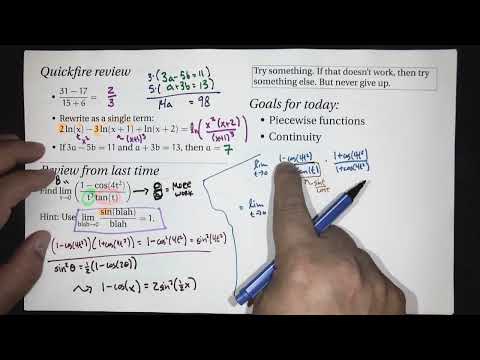
- The limit sin(u)/u → 1 converts small-angle trigonometric expressions into algebraic approximations; for (1 − cos(4t²))/(t³ tan t), rewriting with a conjugate gives a limit of 8.
- A two-sided limit exists exactly when the left- and right-hand limits both exist and have the same value; at x = 0 in the example, the values −1 and 0 make the limit fail to exist.
- For nested expressions such as f(1 + x), the direction of the inner input matters: x → 0⁻ makes 1 + x approach 1 from below, while 1 − x approaches 1 from above.
- Continuity at a requires three conditions: f(a) is defined, the two-sided limit exists, and that limit equals f(a).
- A removable discontinuity can be fixed by defining the function at the point to equal its limit; the graph example is repaired by setting f(3) = 2.
- A jump discontinuity cannot be fixed by changing a single function value because the left- and right-hand limits disagree.
Chapters
0:00
Quickfire Review: Logarithm Rules and Elimination
- Reviews order of operations with (31 − 17)/(15 + 6), which simplifies to 2/3.
- Combines logarithms by moving coefficients into exponents, addition into multiplication, and subtraction into division.
- Solves 3a − 5b = 11 and a + 3b = 13 by multiplying the equations by 3 and 5 to eliminate b, yielding a = 7.
5:30
Recognizing When a Trigonometric Limit Is Needed
- Recalls the foundational limit sin(u)/u → 1 as u → 0, which connects trigonometric expressions to algebraic approximations.
- Introduces lim as t → 0 of (1 − cos(4t²))/(t³ tan t), an indeterminate 0/0 form with both algebraic and trigonometric parts.
- Uses the conjugate of 1 − cos(4t²) and the identity 1 − cos(x) = 2sin²(x/2) as ways to expose sine terms.
12:20
Evaluating the Trigonometric Limit as 8
- Rewrites 1 − cos(4t²) using its conjugate and rewrites tan(t) as sin(t)/cos(t).
- Uses sin(u) ≈ u and cos(u) ≈ 1 near zero to see that the numerator contributes approximately 16t⁴ while the denominator contributes approximately 2t⁴.
- For a formal calculation, inserts sin(4t²)/(4t²) and sin(t)/t, whose limits are both 1; the remaining constants give 16/2 = 8.
19:30
Problem-Solving Mindset and Lecture Goals
- Shares Jim Cannon’s advice: try an approach, learn from what fails, try something else, and do not give up.
- Encourages students to attempt problems rather than avoid mistakes, since unsuccessful attempts can guide the next step.
- Sets up piecewise functions, one-sided limits, and continuity as the day’s main topics.
22:00
One-Sided Limits and the Two-Sided Limit Test
- Defines x → c⁻ as approaching c from the left and x → c⁺ as approaching from the right.
- A two-sided limit exists only if both one-sided limits exist and agree.
- If either side fails to have a limit or the two sides approach different values, the two-sided limit does not exist.
24:30
Testing One-Sided Limits on a Piecewise Function
- Analyzes a function defined as −1 for x ≤ 0, x² for 0 < x < 1, 2 at x = 1, and 2 − x for x > 1.
- At x = 0, the left-hand limit is −1 and the right-hand limit is 0, so the two-sided limit does not exist.
- At x = 1, both one-sided limits equal 1, so the two-sided limit exists and equals 1, regardless of the separately specified value f(1) = 2.
28:20
Tracking Inner Directions in a Graph-Based Limit
- Evaluates a limit involving f(1 + x) and f(1 − x) using a graph where f approaches −2 from the left of 1 and 1 from the right.
- When x → 0⁻, 1 + x approaches 1 from below while 1 − x approaches 1 from above; when x → 0⁺, those directions reverse.
- Emphasizes tracking the direction of each inner expression before applying the graph’s one-sided behavior; the resulting one-sided calculations agree, so the overall limit exists.
37:30
Continuity: Matching the Limit to the Function Value
- Defines continuity at a point a by requiring the limit as x → a to exist, f(a) to be defined, and the limit to equal f(a).
- Describes a removable discontinuity as a case where the limit exists but the function value is missing or incorrect; setting f(a) equal to the limit fills the hole.
- Describes a jump discontinuity as unequal one-sided limits, which cannot be repaired merely by redefining the function at that point.
42:00
Classifying Graph Discontinuities at x = 1 and x = 3
- On the final graph, the two sides disagree at x = 1, so the limit does not exist and the discontinuity is a jump.
- At x = 3, the two sides approach the same value even though the function’s plotted value is wrong, making the discontinuity removable.
- Repairs the removable discontinuity by redefining f(3) = 2, the value approached from both sides.
Summary, takeaways, and chapters were generated by AI from the video's transcript and may contain errors. The video belongs to its creator, Beard Meets Calculus.