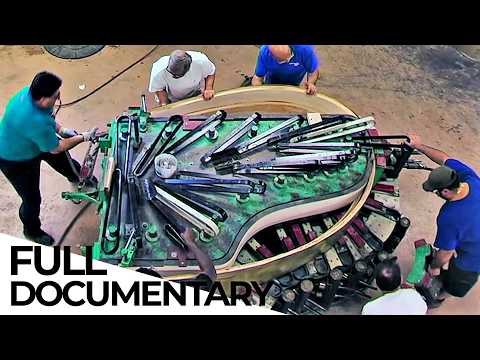
Note by Note: The Making of a Steinway Piano | Musical Instrument | ENDEVR Documentary
 Watch on YouTube →
Overview
Steinway’s Astoria factory makes a little over 2,000 pianos a year by combining methods largely unchanged for more than a century with highly skilled handwork, careful wood selection, and precise assembly. Craftspeople shape and voice each instrument individually, while pianists test concert grands for a personal response; the account also shows how an aging craft depends on training new workers to preserve tacit knowledge.
Key takeaways
- Steinway makes a little over 2,000 pianos per year, relying on individual judgment and handwork rather than the high-volume automation used by factories producing around 100 pianos daily.
- Tiny dimensional errors can accumulate across assembly stages, so accurate tolerances are essential for components to fit and for downstream departments to work correctly.
- The soundboard is central to a piano’s volume and character: it amplifies string vibrations, and its wood selection and freedom to vibrate directly affect the instrument’s sound.
- A piano’s voice is refined through distinct stages of regulation and voicing, including aligning hammers with strings, balancing touch, and evening out the tone across notes.
- Concert pianists select pianos by testing how each instrument responds to their physical touch and musical needs; there is no single sound or action that suits every performer.
- Steinway’s craft tradition depends on experienced workers teaching tacit skills to newcomers, particularly as cabinetmaking expertise becomes harder to recruit and the older generation retires.
Chapters
0:00
Steinway’s Century-Old Methods and the People Behind Each Piano
- Steinway’s production process remains broadly similar to methods used more than 100 years ago.
- Workers sort different woods, including walnut, mahogany, and ebony, for piano components.
- Craftspeople describe taking pride in the visible marks of hands-on work and in making an instrument they may not personally be able to afford.
5:52
How Wood, Construction, and Player Preference Shape Piano Sound
- A piano’s tone depends on its wood and construction; even slight variations can change the sound, so the work cannot simply be rushed.
- Bent rims rest in a conditioning room before the next construction steps, allowing the wood to settle.
- At Steinway’s 57th Street concert department, pianos rotate among performers for use around New York, across the country, and occasionally abroad.
- Pianists choose instruments by feel and response, including preferences for a heavy action that pushes back against a forceful touch.
10:05
Rim Assembly and the Consequences of Tiny Measurement Errors
- After a bent rim leaves the conditioning room, workers begin assembling the piano around it.
- A discrepancy of just one hundredth of an inch can compound across operations and prevent later parts from fitting.
- Each assembly stage depends on the accuracy of the previous one, making one worker’s tolerances consequential for departments farther along the line.
- The action—the keys, levers, and hammers that strike the strings—draws attention as a complex mechanical system in its own right.
12:30
A Piano’s Personality Emerges Through Craft and Musical Choice
- A good piano must support contrasting musical characters, from powerful, solid playing to intricate passages and simpler textures.
- Craftspeople bring different cultural backgrounds and techniques to the work; their combined approaches contribute to each piano’s individuality.
- One maker describes spending 32 years at Steinway after originally planning to stay only five.
- Pianists including Kenny Barron select instruments according to their individual preferences rather than expecting one piano to suit everyone.
17:23
Hand-Fitting Components as Piano Companies Disappear
- A piano builder cannot predict every detail of the finished sound: the result comes from the interaction of many elements.
- One craftsperson describes recognizing and correcting problems by touch while assembling the case and plate.
- The industry has contracted sharply from roughly 1,600 piano-company names in the late 1800s to only a handful today.
- Long-term practice matters: experienced cabinetmakers develop a caliber of work that is difficult to find among new recruits.
22:55
The Soundboard’s Role and the Value of Hand-Cut Details
- The soundboard amplifies string vibrations and projects them into the air; without it, the strings would sound like an unplugged electric guitar.
- Soundboard wood selection and the board’s freedom to vibrate are critical to the instrument’s voice.
- Workers cut details such as bridge notches by hand because changing angles make machine work difficult to control.
- The subtle adjustments depend on a craftsperson’s hands and judgment, not only on measurements.
26:52
Recruiting Craftspeople, Checking Fit, and Finding a Piano’s Voice
- Steinway finds it increasingly difficult to recruit workers with the fine woodworking skills required for piano making.
- Workers check that the soundboard can vibrate without interference and make small adjustments when the plate does not fit to specification.
- Pianists describe discovering classical music through Liszt’s Hungarian Rhapsody No. 2 in the Tom and Jerry cartoon, and through recordings such as Art Tatum’s playing.
- A family considers buying a grand piano for its son, who inherited musical ability from his grandfather.
34:42
Why Steinway Makes About 2,000 Pianos a Year by Hand
- Steinway produces a little over 2,000 pianos annually, while some competitors make around 100 pianos a day.
- Balancing string weight, touch, and feel requires workers to assess the instrument directly rather than relying on automated metal tooling.
- The factory’s approach seeks to combine modern production with time-intensive craftsmanship and attention to the physical object.
37:04
Hammer Regulation and the Craftsperson’s Path Through the Factory
- A piano regulator aligns hammers with strings and synchronizes the action so the parts move evenly.
- Regulators adjust individual hammers when they lean or travel off-center, helping each note respond consistently.
- One worker advanced through jobs including pushing plates, sanding, and planing before becoming a regulator.
- A piano’s distinctive resonance is sometimes apparent only to listeners with a particular sensitivity to sound.
41:45
Concert Pianists Test Dynamic Range and Personal Response
- Pianists value an instrument that responds to their touch and offers a wide palette of colors and a naturally singing tone.
- Choosing a concert piano involves matching its sound to the music, from very quiet details to powerful, expansive passages.
- A pianist calls the performance itself fleeting: unlike a finished painting, the musical result exists only while it is being played.
- A returned concert piano arrives cold from a truck, illustrating how an instrument’s condition can affect the selection and evaluation process.
46:20
Final Voicing, Passing Down Knowledge, and Choosing the Finished Piano
- Tone regulators adjust touch and hammer voicing to find each piano’s voice and even out the sound across its notes.
- Experienced workers pass on techniques learned from predecessors so newer craftspeople can maintain Steinway’s quality.
- A finished piano is judged by whether it feels easy to play and sounds even and pleasing, not by an impossible standard of perfection.
- At the final selection, a pianist favors one instrument’s immediacy, clear attack, and direct sound.
Summary, takeaways, and chapters were generated by AI from the video's transcript and may contain errors. The video belongs to its creator, ENDEVR.